Williamstown Selectmen Seek 'Data' on Legalized Pot Impact
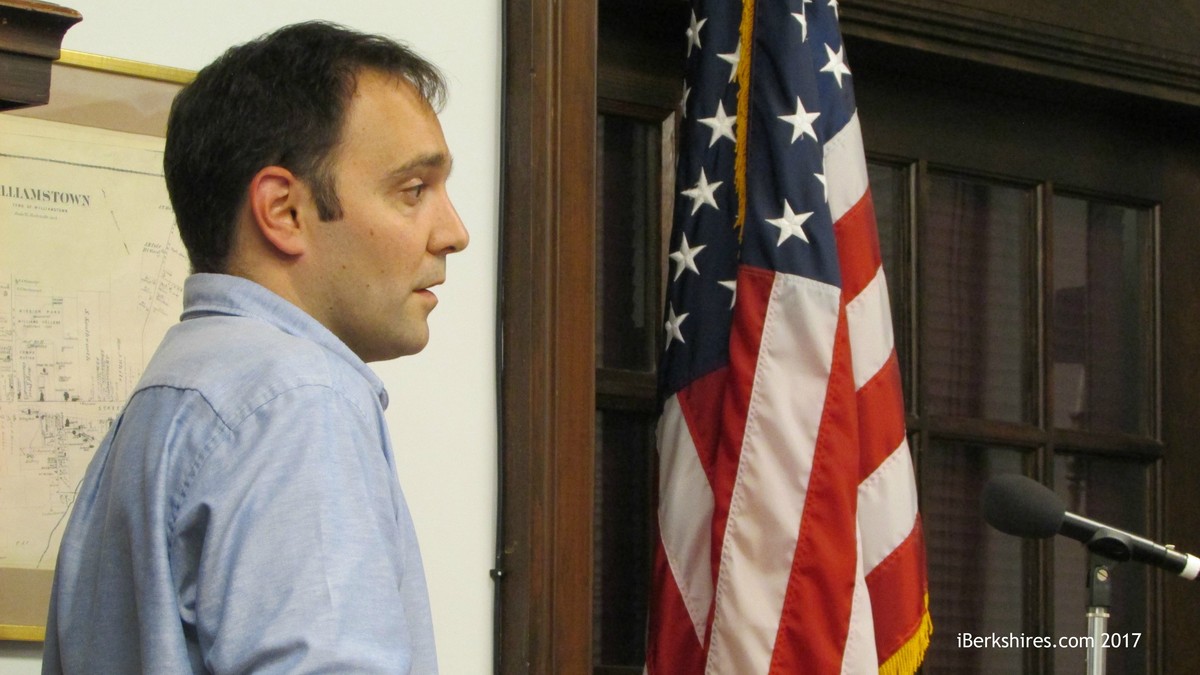
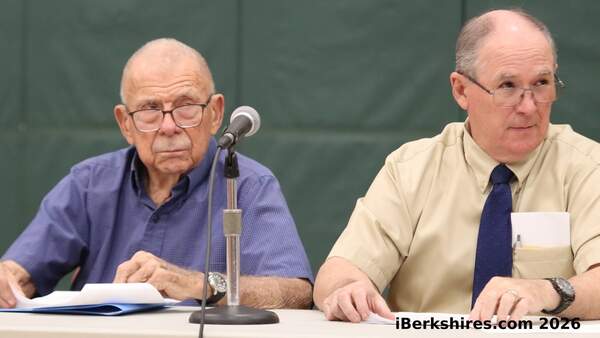
School Committee Chairman Joe Bergeron updates the Board of Selectmen on regionalization efforts.
On Monday, the board revisited the question of what kinds of local fees to attach to the sale of pot if and when a purveyor opens shop in the town next year.
Throughout the commonwealth, towns and cities are grappling with how to regulate the drug's sale while they wait for Boston's new Cannabis Control Commission to release licensing rules on March 15.
Two members of the Williamstown board attended a workshop on the issue earlier this month in Lenox. Monday's discussion left board members with the feeling that they should explore how communities in Colorado and Washington, which legalized pot in 2012, have dealt with recreational marijuana.
"There are other states that have gone through this," Selectwoman Jane Patton said. "Is there information to glean from them that says, 'This worked,' 'This didn't work,' 'It made sense financially,' or 'It didn't'?
"I would love to get my hands on some data because it is such an emotional thing. It screams out for a level of responsibility on our end to find the data. If it's not in Massachusetts, does it make sense to reach out to communities in other states that have done this?"
"It does," Selectman Andrew Hogeland replied. "And I don't want to wait until March to start this process. It's going to take some sustained effort. We can't just do it the last two weeks in March.
"If there is a vote to ban it completely, and it fails … we need to have a contingency plan ready."
The issues at the local level in Massachusetts revolve around a temporary "host community fee" up to 3 percent to cover costs directly related to mitigating the impact of recreational pot, a local option tax of up to 3 percent and a potential outright ban on marijuana retail within the town's borders.
Town Counsel Joel Bard provided the board with some clarity on the last point. A vote to ban pot sales would originate with the Board of Selectmen and, since the majority of Williamstown voters favored legalized pot in the November 2016 statewide vote, the town would be need a two-stage vote to institute a ban.
In order for Williamstown (or towns with a similar November 2016 vote on Ballot Question 4) to ban retail pot, it would need both a ballot vote and a two-thirds vote by town meeting.
Town officials asked Bard whether such votes could be initiated by a citizen's petition.
"The law does not expressly address this question but it is our opinion that the answer is no," Bard wrote. "The law, as recently amended, states, in G.L. c.94G, §3(e)(3), 'A ballot question under this subsection [authorizing marijuana bans] may be placed on the ballot at a regular or special election held by the … town by a vote of the board of selectmen …and subject to a municipal charter, if any.' A general premise of state election law is that questions may only be placed on an election ballot when expressly allowed by law and only in the manner prescribed by law.
"With respect to the language deferring to local charters, some municipalities have charters which allow local voters to petition to place questions on the local ballot. Williamstown does not have such a charter."
But the order of the two-step process to ban retail pot also created some confusion for the BOS. Williamstown holds its spring town election prior to its Annual Town Meeting; if the pot ban ballot question passed at the polling places, it would then go to the floor of town meeting. But town meeting is a deliberative body that usually has the power to amend articles before it. That theoretically creates a problem if the meeting attempts to alter language that already has been passed at the ballot box.
A less theoretical question involves whether and how the town would tax marijuana sales.
It seems very likely Williamstown and other communities will take advantage of the 3 percent local excise tax to add to local revenues. But the selectmen and Town Manager Jason Hoch struggled with the host community fee question.
"The meeting we went to commented on the host agreement piece, and you're right, Jason, it does need to be rationalized," Selectman Jeffrey Thomas said. "It's not a tax. It's a charge."
Hoch indicated he had no way to know whether the town would incur any costs from hosting a pot shop, let alone how much those costs would be. And he noted there is no analogous "hosting fee" attached to new alcohol licenses in the town.
Patton pushed her colleagues to study the issue and find answers that her constituents are looking for.
"I get asked these questions a lot," she said. "Are there ways to ban it? Will the money be worth it from the tax? Will there be money earmarked for counselling and help for folks who need help [with drug abuse]? I feel like so much of this is still so ambiguous. And I understand why it is."
But looking to communities with a track record on retail pot is a start, she said.
In other business on Monday, the Board of Selectmen heard a presentation from Williamstown Elementary School Committee Chairman Joe Bergeron about the ongoing discussion around expanding the Mount Greylock Regional School District to include its two "feeder" elementary schools, WES and Lanesborough Elementary School.
Bergeron was joined at the meeting by: his counterpart on the Lanesborough Elementary School Committee, Regina DiLego; WES Committee member Dan Caplinger; Mount Greylock School Committee member Carolyn Greene; and interim Tri-District Superintendent Kimberley Grady.
Bergeron told the board that the current Tri-District arrangement, under which the three school districts share central administration, has achieved cost savings and provided educational benefits. But it has downsides that could be addressed by full regionalization.
"The setup we have now is complex," Bergeron said. "It poses significant challenges to recruitment and retention of staff. … We believe a fully regionalized school district would, in my and other School Committee members' opinions, continue to provide quality education at a lower cost."
Bergeron explained that a working group that includes DiLego and himself has crafted a proposed amendment to the 1958 two-town Mount Greylock Regional Agreement that maximizes local control of each town's elementary school.
While the elementary schools' budgets would be the purview of the newly constituted Mount Greylock Regional School Committee, the district would assess each town for K-6 education based only on the operational costs in each town's school. In other words, taxpayers in each town would pay for (and town meeting voters would vote on) only the operational cost of the school in their hometown.
"In a typical regional school district, as is the case for Mount Greylock, both towns send students to buildings that serve both towns," Bergeron explained. "In that case, it makes sense that you pay based on the percentage of students from each town. The fact that our elementary schools will continue to predominantly serve students from each town opens the door [for the assessment contemplated in the draft amendment]."
Bergeron said both the Mount Greylock and Lanesborough committees plan to consider the draft language at their meetings this month, and he hopes to be able to report back to the Williamstown board at its Sept. 25 meeting.
School officials are aiming for special town meetings in both Williamstown and Lanesborough on Nov. 14 to approve the regional expansion amendment.
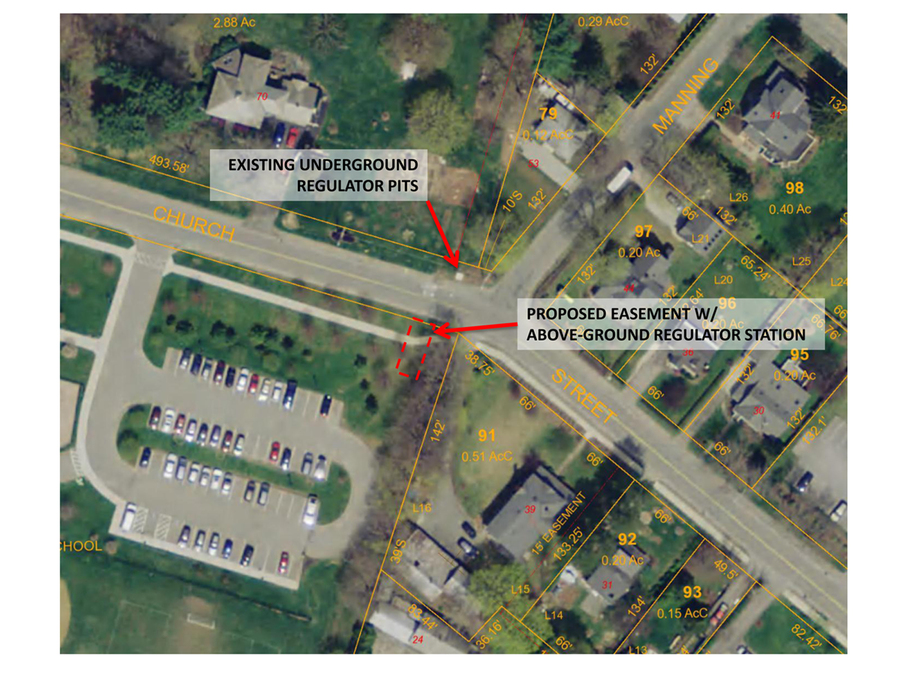
A Google Earth image shows the proposed location of an easement sought by Berkshire Gas to relocate a regulator station.
• The board heard a proposal from Berkshire Gas to relocate a regulator station from its current underground location on the northwest corner of Church Street and Manning Street to an above-ground site on town-owned land across the street near the staff parking lot for Williamstown Elementary School. If the project, which has the verbal approval of school officials, goes forward, town meeting will be asked to authorize an easement for 120 square foot patch of land.
• Chairman Hugh Daley began Monday's meeting with a moment of silence in recognition of the anniversary of the Sept. 11 terrorist attacks and the victims of this month's hurricanes.
Tags: marijuana, regionalization, zoning,