Williamstown Residents Approve New Fire Station
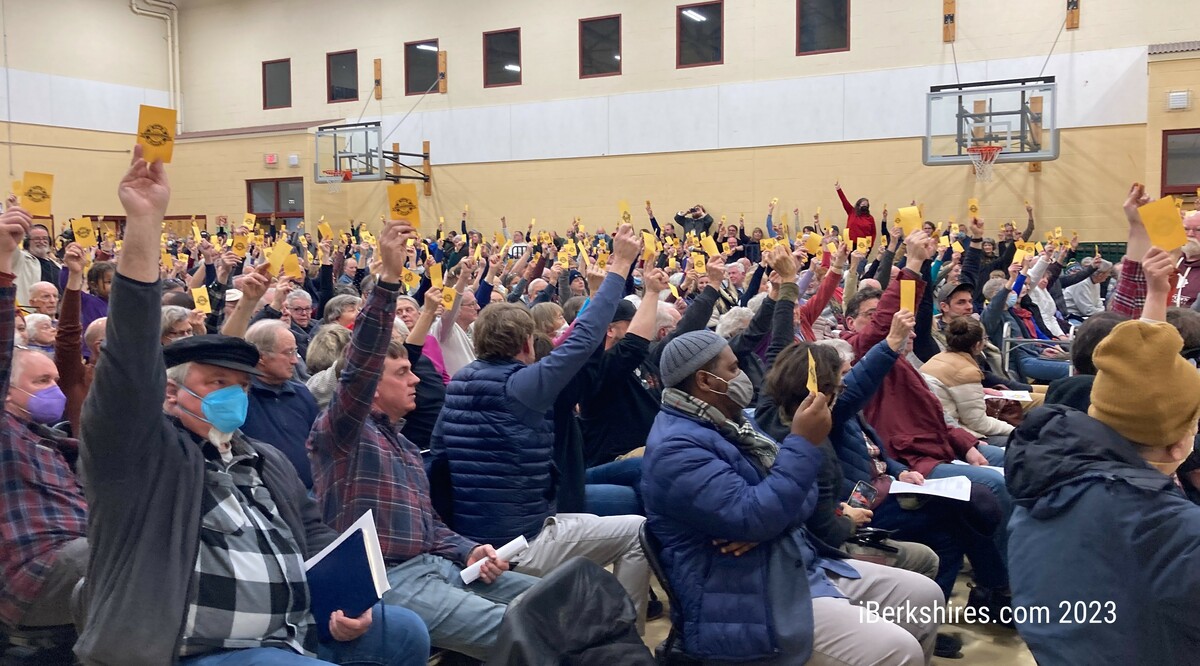
WILLIAMSTOWN, Mass. — An overwhelming number of voters at a well attended special fire district meeting Tuesday approved a $22.5 million project to build a new fire station on Main Street.
By a vote of 509-32, attendees of the meeting at Williamstown Elementary School gave the district permission to borrow up to that amount to replace the aging, cramped facility on Water Street.
The vote is the culmination of a decade-long effort to replace the current station with one that officials say will meet the needs of the community for decades to come and which meets the town's goal of achieving net-zero carbon emissions.
"It's so great to see the community support," said David Moresi, the chair of the Prudential Committee, which oversees the district. "It shows the community was receptive to what we were doing.
"And to see that the overwhelming majority of this crowd was in support of this project, that just blows my mind."
Five hundred ninety residents checked into the meeting out of a voting roll of about 4,900 residents.
By means of comparison, 327 residents checked in to the last annual town meeting in June.
The vote to authorize the borrowing needed to pass by a two-thirds super majority for the district to move forward. In a vote with 541 voters, two-thirds is about 363. The question before the attendees on Tuesday passed with 94 percent of the vote.
Due to the large turnout on Tuesday, the meeting, which was scheduled for 7 p.m., did not get underway until 7:33, when Moderator Paul Harsch called the session to order.
It was 7:55 before discussion on the main motion got underway, and the question was called at 8:30.
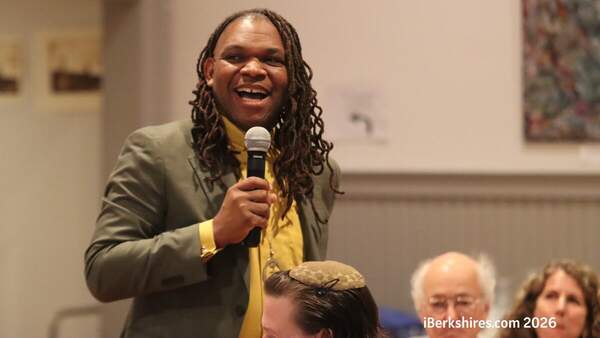
The 35-minute discussion featured some pointed questions for the district officials about the cost of the project, but most of the speakers who went to the microphone expressed support for the new station.
"I think of myself as an accidental supporter of the project," said Stephanie Boyd of the town's Carbon Dioxide Lowering (COOL) Committee. "I went to the Building Committee meetings because I was interested in making the building carbon neutral. But I ended up sitting through a lot of design meetings.
"I learned a lot of stuff about the risks our firefighters take. … They risk their health and safety every time we ask them for help.
"I feel the building we are now considering is appropriate to our community. It will provide a safe environment for those who risk their safety for us."
The largest applause of the night came after Will Titus, an undergraduate at Williams College and a member of the district's call-volunteer firefighter service, talked about how the current fire station adds to those risks for the first responders.
"My turnout coat and pants are hanging on a wall by the trucks … because our station was built before we understood the hazards of diesel exhaust," Titus said. "Every time I go on a call, those toxins transfer from that gear to my skin. I can still smell the exhaust on my clothes when I leave after a call.
"It may be easy to think the new station is too extravagant. But when you realize that each room in the station has a specific purpose, to protect the physical and mental health of our firefighters, they don't seem extravagant. They just seem necessary."
Terry Spaeth pressed the district officials on the math behind the $22.5 million figure on Tuesday's warrant. Spaeth argued that based on the original cost estimate ($25 million) and the cost per square foot at the time of that estimate, the recently announced 4,700 square foot reduction (to bring the project in for $22.5 million) should have brought the cost down by nearly $2 million more.
Tim Eagles of the district's architecture firm, Pittsfield's EDM, explained that there are fixed costs in the project that did not change with the 4,700 square foot cut in building area.
"One of the things that doesn't change on the project is the site cost," Eagles said. "To get the trucks in and out, to regrade, all those prices are the same between [the original square footage and the pared down version]. So, ultimately, the cost per square foot for a smaller building is higher than for a bigger building."
Moresi said after the meeting that he had a good feeling about the community's support for the project even before Tuesday night. But district officials knew the two-thirds threshold was a high bar; five years ago, it earned residents' permission to purchase the Main Street parcel in a third special district meeting on the question – after the question earned majority support but not super majority support at two prior meetings.
"I'd been hearing a lot of support," Moresi said. "Also a lot of questions in the last week. I think as you move closer and closer to vote day, people start taking notice. 'It's being built where?' 'It costs what?'
"And we did see a lot of that. I'm not a social media person, but I know there was a little flare up on social media. … But just to see this crowd turn out tonight on a not too favorable weather night shows this community really cares about this department and wants what is best for the town. This is great."
Tags: fire station,