Williamstown Board of Health Looks to Regulate Nitrous Oxide Sales
WILLIAMSTOWN, Mass. — The Board of Health last week agreed to look into drafting a local ordinance that would regulate the sale of nitrous oxide.
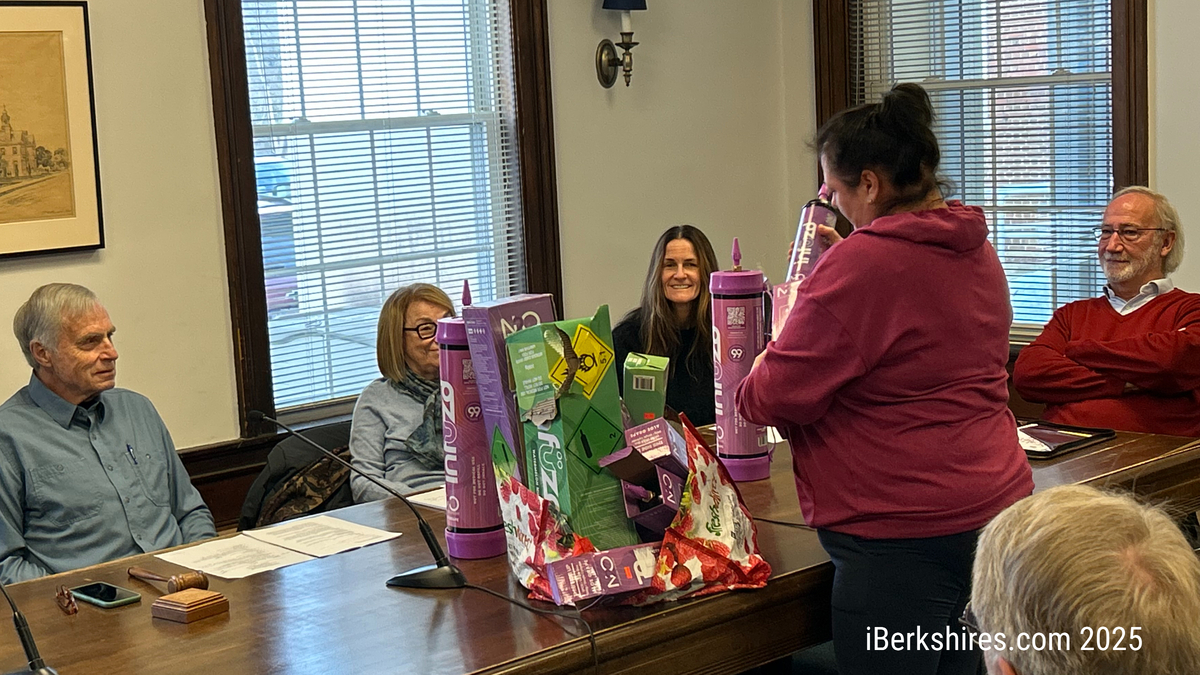
Resident Danielle Luchi raised the issue, telling the board she recently learned a local retailer was selling large containers of the compound, which has legitimate medical and culinary uses but also is used as a recreational drug.
The nitrous oxide (N2O) canisters are widely marketed as "whippets," a reference to the compound's use in creating whipped cream. Also called "laughing gas" for its medical use for pain relief and sedation, N2O is also used recreationally — and illegally — to achieve feelings of euphoria and relaxation, sometimes with tragic consequences.
A study published in the Journal of the American Medical Association earlier this year found that, "from 2010 to 2023, there was a total of 1,240 deaths attributable to nitrous oxide poisoning among people aged 15 to 74 years in the U.S."
"Nitrous oxide is a drug," Luchi told the board at its Tuesday morning meeting. "Kids are getting high from it. They're dying in their cars."
To combat the issue, the city of Northampton passed an ordinance that went into effect in June of this year.
"Under the new policy … the sale of [nitrous oxide] is prohibited in all retail establishments in Northampton, with the exception of licensed kitchen supply stores and medical supply stores," according to Northampton's website. "The regulation also limits sales to individuals 21 years of age and older and requires businesses to verify age using a valid government-issued photo ID."
Luchi told the Williamstown board that the town of Athol is considering following suit.
The issue hit home for Luchi, she said, when she learned that the convenience store associated with the Gulf gas station on Main Street (Route 2) stocks the N2O canisters on its shelves.
"Who goes to the gas station to purchase culinary items?" she asked rhetorically.
She also accused the Main Street establishment of selling alcohol to minors, an offense that has, in the past, brought the establishment before the Board of Health and Select Board, which functions as the town's local alcohol licensing body.
"You don't see a surprised face from me, do you?" asked retired Health Inspector Jeffrey Kennedy, who was at the meeting for another matter, when Luchi made her accusation from the floor of the meeting.
Luchi said she had raised the issue with the town manager and the chief of police and was told that law enforcement was not sure how it could better enforce existing state law that makes it illegal to use N2O to achieve a state of intoxication or sell the substance for that use.
Doing what Northampton did this spring would be a good step, Luchi suggested.
Wendy McWeeny moved that the board look into drafting a regulation with language similar to Northampton's, and the rest of the board voted 4-0 (with Chair Devan Bartels absent) to continue down that path.
In other business last Tuesday, Board of Health heard from representatives of the Berkshire Public Health Alliance and Berkshire County Boards of Health Association and discussed a new air quality sensor initiative led by the Berkshire Regional Planning Commission.
Laura Kitross, who directs the BPHA and county association of boards of health, discussed how those agencies serve local communities.
"Right now, the alliance has 11 communities for which we do all the inspections," Kitross said. "And we have another 19, including Williamstown, for which we do the public health nursing.
"The nurses check the online reporting system [for infectious diseases] seven days a week. Anything that pops up, they make phone calls, as needed, to providers, labs and individuals to make sure the disease doesn't spread wider in the community."
"I like to joke that everyone discovered contact tracing during COVID, but we've been doing it for a couple of hundred years at this point."
Kitross said the alliance has five full-time health inspectors and three part-time nurses.
The Berkshire County Boards of Health Association, meanwhile, formulates and implements emergency response plans and conducts public health education programs.
Sophie Carnes Jannen, a public health educator with the BCBOHA, told the board that she has been working with Russell to hold events at the Harper Center and the weekly farmer's market on Spring Street covering topics including: tick prevention, hoarding and smoking cessation.
"Ruth and I have a coffee hour next week at the Council on Aging, very informal," Carnes Jannen said. "We just received funding from the Williamstown Community Chest to do a fall prevention program at the Council on Aging."
Britney Danials of the BRPC appeared virtually at Tuesday's meeting to talk about the agency's Berkshire County Clean Air Project.
Danials said the BRPC is set to install 62 air sensors across the county, including four in Williamstown: two outdoor sensors at Mount Greylock Regional School and Williamstown Elementary School and two indoor sensors at the Harper Center and Milne Public Library.
The sensors, which BRPC hopes to install by the end of the year or January 2026, will be up for two years and look for levels of particulate matter in the air — both inside and out.
Danials said the data will be available online in real time and historically.
"We're poised to do a lot of aggressive outreach to connect people to the project," she said. "We're trying to disseminate information about the importance of checking air quality. … We will also be providing resources for people to improve their indoor air environment as well."
The Board of Health also received an update from Russell about a boil water advisory affecting the South Williamstown neighborhood around the five corners intersection.
That order impacts some private residences, the Williamstown Historical Museum and two local businesses: the Store at Five Corners, which currently is closed as it transitions to a new operator, and the Green River Regenerative Farm.
The latter has had to cease sales of eggs from its hens because it cannot wash the eggs in water drawn from the Waubeeka Springs Public Water System that serves the farm, Russell said. In November, the owners of the farm took to social media in an effort to "rehome" 3,500 laying hens before they were sent to slaughter.
The boil water order does not impact the Waubeeka Golf Links golf course and restaurant, which operate on a different well, Russell told the board.
Tags: board of health,