Neighbors Raise Objection to Three-House Plan for Cole Avenue Parcel
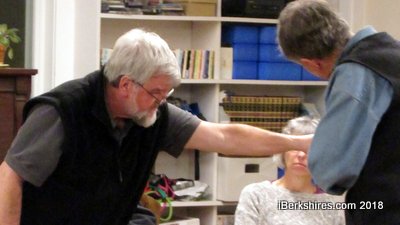
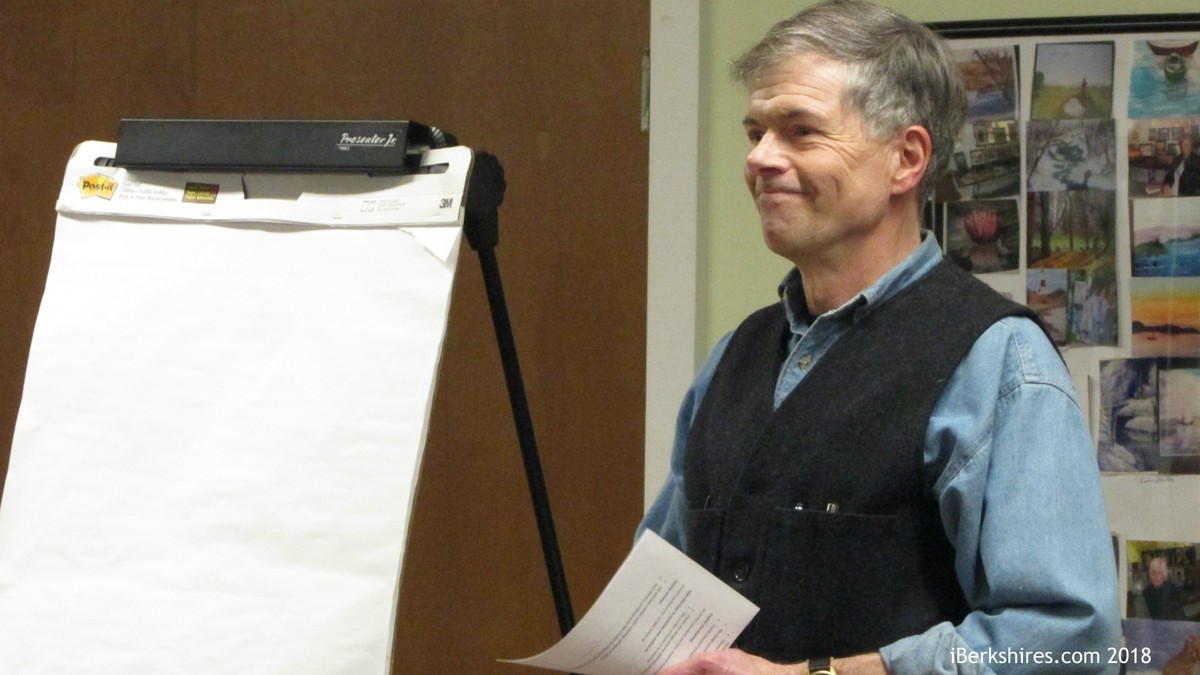
Paul Guillotte, left, makes a point about the site plan shown by Paul Austin at Friday's meeting.
Habitat for Humanity in December told the town's Affordable Housing Trust, which acquired the lot at the corner of Cole Avenue and Maple Street, that it hopes to subdivide it and build three homes of up to 1,200-square-feet that will accommodate three families of four.
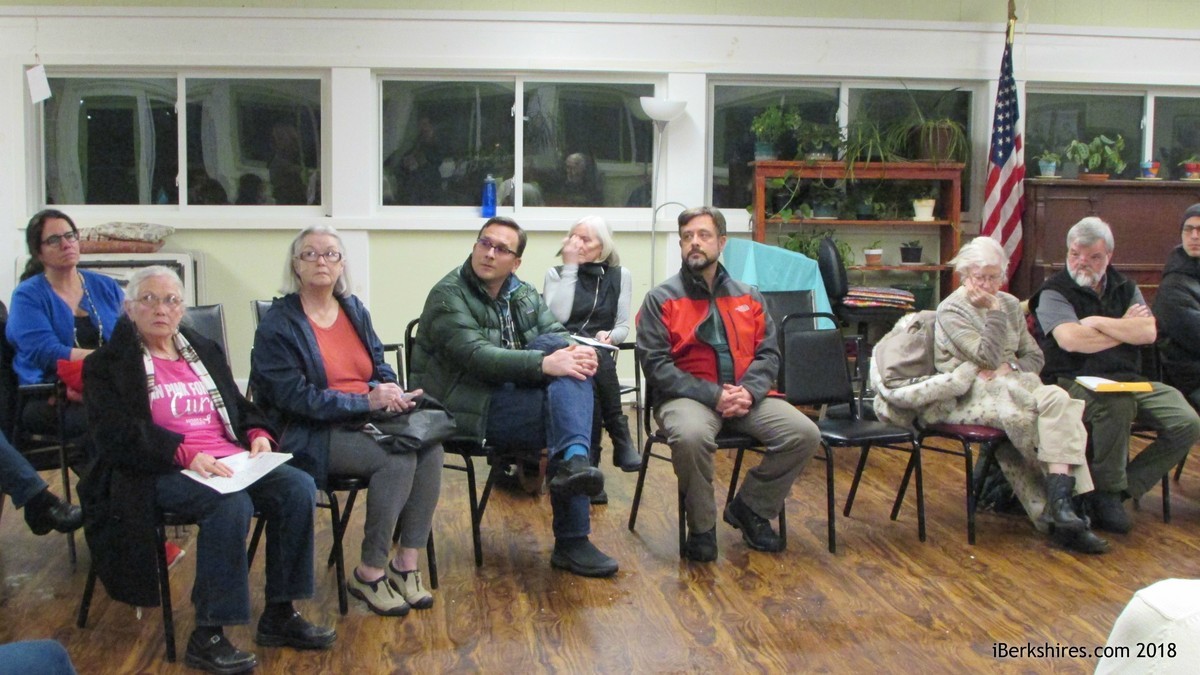
On Friday, it hosted a public forum at the Harper Center and invited residents of the neighborhood to give their feedback.
Although one resident of Cole Avenue encouraged the Habitat for Humanity board to maximize the use of the lot and create as much housing as possible, the majority said three homes on the site would be at least one home too many.
"We want to give someone a nice home with a big yard," Maple Street resident Madeline Levy said. "You say you want [homes] in the style of the neighborhood. Our houses are almost 100 years old and look wonderful."
Levy was one of the most vocal critics of the Habitat for Humanity proposal, which she said went back on what she was told by an official from the non-profit in the past.
"Someone from Habitat for Humanity assured me that Habitat for Humanity only builds one house on a lot," Levy said. "That is what I was told. I was told by someone else it was the Planning Board, along with the Trust, that asked for multiple dwellings there. Where did that come from."
Northern Berkshire Habitat project manager Paul Austin told Levy he was the one who told her that the the non-profit builds single-family homes on properties, which he characterized as part of a discussion of building duplexes.
As another member of the Habitat board noted on Friday, the parcel purchased by the Affordable Housing Trust already is divided into two building lots, and anyone could have purchased the same property and built two homes by right.
Habitat for Humanity in December discussed with the Affordable Housing Trust subdividing the parcel to create a third lot, a division that would be easier under the commonwealth's Chapter 40B provision, which gives relief from local zoning to subsidized housing projects.
The board explained that part of its thinking in carving the parcel into three lots -- besides creating one more home for a low- to middle-income family -- is that smaller lots would create less of a tax burden on the prospective homeowner.
But neighbors were concerned that three small homes would alter the character of the neighborhood, eliminate open space that long has been an amenity to the residents and impact property values in the area.
"The residents of Maple Street should never think that three houses on that lot won't lower your property values," Chris Kapiloff said. "Three houses is going to mean 12 people and six cars."
Kapiloff told the meeting that while he does not live on Maple Street, he does own a residence there, 20 Maple St., through his business, Berkshire County Properties LLC.
Kapiloff, who also happens to chair the town's Planning Board, also told the meeting that the board has had no discussions about that Cole and Maple property. Austin said he thought Habitat for Humanity did hear from at least one member of the Planning Board on the topic, and the board has been discussing changes to zoning that would allow for different types of housing in the the residential district.
Kapiloff at one point suggested that the local residents could try to purchase the property themselves and turn it into a park if they wanted to preserve it as green space.
The three trustees of the Affordable Housing Trust did not react to that suggestion.
Cole Avenue's Paul Guillotte, who wrote the trustees and Habitat for Humanity a lengthy letter outlining his objections to the three-house plan prior to the public forum, reiterated a few of his concerns at the meeting.
Guillotte asked whether Habitat for Humanity had done any studies of the local infrastructure to see whether it would support three additional residences. He noted that the electrical grid in the neighborhood already was overtaxed and prone to blackouts and brownouts.
Austin said issues like electrical and water and sewer capacity would have to be addressed with the town down the road.
Guillotte also suggested that the three residences could just be the beginning of more development on the Cole and Maple plot.
"Five years down the road, the guys on the Planning Board will want to add a garage to each house, and they'll want to make sure each one of those garages has an in-law apartment," Guillotte said.
The Northern Berkshire Habitat board noted that the homes could be deed-restricted to prevent any expansion on the properties. Austin said he has been with Habitat for Humanity for 17 years and only could remember one homeowner who put an addition on his or her home after occupancy.
One of Guillotte's written objections -- the proposed rotation of the three homes to orient them toward the sun for maximum solar power generation -- was addressed before the meeting. Austin said, at the start, that Habitat for Humanity currently is planning to keep the homes perpendicular with the road, in accordance with town zoning.
Guillotte did compliment Habitat for Humanity for its latest drawings of its proposed homes, which show porches, in keeping with the character of the neighborhood.
The best compliment received by the non-profit came from Martha Westerdahl, who lives across Cole Avenue from the parcel in question.
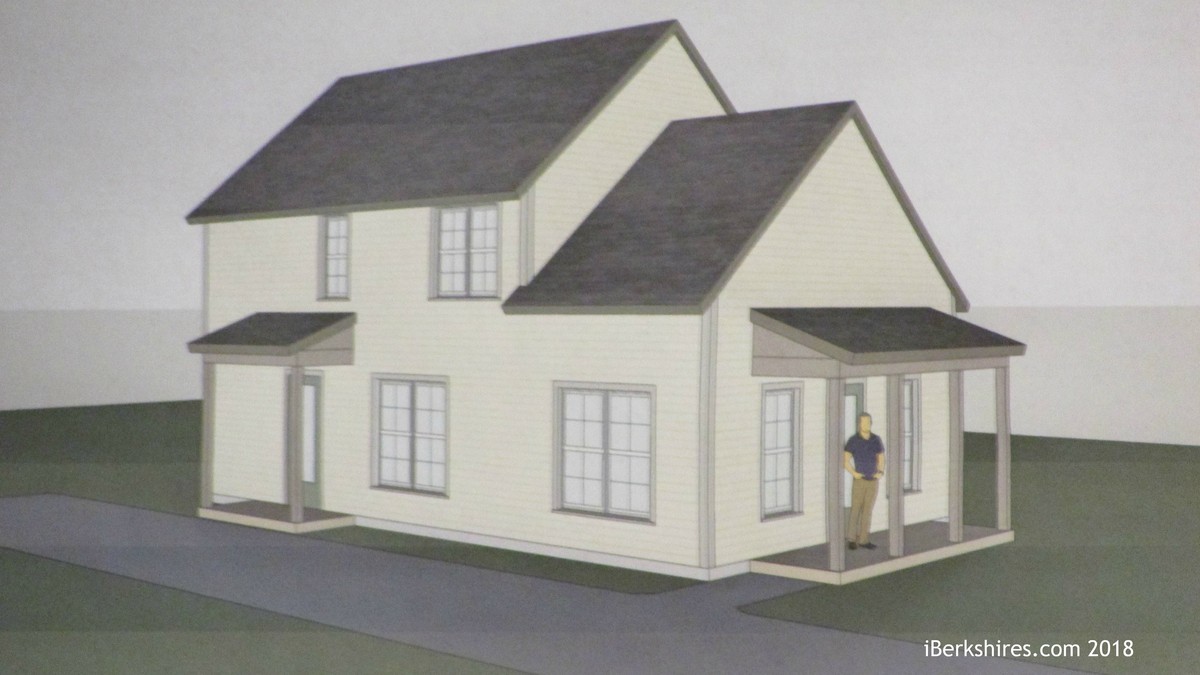
One of the conceptual drawings shown at Friday's meeting.
"I applaud you for trying to put three houses on this land," Westerdahl said later. "It's a good way to reduce the tax bill for people who are living paycheck to paycheck. However, there are challenges to this property. Putting a driveway on Cole Avenue could be dangerous.
"You have to find a happy medium. I'm in favor of putting at least two houses on this lot."
The Northern Berkshire Habitat for Humanity board promised to take Friday's comments into consideration as it continues to develop its plan for the parcel.
"We'll have another meeting in late March, probably," Austin said at the end of the meeting. "What I'm hearing from you tonight is two [homes] would be acceptable."
"Or one and some green space," Levy answered.
Tags: affordable housing trust, habitat for humanity,