BRPC Wants to Know How Towns Spend Chapter 90 Funds
PITTSFIELD, Mass. — One of the first things Gov. Charlie Baker did on taking office in 2014 was release an additional $100 million in money for cities and towns to repair roads.
But towns in the Berkshires didn't use the money that spring. In fact, total spending on Chapter 90 allocations dropped to the lowest spending level in the last five years. Baker's announcement had come halfway through the fiscal year and was hailed by local officials.
The following year, spending peaked locally at $10 million but that was still less than what the state sent to Berkshire towns. The rest of it went into city and town's bank accounts. In the last five years, 75 percent of the county's towns spent less than allocated.
On the surface, those trends could suggest that the state is giving cities and towns more money than they can spend. But Mount Washington Selectman Jim Lovejoy will tell you, that's not the case at all.
"The reason we are not spending it is because it is not enough," Lovejoy said.
This year, Mount Washington received about $40,000 through the state program. Lovejoy said it is eyed to replace a sorely needed culvert. But, there is a sticky legal situation preventing the work from starting right now -- work that hadn't been taken care because the town didn't know if it would have enough to actually do the project this year or not. That money will roll into the following year's totals as the program allows towns to save from year to year.
"There are lots of reasons, at least in a smaller community, to bank this money," Lovejoy said.
Lovejoy calls the program a "valuable commodity" in the municipal management world.
Jim Huebner, of Washington, says the biggest reason towns stash money is because of the uncertainty. Towns don't count on that money from year to year, don't know how much, and don't want to start projects without cash in hand. And town officials never know when there might be an emergency.
"We don't have the assurance year to year that we are getting any money," Huebner said.
He said projects also often span into the following fiscal year because the fiscal year changes on July 1, right in the middle of construction season.
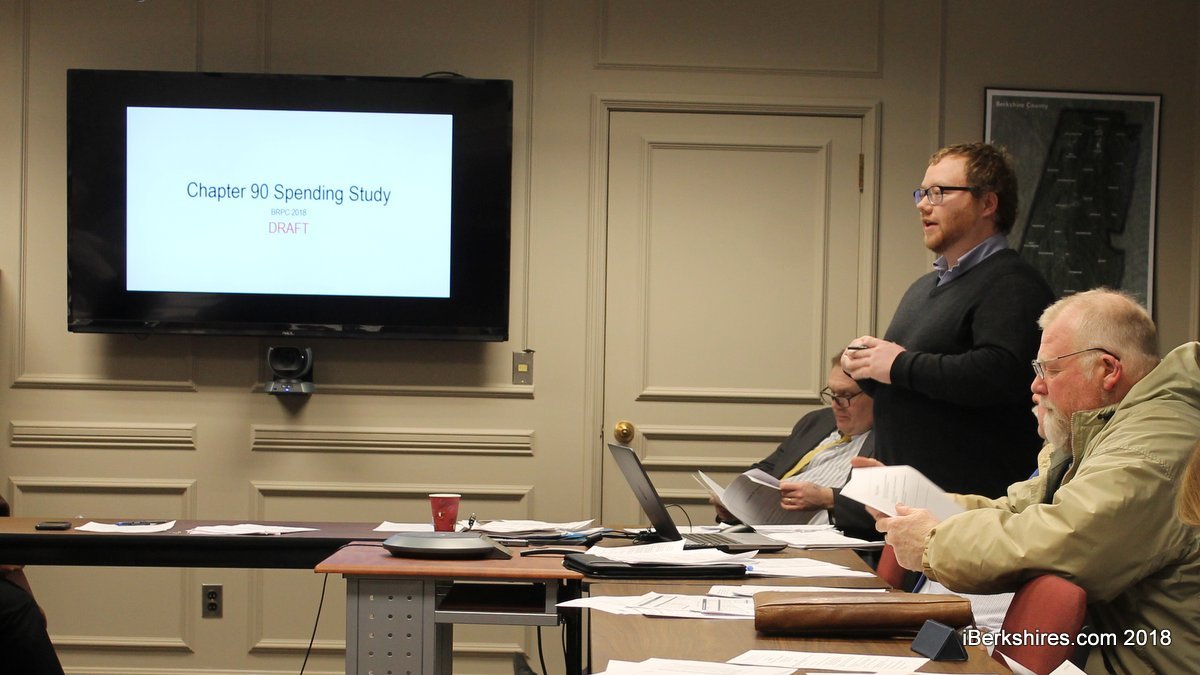
Senior Transportation Planner Eammon Coughlin, of Berkshire Regional Planning Commission, has taken on a study on the use of Chapter 90 in the Berkshires. Coughlin hopes his study can explain how towns use the money, when, and how long they wait to spend it.
Eventually, he wants to craft recommendations that could improve efficiency and effectiveness of the program.
And the timing is important. The Massachusetts Municipal Association is once again leaning on the state Legislature and the governor to increase the amount. Chapter 90 is a state capital borrowing one in to help cities and towns maintain the roads. It is voted each year by the Legislature to be released. Each town receives an allocated based on a weighted formula that considers road miles, population, and employment.
By those factors, it is no surprise that the Berkshire towns with the most state Chapter 90 funding are Pittsfield, North Adams, Great Barrington, Sheffield, and New Marlborough. Receiving the least are New Ashford, Hancock, Mount Washington, Alford, and Clarksburg.
In total, Berkshire County receives around $8 million, with the city of Pittsfield being the biggest recipient with $1.3 million annually. Most towns receive $200,000 or less.
At the end of 2016, Pittsfield had close to $5 million in unspent Chapter 90 funds. The city had only spent three-quarters of the money it had been given over the last five years and yet, each year it borrows money on its own during the annual budgeting process for roads. The town of Lanesborough is looking to increase its budget for road repairs despite having about $100,000 of Chapter 90 funding in the bank.
Seven Berkshire municipalities have around four or five years worth of allocations in unspent funds -- Savoy, Pittsfield, Cheshire, Peru, New Ashford, Williamstown, and Egremont -- four of which are in the bottom 10 in the county in total allocation. Egremont tops that list with 537 percent of its average annual allocation in balance -- it also receives the ninth lowest allocation in the county with less than $200,000 per year.
Coughlin suggested the trends show that towns could be saving for more expensive repairs. He said spending on resurfacing projects dropped from 75 percent to 36 percent during the last five years. While construction work has increased from 14 percent to 55 percent, indicating that the money is being spent on deeper and more long-lasting repairs than in the past.
"Spending on resurfacing over the five year period decreased and spending on the more complicated projects increased," Coughlin said.
He said towns are using only between 10 and 15 percent per year on engineering and equipment while the rest is going to construction and resurfacing. When it comes to the engineering expenses, he said the smaller towns spend less of its money on engineering. Of the 16 towns with the lowest allocations of state funds, only three of them spent money on engineering. Among the other half, 11 of 16 spend money on engineering.
Over the last five years, six Berkshire towns have spent more than they were allocated -- Clarksburg, Dalton, Lenox, Lee, Sandisfield, and North Adams. That could be explained if those towns had saved money prior for a large project and construction happened during the reporting period.
Department of Transportation's District Highway Director Francisca Heming thinks that expanding the review to take in more than five years will help paint a clearer picture of the spending trends. But Coughlin said the last five were the only ones available.
Coughlin presented his data to the Metropolitan Planning Organization last Tuesday. His conclusion: to be determined.
He is early in his study and is now working on getting input back from the heads of the department of public works about it. He said he sent out email surveys to nearly two dozen already but had only heard back from two so far. He plans to send letters to the Board of Selectmen in the Berkshire towns.
"We've had very bad luck getting info back from the towns," Coughlin said.
Chapter 90, first enacted in 1973, has grown to become a massive crutch for cities and towns. And Coughlin wants to know if it can become even better.
"It is critical that we get more input from the local communities in how they spend their money," said Lovejoy.
Tags: BRPC, Chapter 90, road work,