Goals Set To Make Berkshires 100 Percent Renewable Energy
PITTSFIELD, Mass. — The technology is available. It is just a matter of the right policies and right actions to make it happen.
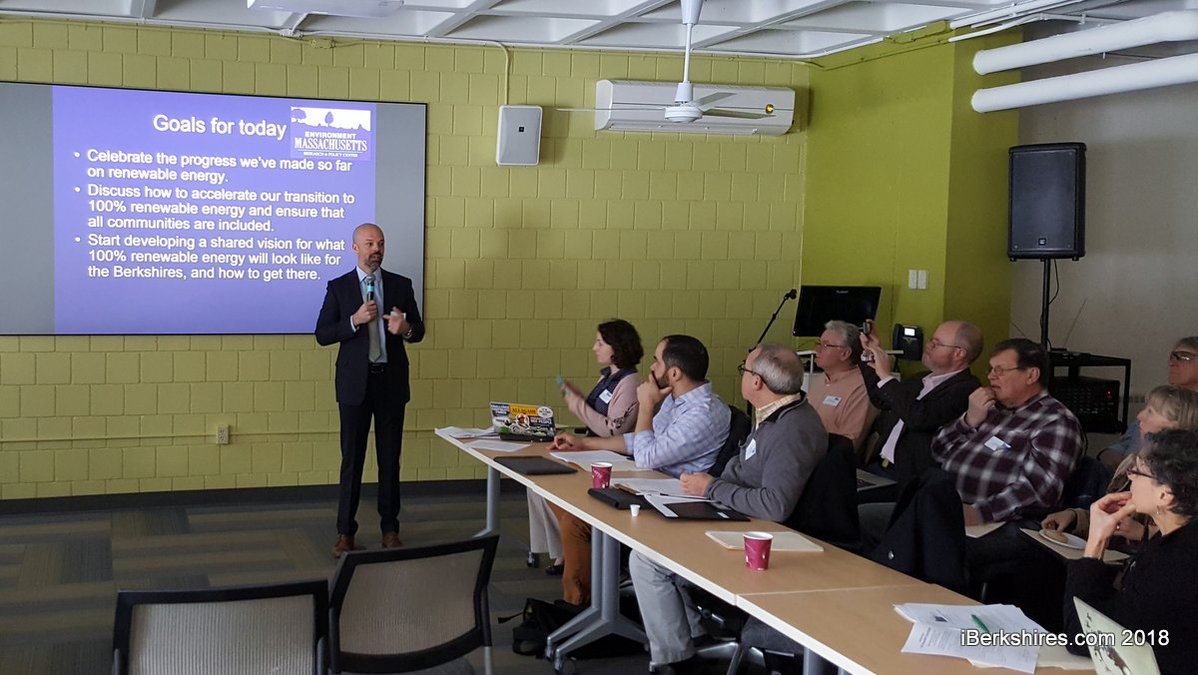
That is what a coalition of environmentalist believes when it comes the state becoming 100 percent powered by renewable energy. On Monday, local leaders and organizations joined for a summit to dive into the issues.
"We believe a lot of pollution and environmental degradation happened and continues to happen because as a society we are stuck in old ways of thinking. We need these new ways of thinking and action to bring policy and practice into alignment about what it will take to bring about a cleaner, greener future," said Meghan Hassett, an organizer with Environment Massachusetts, said.
The organization has been building a coalition behind the issue and Monday's daylong meeting is the fifth it has organized throughout the state. The end goal is to prepare a strategy to hit that goal as the legislature mulls an act to get there by 2050.
"It is also 100 percent doable. We've been seeing rapid progress in Massachusetts just in the last 10 years. We have grown solar 300 times and now have three times as much solar as Florida, which is kind of silly if you think about it. It is because of the strong solar policies we've enacted so far," Hassett said. "We can do so much more. Our offshore wind has the potential to meet 11 times our annual electricity consumption and just putting solar on every available rooftop would meet 47 percent of our electrical needs."
Hassett said the focus remains on three areas: reducing energy consumption with the rollout of more energy efficient technology, replacing fossil fuel plants with solar and wind production, and keying in on powering heating and transportation through clean electric sources. They will be pushing for the state to adopt the policy and set benchmarks to get to 100 percent renewable.
"we have grown a lot of momentum statewide. We are working on campuses and in cities and towns across the state building grassroots support," she said.
The transportation aspect of it is one of the standout points for state Sen. Adam Hinds.
"We've also seen that transportation is stubbornly stuck around 1990 emission levels. It's bad. We know that 40 percent of our carbon emissions are coming from transportation," the Pittsfield Democrat said.
Hinds said some of the hold up on electricity has been related to costs. But, those costs have been coming down and state incentive programs will help cost parity. Managing that through a deliberate strategy is important, Hinds said. The state has previously placed a lot of effort into rolling out solar but that has recently stalled because of uncertainty with incentive programs.
"When I look at the challenges, the first thing that jumps out at me lately is the solar policy choices. For me, that's focusing on Eversource. We now have a demand charge that's going to be going in at the end of the year. And we've seen a reduction of solar new installations of about 21 percent in this last year," Hinds said.
It is the solar realm in which Pittsfield has placed focus in recent years. Mayor Linda Tyer said those efforts have not only helped the environment but also with the city's finances.
"There are opportunities to be environmental stewards and be good fiscal servants of your communities," she said.
Tyer highlighted three examples of that. At the landfill, Ameresco built a 2.9 megawatt array and the city committed to buying 100 percent of the electricity produced from it. She said between net metering and personal property taxes, the city will benefit to the tune of $2.6 million over the course of 20 years.
At the wastewater treatment plant, a 1.5 mW array produces 75 to 90 percent of the energy used at that plant. That product, completed in 2011, was supported by low interest loans from the state.
A third one is currently proposed at the airport by Oakleaf. That project will also generate lease money and personal property taxes. And there are an array of privately funded arrays throughout the city.
"In particular, Pittsfield has been a leader in maximizing opportunities around solar energy. Since 2014, 11 stand alone solar developments have been permitted and constructed within the boundaries of the city of Pittsfield. That is a total of 16 megawatts. Of those 11, three of them are specific to the city of Pittsfield," Tyer said.
The city is also moving forward with switching streetlights to LEDs and was granted $75,000 to do a feasibility study on the installation of microgrids downtown.
"The city of Pittsfield as begun to develop a net metering strategy. We received a 12,500 grant from the Massachusetts DOER to review additional opportunities for net metering capacity in the city," Tyer said.
Towns throughout the Berkshires can tell similar stories, just with different examples of projects taking place there. Tyer believes the cities and towns can lead the effort toward 100 percent renewable.
"If every community does their part to advance these energy technologies, we can achieve 100 percent renewable energy right here in our cities and towns," Tyer said. "We are the leaders of this effort. It depends on us and our positions."
Hinds said the local aspect are becoming even more important with the federal government "dismantling" commitments toward renewable energy levels as a nation - specifically the withdrawal from the Paris Accord.
"We see these clear choices being made at the national level ... it elevates the importance of what all of us are doing at the state level and elevates what we are doing at the town level," Hinds said.
Hinds said there are multiple efforts moving forward on the energy and environmental front, including offshore wind legislation.
Officials of Berkshire Community College, the host of the summit, said the 100 percent renewable efforts can follow a similar blueprint to what the college did toward hitting a zero waste goal in 2020. For that, it was a series of small steps that have made a big difference, according to interim Dean of Students Christopher Laney.
It was in 2009 when the college joined in a national competition known as Recycle Mania. The college then ranged 41st out of about 400 in diversion rates. With only a little over a third of its waste going to recycling, the college put together a Green Team to change those numbers. They started with some smaller changes and boosted that number to 50 percent. They then contacted the Center for Ecological Technology and had a trash sort to find out exactly what was the biggest volume of trash. The results were plastic bags that the garbage was kept in.
"We were able to convince people that they should get rid of the trash barrels in their offices and classrooms. Then, you can have fewer bags. People can walk out of their office and their compost or recycling in the containers that are out there. Little steps. Lots of little steps start to add up," Laney said.
They bumped it up to 54 percent. Then the college contracted with a company to pick up compost and cafeteria staff moved to more compostable materials. The diversion rate jumped to 71 percent. And now, the college is ranked first in the state and third in the nation with an 82 percent rate.
And the college does its part with solar energy, with nearly every building it owns having panels.
"Massachusetts has come a long way, but we cannot rest on our laurels. There is so much at stake, but we also have so much to gain from going 100 percent renewable," Hassett said. "We must do all we can, as fast as we can, to reach an entirely clean energy future."
Tags: alternative energy, environment, green technology, recycling, renewable energy, sustainability,