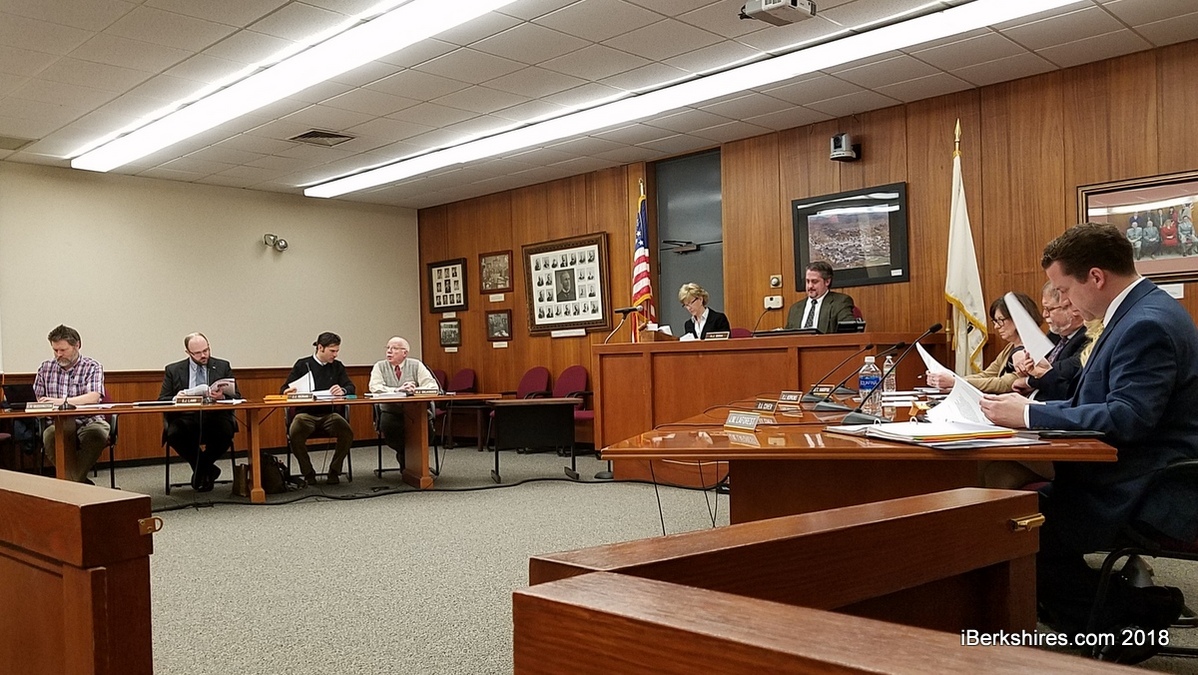
North Adams Council Approves Marijuana Ordinance
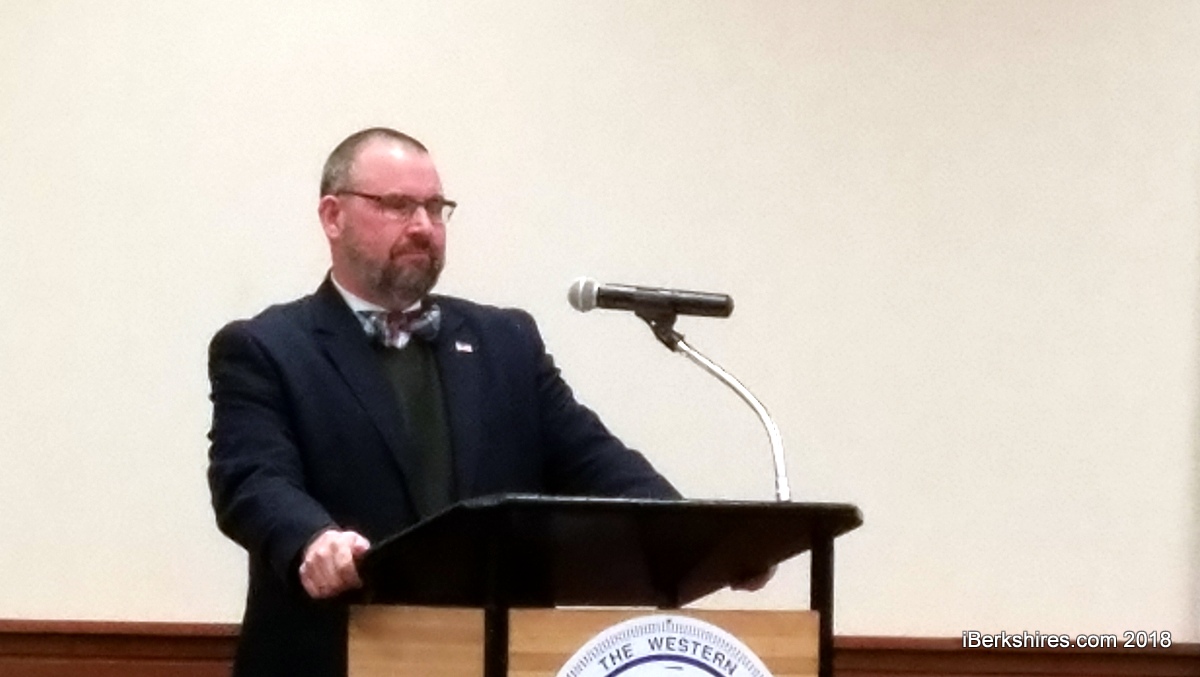
Mayor Thomas Bernard had hoped to push through two ordinances on pot consumption and fines but the council referred them for further review.
A third related measure was referred back to the mayor's office at his request.
The ordinance has been in the works since January, when Mayor Thomas Bernard in one his first acts in office formed a working group to fast track an ordinance on retail marijuana before the state begins accepting applications in April.
The measure was formed by the working group, with the facilitation of Director of Community Development Larysa Bernstein and Christopher Gruba of Berkshire Regional Planning Commission. It was then recommended to the Public Safety Committee and the Planning Board, both of which offered modifications to the language.
Those modifications took up the bulk of the meeting, which lasted until just after 9 p.m.
The amendments approved on Monday included changing day-care facility to day-care center, to clarify it was specifically to institutions and not home day-cares. The paragraph within which that phrase was located also was shortened in line with recommendations from the Public Safety Committee.
A reference to places of worship was removed and the lengthy list of venues that trigger a 500-foot setback for licensed marijuana establishments was reduced to "any school, day-care center or similar facility where organized youth activities occur; distances shall be measured by a straight line between the nearest structure of the site facility and the LME building; outdoor facilities and structures, such as playgrounds, shall be considered part of the facility."
That paragraph also included the phrasing that "the special permit granting authority may modify or waive this requirement" at the request of the Planning Board.
Both Councilors Marie Harpin and Eric Buddington objected to giving the planners the authority to waive the setback requirements.
Harpin said public hearings had been held and people had already weighed in on the language.
"My issue is we had all these meetings and we had public input and we had this method of marijuana use," she said. "I think it's important that once it's established, and we established policies important to the people who spoke, we should honor that."
Buddington thought it was a matter of making sure those seeking permits know what the regulations are rather than diluting them so that they seemed like suggestions.
Other councilors, however, said the Planning Board should have the flexibility to make determinations in gray areas, such as being a few feet under the setback. Any permitting would also require a public hearing and site review, giving residents the opportunity to speak on it.
"By adding this line, it allows them to operate within the means they usually operate," Councilor Joshua Moran said. "When it comes to these special permits, it's extremely vetted. They still have to abide by the rules yet it gives them that little bit of wiggle room."
Councilor Wayne Wilkinson, a former Planning Board member, said, "We should let the Redevelopment Authority and the Planning Board do their jobs."
Harpin's motion to amend remove the language giving authority to the Planning Board was defeated 7-2, with only Buddington joining her.
Buddington also motioned to remove language that noted the Planning Board did not have permitting authority within zones under the purview of the Redevelopment Authority. He thought the language redundant since, by ordinance, the planners have no authority n Urban Renewal Zones.
Councilor Benjamin Lamb thought it useful, thought. "It's a clarification point," he said, since a business coming in might not know about the existence of the Urban Renewal Zones.
Harpin wondered if putting it in would then mean the council would have to remove it if the Redevelopment Authority is dissolved. Wilkinson, however, said it would take a long time to dissolve the authority, if the city did go that way.
The language stayed in with only Buddington voting against. He also motioned for a modification he suggested to eliminate redundancies of using text and tables to show uses in different zones. The council approved his recommendation to refer to the tables.
The vote to pass the ordinance to a second reading and publish as required was unanimous.
Two ordinance changes submitted by the mayor — one on public marijuana consumption and a second setting fines for violations of that ordinance — were referred the Public Safety Committee.
Wilkinson objected, saying the ordinances seemed reasonable and there was no need to beat the marijuana issue to death.
"Even if we beat things to death, that's kind of our job to do it," said Councilor Rebbecca Cohen. "I will beat everything to death if I have to."
The mayor said he would prefer the ordinances "sooner rather than later" and hoped to push them through on the same time line as the retail marijuana ordinance.
The mayor's third ordinance, on setting a 3 percent local tax on marijuana products, referred to the wrong state law because of changes by the state Cannabis Control Commission, he said. Bernard said he would resubmit it for the next meeting.
Wendy Penner, director of prevention for the Northern Berkshire Community Coalition, has spoken about youth marijuana use at all of the meetings. She repeated to the council that how communities zone has an impact on youth use of substances like alcohol and pot.
"I haven't heard any of you comment on this at all in the conversations," she said. "I think people to look to North Adams — we're kind of the hub of Northern Berkshire — I think it's an opportunity to provide leadership in considering this in the conversation. There's different ways to do that. One is how you zone and how you share your perceptions about the issue."
She invited them to attend NBCC's monthly meeting or to meet under other circumstances.
The councilors said they were aware of the issues surrounding youth access to marijuana and thanked Penner for providing them with feedback.
"The concern for youth has been shared by the CCC, the working group, the Public Safety Committee and the council as a whole," said Councilor Jason LaForest, who was a member of the working group. "I would say it's been at the forefront in most of our minds. Most of us, if not all of us are parents and there is a lot of evidence to question the use of marijuana as a gateway drug."
Tags: marijuana,