Grady, Taconic's Vosburgh Named Finalists for Mount Greylock Superintendent
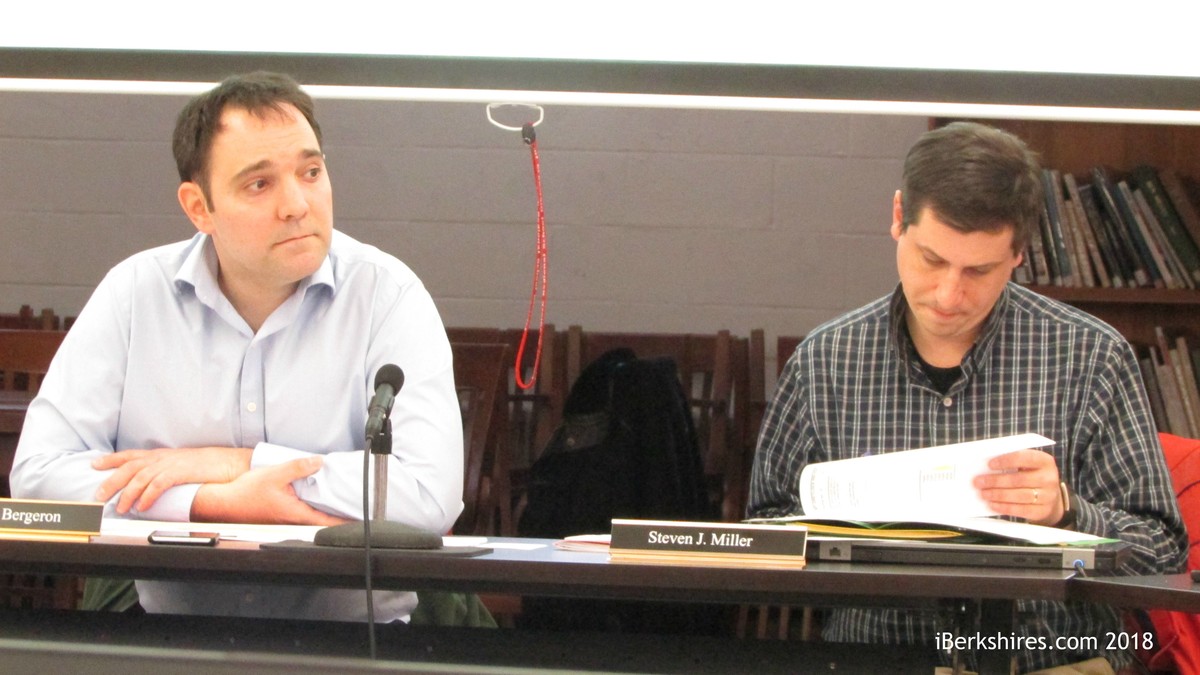
Mount Greylock Transition Committee Chairman Joe Bergeron, left, and Search Committee Chairman Steven Miller participate in Tuesday's meeting.
The committee, an amalgam of the three elected school committees at Mount Greylock, Lanesborough Elementary and Williamstown Elementary, was presented two candidates by its Search Committee, which reviewed five applicants for the post.
On Tuesday, Search Committee Chairman Steven Miller told the full Transition Committee he had notified the two finalists and received confirmation from each that he and she would like to continue in the process.
He also told the committee that after consulting with the Massachusetts Association of School Committees, he learned that the district had three options: interview and conduct site visits at each of the finalist's districts, interview each candidate or vote to offer the position to one of the finalists without conducting interviews.
The committee, which voted 4-3 to post the job in the first place and 7-0 to say it had a "strong internal candidate" in its advertisement, split 5-2 on whether to continue to the interview phase of the process.
Once again, Al Terranova was the strongest voice in favor of a protracted process.
"I can't believe we're having a discussion about whether we should interview candidates," Terranova said. "We advertise, we get [MASC's] Dorothy Presser involved, we have a subcommittee, blah, blah, blah, blah, blah, and then we just vote?
"We have a process. We said we were going to have a process. I say we're obligated to give those candidates the opportunity to come before us. It's not like we're going to be flying to San Diego or they're going to fly here."
Terranova was joined in the majority vote by Dan Caplinger, Carolyn Greene, Joe Bergeron and Miller.
Chris Dodig and Regina DiLego, who voted on Jan. 18 against posting the position, again were in the minority on Tuesday night.
"Part of the process, Al, is this committee can decide whether it wants to interview," DiLego said prior to the vote. "Just because we have a process, it doesn't mean you have to have interviews."
Greene, who joined Terranova on Jan. 18 in arguing for a commitment to a search process, said Tuesday she understood the argument for bypassing the interviews.
"I'm in the middle," she said. "Even though I did advocate for the process … the search has yielded fewer candidates than we thought it might and necessarily candidates with the experience we thought it might.
"We have the candidates' material. If we have strong feelings that it's not necessarily true that both candidates are coming in at this point with the level of experience we need, this may be the end of the process. That's the point, Al. We voted for a process. I advocated for a process. But now we see what that process has yielded."
Miller also said he was torn on the question, and he indicated members of the Search Committee had similar mixed feelings.
"The committee was very conflicted on what they thought would be the best process," Miller said. "At times, there was a desire to advance one candidate [to the Transition Committee]. At times, there was a desire to advance two candidates."
Dodig said it was a difficult decision for the Transition Committee.
"I think, certainly, if you have a pool where you don't have a qualified second candidate, you wouldn't go through the [interview] process," he said. "We were lucky enough to get a second candidate who seems quite qualified. It's a tough call here."
Bergeron, the chairman of the Transition Committee, told his colleagues to send him questions they would like to ask during the interview, and he will compile a standard list to ensure that both candidates are asked the same set of questions.
He said he would like to schedule the interviews next week with the hope of naming a superintendent by the end of the month or as early in April as possible.
The Transition Committee's next scheduled meeting is March 27.
In other business on Tuesday, the committee held its fiscal 2019 budget public hearing and voted on the $17.6 million budget it will send to its member towns for approval.
That budget was drafted without any plans to receive tuition revenue from the Town of New Ashford for the pupils it normally sends to Lanesborough Elementary School. The regional school district is in the process of reaching an agreement with the sending town, which has objected to a tuition rate hike previously approved by the Lanesborough School Committee prior to regionalization.
Grady, who excused herself from the meeting for most of the superintendent search conversation, told the Transition Committee she has a meeting on Wednesday morning with the School Committee chairwoman and superintendent in New Ashford. The New Ashford School Committee has a meeting posted for Thursday morning.
The budget approved on Tuesday has slightly less impact on town budgets than the one reviewed by the committee last week.
On the elementary education side, things remain the same. After one-time cost shifts due to regionalization of the PreK-12 district, the cost of Lanesborough Elementary School to local taxpayers is forecast to drop, slightly, from $2.47 million to $2.45 million, a drop of .86 percent. The cost of WES to Williamstown taxpayers goes up, from $6.36 million to $6.48 million, a rise of 1.84 percent.
For Mount Greylock, the cost of the operating budget plus the capital expenditure assessed to the two towns is up by 3.48 percent, from $9.56 million in FY18 to $9.89 million for FY19. Each town’s share would go up by about the same percentage: Lanesborough’s share would go from $3.17 million to $3.27 million (up 3.34 percent); Williamstown’s share would go from $6.39 million to $6.62 million (up 3.54 percent).
Also on Tuesday, the Transition Committee expressed its thanks to longtime LES and Mount Greylock committee member Sheila Hebert, who is stepping down from the Mount Greylock School Committee prior to its dissolution on June 30.
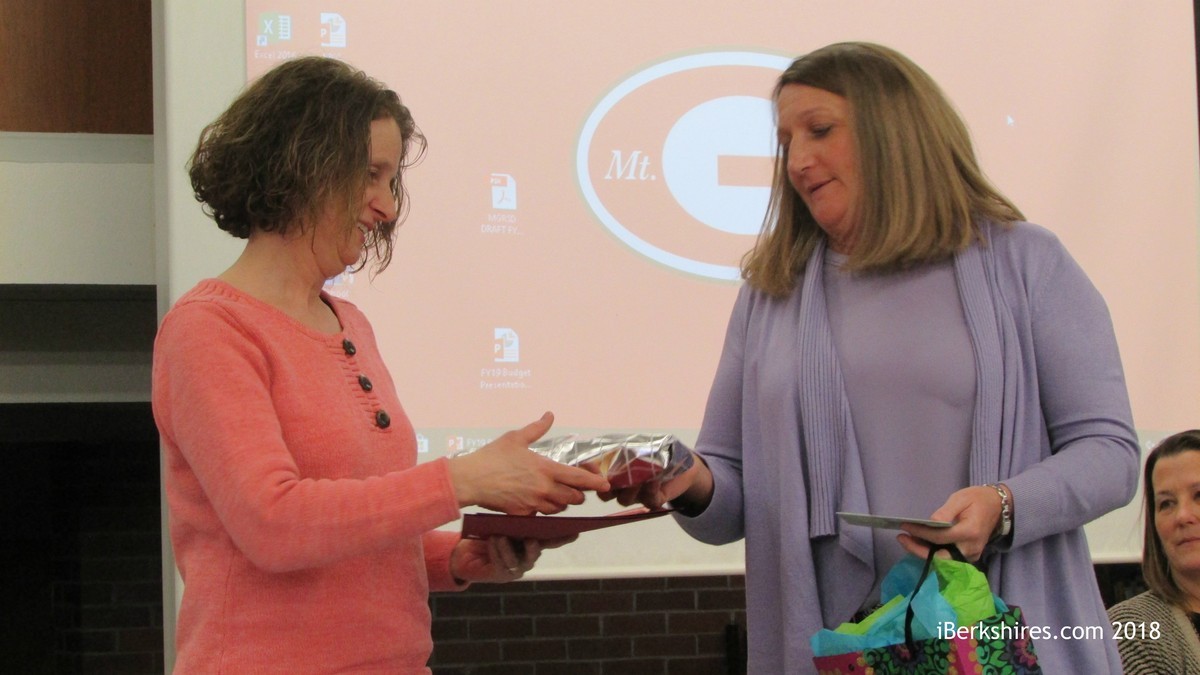
Hebert, who most recently served as chairwoman of the "legacy" Mount Greylock committee, received certificates and gifts from the district.
"This is a bittersweet moment within the agenda," Bergeron said. "We say farewell to Sheila for many years of extraordinary service … to just about everything that impacts education in our towns."
"On behalf of the Town of Lanesborough, Sheila has been, along with Regina [DiLego] a steady influence on our town," said Dodig, a fellow Lanesborough resident. "She deserves both towns' thanks."
Tags: fiscal 2019, MGRSD_budget, search committee, superintendent,