North Adams Committee Advises No Rate Changes at Transfer Station
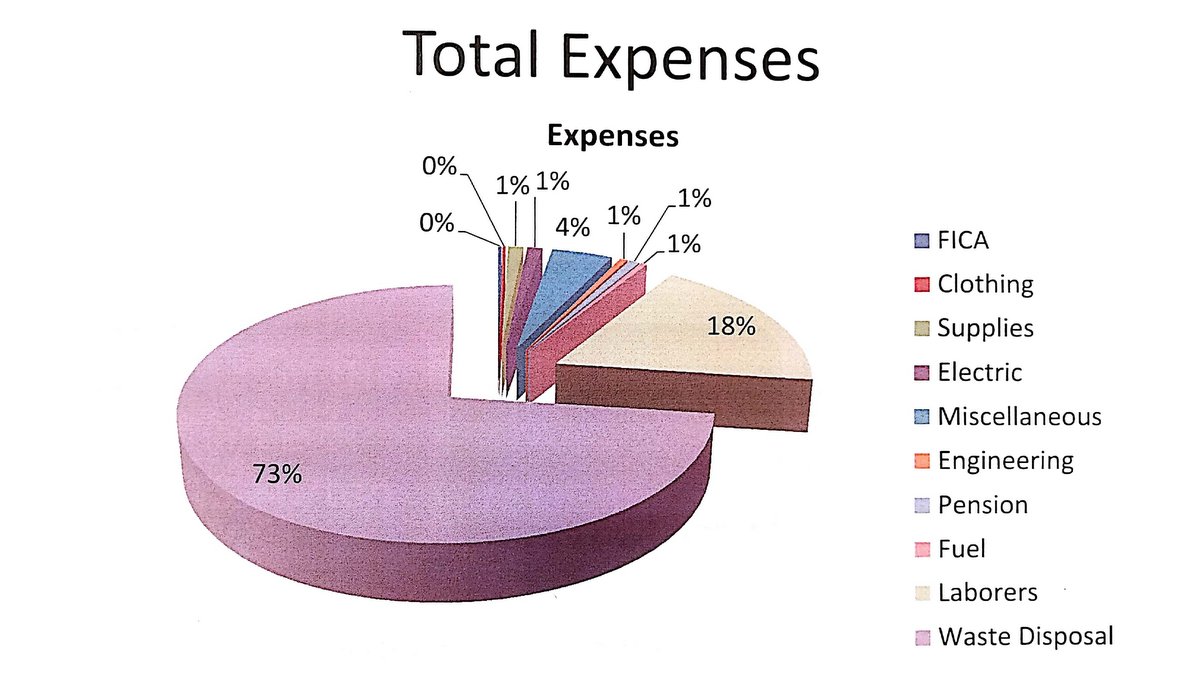
A pie chart expenses for the transfer station. The budget for fiscal 2019 is $455,184.27.
Administrative Officer Michael had brought forward several proposals on changing to a single-rate sticker fee and adding a $6 one-time charge. But committee members felt that the transfer station was a convenience for many in the area and fees shouldn't be reduced at this point.
"I would keep everything the same and then next year, if we find our nonresidents has dropped more than the $15,000, then if we were looking to be competitive, that's the point we say OK," said Chairman Joshua Moran, referring to the amount of revenue that would be reduced with the proposed flat fee.
Member Jason LaForest had concerns about North Adams taxpayers "subsidizing the facility for residents of other communities."
Canales said the goal has been to right-size and streamline operations at the transfer station, a project that has taken some time. For years, he said, the actual costs to operate the station had not been reviewed and the charges had not changed, which had lead to taxpayers taking on more of the cost burden than nonresidents.
"When we first started focusing on this pay-to-throw, it cost residents essentially more money to get rid of the trash than nonresidents, because when there was a shortage or when we had to pay extra money for the transfer station for upgrades, that taxpayers were charged the remaining balance," Moran explained.
Canales said that has changed as revenues have been adjusted to match costs. All of the large haulers have moved to TAM in Pownal, Vt., but the city still sees a number of small haulers. With the reduced volume, it's been able to classify as a small-scale operation, saving on testing and forms required by the state.
The administration proposal had been for a flat sticker price of $60 a year for everyone; eliminate temporary and half-year stickers in favor of a single user-fee; and adjust the hours of operation. The flat rate would translate to a reduction of $12,725 in revenue for next year.
The total cost to operate the transfer station is proposed at $455,184. Non-residents make up 488 of sticker-holders, bringing in $39,000; commercial haulers hold 202 stickers for $17,170 in revenue. Nearly 1,200 resident stickers are sold annually for $71,000 in revenue.
The cost for disposing of trash has gone up by 16 cents a ton, from $113.64 a ton. Waste disposal takes up 73 percent of transfer station costs. With an annual sticker price of $60, it would cost the average family of four about 50 cents more to dispose of a ton of trash. However, the administration was not advising any price change. The bag prices of $1 for a small and $2.25 for a large would remain the same.
Member Marie T. Harpin asked if the reasoning for flat rates was to stay competitive with other communities.
Canales said yes, to an extent. Operations have stabilized, he said, and "we have a significant clientele from Adams but a lot of those are small haulers."
Adams has opened its own transfer station, at $75 a year for residents, but he believed everything had to be bagged. North Adams, in contrast, has a scale that will allow truckloads of debris.
"We have the scale that allows us to take construction debris for small haulers and the rest," Canales said. "That's very convenient."
The current rates are $60 for residents, $80 for nonresidents and $85 for commercial.
Moran thought it was worth the extra $5 a year for Adams haulers to be able to drive over the scale.
The committee preferred to keep the rates as they are for now and re-evaluate them next year. Members did, however, think the $6 fee for one-time use — in addition to bag and scale fees — might be too low. (Scale fee is $6.)
Canales said the $6 option was a placeholder to begin conversations; the administration had also considered $8 and $10.
"You don't necessarily make it affordable for someone who's coming up that only is going to using it once or twice anyway," Moran said. "I would be leaning toward that $10."
The one-time fee would be useful for people who are not full-time residents, for residents who hadn't had a chance to get their stickers, and to encourage people to buy the one-year stickers. It would also catch people who didn't have stickers; the city plans to crack down on people showing up without one.
Trying to fill out forms at the transfer station for temporary stickers was cumbersome and backed up the operation, Canales said. "We're trying to get them to City Hall to buy their stickers."
The transfer station is also trying a new traffic pattern with everyone entering on the right side, toward the scale, making the loop and exiting on the left on Tuesday through Saturday. The traffic on Saturday is much greater so those going over the scale would enter to the right; those dropping bags and recyclable would enter on the left, turn at the end and exit through the lane on the side of the containers.
This formation would allow for a foreman and scale house worker during the week; the transfer station would operate from 7 to 2, closing an hour earlier than currently so all the containers can be cleaned out for the start of the next day.
On Saturday, there would be a foreman, scale house worker and a third Department of Public Works employee to help with emptying the containers. The hours would remain 7 to 2.
The committee voted to maintain current rates, eliminate temporary and half-year stickers, institute the $10 one-time fee, and change the hours of operation during the week. Some of these did not require City Council approval but all three committee members thought it should be brought to the full council's attention.
"These are ways in which we've been incrementally making it more efficient, cleaner, and better run operation," Moran said. "Will it be different? Yes. But it doesn't mean the way it was done before is the right way."
Tags: fiscal 2019, transfer station,