County's Colleges Train Workers for Post-Pandemic Economy
PITTSFIELD, Mass. — The county's institutions of higher education are ready to do their part to help their students navigate their way through a post-COVID-19 economy.
On Friday, the presidents of Berkshire Community College, Massachusetts College of Liberal Arts and Williams College and the provost of Bard College at Simon's Rock participated in a virtual town hall hosted by 1Berkshire.
Johnathan Butler led the hourlong conversation, which focused largely on how colleges are adapting to the current closure of their physical campuses and making plans for the fall 2020 semester.
But at one point Butler asked how the schools are situated to help address workforce development needs at a time when Berkshire County has nearly 30 percent unemployment.
BCC President Ellen Kennedy said the community college recently realigned its workforce programming.
"We now have a director of allied health, a director of advanced manufacturing, a workforce director of allied health, a workforce director of advanced manufacturing and a workforce director of hospitality," Kennedy said. "And we're totally focused on working with those different business sectors in how do we develop curriculum, what other skill sets do you need, what is the focus of developing non-credit and for-credit and certificate-based programs that will meet the needs that have been identified."
BCC received a state grant to develop a curriculum in the hospitality field along with partners in the private sector. The school just received permission to transition that curriculum to an online program, Kennedy said, and there will be funds available to provide for tuition and fees that BCC will be announcing shortly.
"We're doing things virtually, we're doing things that are at no costs, we're applying for many grants to provide funding to cover the costs of individuals or whole industry sectors to participate in way ways to upscale themselves," she said. "A lot of the curriculum we put in play this summer was devoted to upscaling — providing people who might have a little bit of time right now, and it' an opportunity to get a certificate, to pursue some classes that would make you more marketable as you think about what your next steps are."
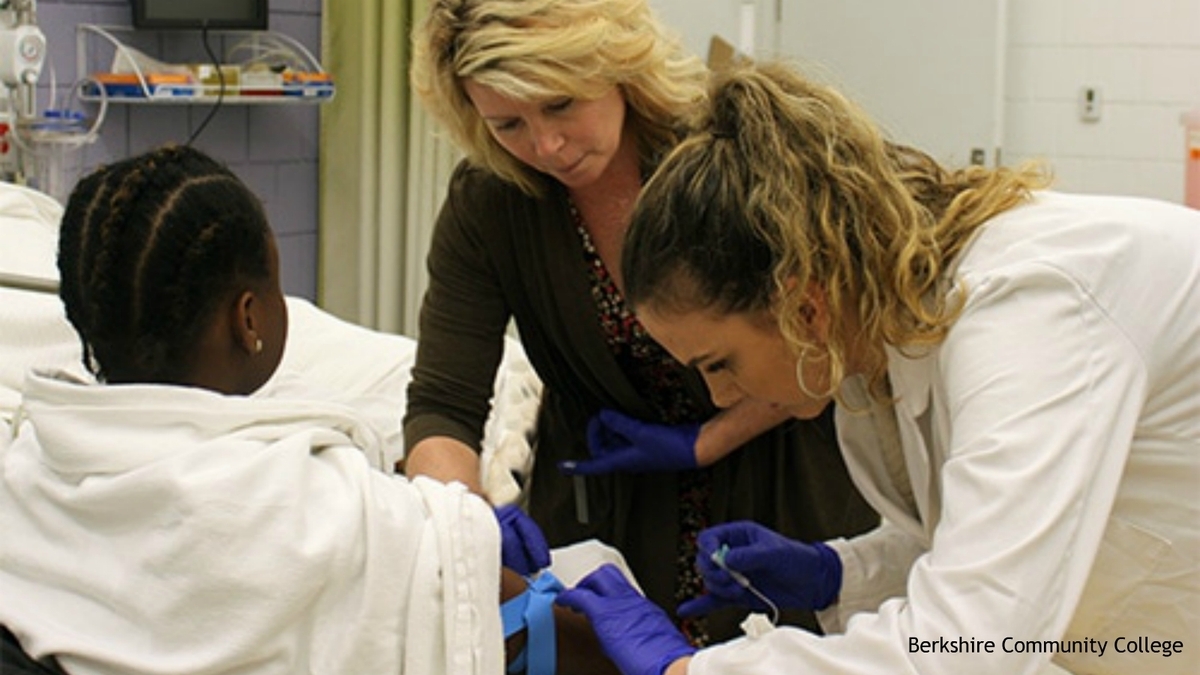
As the school most closely aligned to the notion of workforce development, BCC's health-care programs are particularly timely in a global pandemic.
"We are about to launch a January cohort for our [associate degree in nursing] program," Kennedy said. "I will be piloting that without about 25 students. So we'll be taking in a full class this fall in our nursing program, our registered nursing program, and then launching a second cohort in January.
"We're launching our respiratory therapy program, which is something that people in our community might be interested in pursuing. There's been so much attention on the respiratory therapy assistant and the role of respiratory therapy in addressing the pandemic. We know that there are people who may have some new interests who may be in a different position than they were just a few months ago."
MCLA President James Birge noted that community colleges are positioned to adapt quickly in a crisis and thanked Kennedy for BCC's efforts. But four-year residential colleges like the North Adams school also have a role to play, he pointed out.
"I think programs are really important to the recovery of Berkshire County," Birge said. "We have a number of health suite programs, health sciences and community health education. We're looking at developing others that we think are going to be in demand, certainly in the Berkshires."
No matter what degree you pursue, though, there is a benefit to pursuing a degree beyond secondary education, Birge said.
"When you look back at the 2009 recession and you look at unemployment levels, at the height of that recession, the unemployment level was at 15 percent," he said. "For people with a bachelor's degree, the height of their unemployment was 5 percent. So people who have a college degree are much more agile in a changing labor force, where they can find the work that they need. They have a broad set of skills that they can change … the focus of their career path more easily.
"I think that's one of the important things that all of us offer: degrees and credentials that create a skill set for our students and graduates that allow them to be more agile in a changing environment."
Williams College President Maud Mandel agreed.
"The kinds of educations we all provide — and we provide very different kinds of educations, different ways in which we prepare students for the life that comes after — but it is so important, particularly now, as we try to create problem solvers and thought leaders and people who are going to move society forward, that we continue this work.
"Whatever lessons we take out of this [pandemic], I think we have to double down on our core missions and protect our institutions so that we can prepare these students to go out and solve some of the problems that are emerging and take the lead on the research and institutional efforts that are going to have to happen in the years to come."
Tags: 1Berkshire, COVID-19, higher education,
More Coronavirus Updates