Adams Offers Police Chief Position to South Carolinian
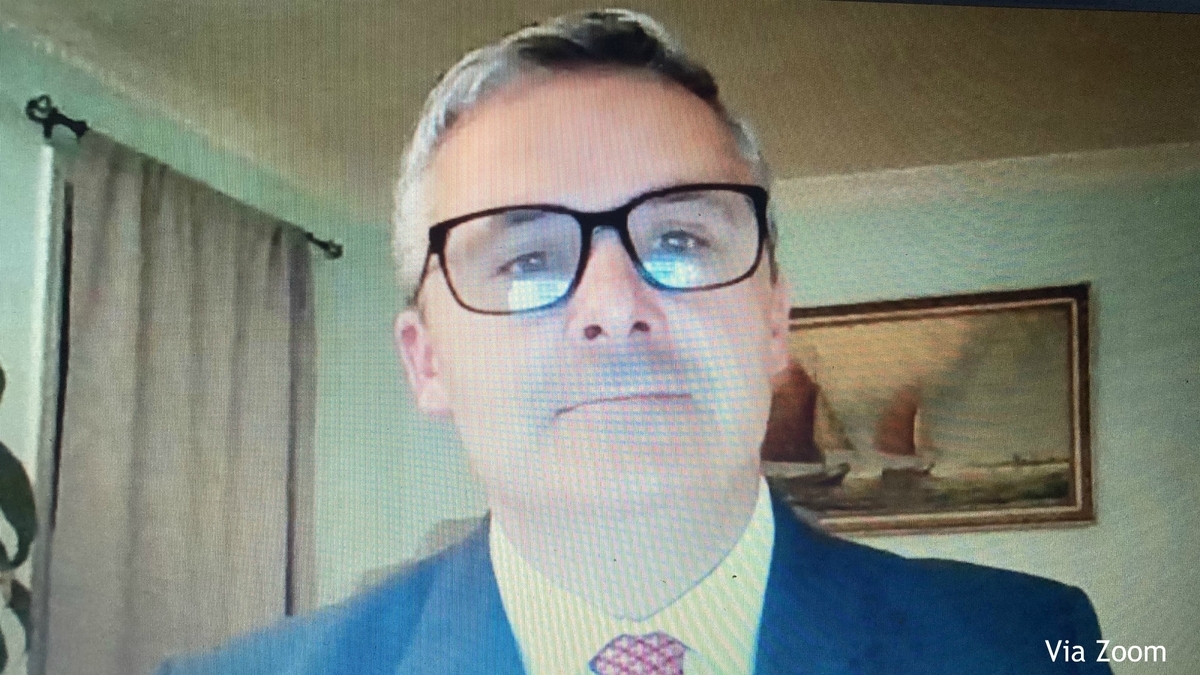
ADAMS, Mass. — A divided Board of Selectmen on Thursday voted to offer the position of chief of police to K. Scott Kelley, who currently serves as the chief of police at South Carolina's Spartanburg Community College.
On Wednesday, the board interviewed Kelley and former Egremont Police Chief Erik Josephson, the two remaining finalists from a nationwide search that yielded 37 applications.
Selectman John Duval, who placed Kelley's name in nomination on Thursday evening, said the difference for him was that Kelley reminded him of current Interim Police Chief Troy Bacon.
"We were very fortunate to hire Chief Bacon after a long search, and he fell right into place, in my opinion," Duval said. "His personality, his leadership skills really meshed well with the department we have, which is a younger force than we had in the past.
"That was going through my mind, that the current department, from what I hear and see, personally, that type of personality appears to be one we'd like to have moving forward."
Duval also said he was impressed with Kelley's explanation of how he came to apply for the position in Adams.
Kelley on Wednesday told the board he was intentional in his decision to apply for a posting in the North Berkshire town of 8,500. His wife spent part of her youth in Massachusetts and had a strong affinity for the commonwealth, he said.
"What the decision was, years ago, was that I was going to get my 25 years vested in South Carolina, and then we were going to seriously open the door to these possibilities," Kelley said. "A year ago, we started making personal moves that would prepare us for when September came. September was when I reached 25 years in law enforcement in South Carolina.
"I've never had an issue with wanting to come to the Northeast, where she's from. In general, as far as my family is concerned, you have low crime, you take education seriously, and with my children, that's important. … I don't just want a position. I don't just want to be a chief of police. I want our family to be part of the community."
Duval referred directly to those sentiments in explaining his decision 24 hours later.
"Having some ties to the area was big to me also," he said. "He said that when they come here, they not only want to move to our community, they want to be active members in our community, which really made a big difference for me."
Duval was joined by Richard Blanchard and Chair Christine Hoyt in voting to authorize Town Administrator Jay Green to enter negotiations with Kelley.
Joseph Nowak was the lone dissenting voice, citing concern about the trajectory of Kelley's career, which took him from Anderson, S.C., (population 27,000) to the resort community of Folly Beach, which has 2,600 year-round residents but balloons to several hundred thousand in the summer, and lastly to Spartanburg CC, which Nowak characterized as "a pretty small school."
Hoyt later noted that, as Kelley indicated in his interview, Spartanburg has about 5,000 students and 2,000 faculty and staff, which compares to Adams' population of about 8,500. And the South Carolina school has five campuses in four different municipalities, Hoyt noted.
Kelley also talked in his interview on Wednesday about his experience working on South Carolina's Internet Crimes Against Children Task Force and a stint at the much larger Clemson University, experience he drew upon when talking about his work around issues of diversity.
"With Anderson, we had populations, and a lot of those were divided up financially," Kelley said. "Then I spent three years at Clemson University, and Clemson University, even at that time, had a student population of somewhere around 35,000. That is where I grew and I learned about different cultures, ethnicities, beyond my own. That gave me a great understanding, and I learned to stop sometimes and just listen to someone and their thoughts.
"Because what my concern is or what I might think is right -- if someone is coming from a different place of knowledge or historically or religiously, that doesn't mean they're wrong. I need to be able to listen to that, understand where they're coming from. It served me well. Everywhere I've been has been a different type of diversity."
Kelley's prior experience also exposed him to work on developing police policies and procedures, something the board expressed an interest in during the interview.
Kelley talked about the experience he had with Folly Beach Chief Andrew Gilreath.
"We had a year of a really painstaking buildup," Kelley said. "When we took over, we found that things were not the way it should be. And so we started trying to fix these things. Policies and procedures was huge. We were way behind in that. We were not up to date. And for some things, we didn't even have standard operating procedures.
"So, between me and Chief Gilreath, we developed all of the policies and procedures that, as far as I know, are still in place at Folly Beach. After a year or so, things smoothed out. When I left, I was so very proud of the department that I left because we had come so far and worked so hard to get where we were at."
Duval picked up on another part of Kelley's answer about policy development: the need to hear multiple voices.
"The first thing he said was that, 'I'm going to have my patrol officers be a part of the process,' " Duval said. "I was like, 'Wow.' … When I heard that, I thought, he's including his team on the police force as part of the decision making. That's another thing I was impressed by."
Blanchard echoed Duval's sentiment about Kelley's temperament being similar to Bacon's.
"I think [Kelley's] leadership style would be more in tone with that of Chief Bacon, and we've seen how well that has worked in our department," Blanchard said. "Nothing against Chief Josephson. I think Chief Kelley would be more of a mentor. … I think he'll be a better fit for our department."
Duval also commented on Kelley's answer to a question about the use of metrics in administering a police department.
"Scott Kelley mentioned that when you provide any type of metrics for public view or for a large audience, you need to explain in great detail what the measures mean," Duval said. "Someone can take those measures and show them to somebody else and somebody else and the story gets bigger and bigger and the problems get bigger and bigger.
"But when you provide those metrics, as Scott Kelley indicated … there has to be a lot of discussion before public or other entities take a look at these measures. We still want them -- at least I do -- but there has to be a lot of discussion behind that. That response was really a good response."
Bacon, who served on the town's screening committee to narrow the field to its finalists, attended Wednesday's virtual meetings to watch the interviews and was present on Thursday as the board deliberated and voted on the Zoom platform.
All four members of the board used the opportunity to praise Bacon and thank him for his service to the town, which comes to an end at the end of the month.
"It's been a pleasure working here and getting to know all of you," Bacon said. "I think if you show the incoming chief the same welcome you showed me, it's going to be awesome."
Tags: Adams Police, police chief,