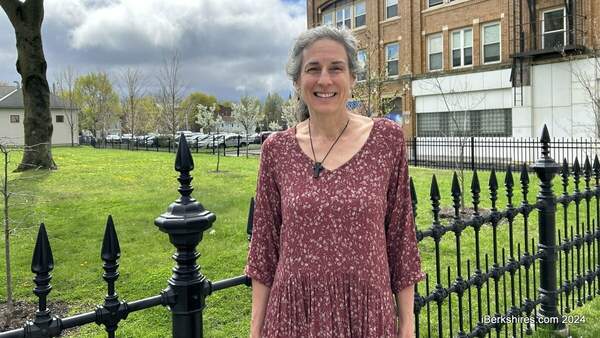
Across the country, there are nearly 135,000 Occupational Therapists, and Suzanne Childs, who provides this specialized care at the Center for Rehabilitation at BMC, says OT goes beyond helping someone regain their functions for work.
"We promote functional independence for people and help restore not only vocational skills, but also homemaking and daily living skills," said Childs. "Occupational Therapy covers the full range of activities people of all ages do to live functional, meaningful lives."
Suzanne has been with BMC since 1994 and has served as an Occupational Therapist in the Berkshires for nearly 30 years, most of that time in the outpatient setting. She came to the Berkshires after providing OT services in New Jersey, Pennsylvania, and later New York state.
"Occupational Therapists often work together with Physical Therapists, but our roles are quite unique. PT focuses on improving the patient's ability to move their body, whereas I concentrate on improving my patient's ability to perform activities of daily living. We help our patients to do things beyond their PT care, such as brushing their teeth, getting dressed, making meals and all of their other everyday tasks that may have been impeded by an illness or injury."
Suzanne is a graduate of Eastern Michigan University and completed her clinical education at Toledo Mental Health in Ohio and Magee Rehabilitation Hospital in Philadelphia. Over the years, she has provided care for spinal cord injury, stroke, post-acute rehabilitation for children and young adults and general rehabilitation.
If you need Occupational Therapy or any kind of rehabilitative care, ask your primary care provider for a referral or call the Center for Rehabilitation at BMC at 413-447-2234.

iBerkshires.com welcomes critical, respectful dialogue. Name-calling, personal attacks, libel, slander or foul language is not allowed. All comments are reviewed before posting and will be deleted or edited as necessary.
No Comments
BRTA Sees Highest Ridership to Date
By Breanna SteeleiBerkshires Staff
PITTSFIELD, Mass. — The Berkshire Regional Transit Authority has recorded its highest ridership in the history of the authority.
The BRTA recorded 731,444 for fiscal 2026 year, with fixed-route ridership at 666,000 passengers, paratransit (ADA) ridership at 65,000 passengers, and Link 413 ridership at 952 rides since it started earlier this year.
Administrator Kathleen Lambert and Operations Manager Benjamin Hansen said the higher ridership is likely thanks to the free fare. Free fare was first introduced to the BRTA in late 2024, this was the first full fiscal year and it won't be the last.
Lambert said she feels very good about the new number and while it's in part because of the fare free initiative, it's great to just be a service to the community.
"The point is, transit keeps more money in people's pockets if they're not paying for gas and transportation," she said. "I know there are improvements to be made, especially around frequency and different forms of opportunities to travel, and I want that to be the situation. But right now, we're kind of getting everything into shape, getting prepared for new service, and prepared for the next iteration of the RTA."
The high ridership also comes at a time of high route cancellations because of a lack of drivers. Lambert said the authority currently has 26 drivers with a goal of attaining 33 to 35. The new operating company, Keolis, is still looking for more hires. This past fiscal year, the BRTA saw 3,457 trips cancelled but hopes to have no cancellations by the end of September.
Hansen gave the ridership data at the July meeting, also showing off the new data that will be easily available on the website for anyone to view in an effort to be more transparent with the public.
The most affected routes were Route 1, the Pittsfield to North Adams Connector, and Route 2, the Pittsfield to Lee, which had more than 750 cancellations.
Although Route 1 had some of the most cancellations it still remained the most popular route with 176,123 riders through 9,729 trips. Route 34, the North Adams Loop, came in second with 127,147 riders also through 9,729 trips. Again, even though Route 2 had some of the most cancellations it came in third with 76,305 riders with 8,597 trips.
The Link413 service has also grown in ridership. Some on the board contested the start of the Link413 service, worried that the start of the service took drivers away and didn't see ridership high enough. The new data shows that the ridership almost doubled from the previous month from 179 in May to 313 in June.
Lambert also noted it was not possible to cut the service as it was properly approved and if they had to cut, they would have to give back their portion of the grant money, which would be impossible. She mentioned this to the group since former board member Rene Wood and others had asked to see what was possible with the service and when it was accepted and if it should still be running.
"We took the money, we ordered the vehicles. We took the vehicles. We've been running the service. To abandon the service is against the MassDOT contract. We do have a contract for the funds. We accepted all the money. If we rescind the contract, then we rescind the funds, and that means paying back a couple of million dollars, which we don't really have, and our portion would be at least one third of that, probably more because we run 50 percent of the service," Lambert said.
The Link413 service is a partnership between the BRTA and the Franklin Regional Transit Authority (FRTA), and Pioneer Valley Transit Authority (PVTA). The most popular route is the Pittsfield to Northampton with over 60 percent of ridership.
On July 6, Gertrude Willey celebrated her 100th birthday, but after more than three decades of volunteering in her community, she says staying active is the secret to her longevity.
click for more
The annual "I Am a Part of Art" exhibit is the organization’s biggest exhibit of the year, this year featuring over 300 works of art by 250 artists with disabilities, spanning the Lichtenstein Center and Clark Art Institute. click for more
A housing production plan helps create a pathway for municipalities to build housing through specific goals while contributing public input and a survey of community needs. click for more