image description
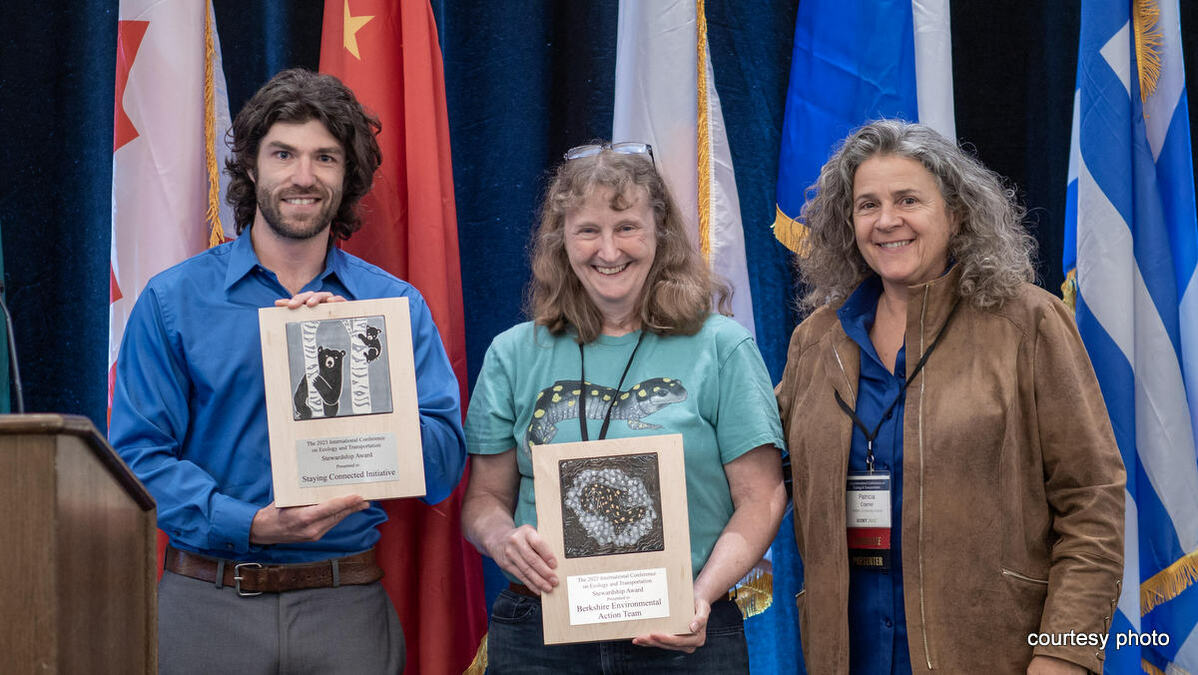
BEAT Staying Connected Initiative Coordinator Mikael Cejtin, left, and Executive Director Jane Winn show off their locally-made stewardship awards, presented by Patricia Cramer, director of the Wildlife Connectivity Institute.

BEAT Receives International Stewardship Award
Print Story | Email Story
PITTSFIELD, Mass. — Berkshire Environmental Action Team received a stewardship award for its work protecting and re-connecting wildlife habitats in the Berkshire Wildlife Linkage area. 
 
The award was presented June at the International Conference on Ecology and Transportation.
 
The local environmental organization's habitat effort is part of a larger Staying Connected Initiative: a partnership of many conservation organizations that work together to maintain landscape connectivity across the Northern Appalachians in the Acadian Region of the United States and Canada.  

Tags: BEAT,   recognition event,   
If you would like to contribute information on this article, contact us at info@iberkshires.com.

Dalton Air Quality Report Links Dust to Digsite

By Sabrina DammsiBerkshires Staff
DALTON, Mass. — For more than a year, neighbors of Berkshire Concrete's unauthorized dig site have complained that sand drifting into their neighborhood is affecting their air quality.
 
A five-month study is providing data that may support these claims.
 
Air Partners Collaborative of Needham monitored the air quality over five months — from October to April — using a network of monitoring sensors at strategic locations surrounding the site. 
 
Sensors were positioned west and southeast of the site at four locations: Raymond Drive, Off Prospect Street, Renee Drive, and the shooting range 80 meters northwest of the site to provide background measurements for the northwesterly winds. 
 
During the observation period, it was determined that Dalton is experiencing "extreme events of coarse particulate matter, with an aerodynamic diameter of 10 micrometers (PM10)
 
The National Ambient Air Quality Standards for PM10 is 150 micrograms per cubic meter within a 24-hour period, the report says. But Dalton is seeing concentrations reaching 1,000 to 10,000 micrograms per cubic meter during individual events. This is seven to 67 times the national standards.
 
The wind direction analysis indicates that 10 of the 12 exceedance events, or 83 percent, suggest the digsite may be contributing to the issue, but this cannot be proved with certainty.
 
View Full Story

More Pittsfield Stories