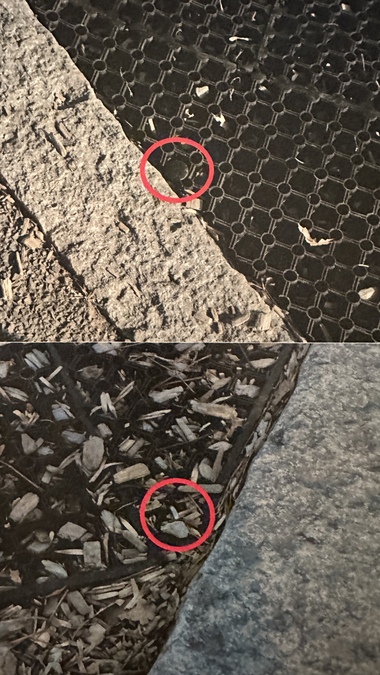
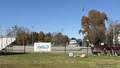
The mats are attached to the ground through pins and nubs.
DALTON, Mass. — The Americans with Disabilities Act Committee is exploring adding playground mats to town parks.
These mats would be laid out to provide accessible routes to playground equipment and swings.
ADA coordinator Alyssa Maschino heard about these mats while attending an Advanced Community Access Monitor Training.
"[The state Division of Professional Licensure Office of Public Safety and Inspections Architectural Access Board] brought this up which I thought was very clever," Maschino said.
"It's like a rubber matting system, which is very inexpensive compared to paving a pathway in the parks."
The mats are fixed to the ground using pins and nubs. They are also secured to play equipment and swing sets using plastic stakes and stainless steel pins. The mats are connected to each other using zip ties. The mats are "relatively" quick to install and easy to maintain and repair.
Newton paid approximately $3,000 to cover the costs of the mats at one of its parks but it looks like they did quite a bit, Maschino said.
"Anything we can do to accentuate the beautiful parks we have and to make Dalton a more enjoyable, livable, accessible place," committee member Lyn Clements said.
"It not only makes it easier for those children and adults who already live here. It makes us more attractive to diversify our community more and I think that's a great thing."
These mats could also help in case the town considers investing in an ADA swing so disabled children can also enjoy the town parks, similar to Springside Park, Maschino said.
The Green Committee is going to need something like this because it is putting electric vehicle chargers at Pine Grove Park, committee member David Wasielewski said. Wasielewski also serves as the town's Green Committee chair.
"We're gonna need something to stabilize that area as well and make it accessible," he said.
Maschino is currently in communication with Highway Superintendent Edward "Bud" Hall to gauge his interest.
If you would like to contribute information on this article, contact us at info@iberkshires.com.
Your Comments
iBerkshires.com welcomes critical, respectful dialogue. Name-calling, personal attacks, libel, slander or foul language is not allowed. All comments are reviewed before posting and will be deleted or edited as necessary.
No Comments
Community Conversation for Opioid Response Funding
By Breanna SteeleiBerkshires Staff
PITTSFIELD, Mass. — Massachusetts is expected to receive a billion dollars through settlements with various companies that have supplied opioids.
Sixty percent of these monies will go toward the Opioid Recovery and Remediation Fund to help manage state efforts with 40 percent going towards municipalities.
State public health officials have been holding listening sessions on how to best to use the settlement. Some of those ideas in Berkshire County were drug courts and mandatory treatment, recovery programs for mothers with small children, and lowering barriers for transitioning into treatment.
On March 12, epidemiologist Casey Leon and Director of Opioid Abatement Strategy and Implementation Julia Newhall from the Bureau of Substance Addiction Services, and Erika Hensel project manager for opioid response with the Attorney General's Office, attended a session at the Living in Recovery Center.
Andy Ottoson, who co-facilitates substance prevention and overdose reduction programs at the Berkshire Regional Planning Commissions through the Berkshire Overdose Addiction Prevention Collaboration, led the conversation.
In attendance were also District Attorney Timothy Shugrue, state Rep. Tricia Farley-Bouvier, Berkshire Athenaeum social worker Gabriela Leon, and city and recovery center representatives.
Shugrue said low-level drug cases should be diverted into treatment pretrial rather than prosecuted. He said many courts and counsels are not using the programs available or are unaware of diversion options. He asked if there could be training for judges to promote diversion as an option and to coordinate so that more people are diverted early, which could help reduce overdose risk.
Sixty percent of these monies will go toward the Opioid Recovery and Remediation Fund to help manage state efforts with 40 percent going towards municipalities. click for more
Thousands of Berkshire County residents are expected to join millions of other Americans on Saturday in the third "No Kings" day of protest. click for more
More than 200 of the 250 students picked in the lottery for Taconic's class of 2030 have accepted enrollment, and the remainder have until Friday. click for more
Interim Superintendent Latifah Phillips emphasized that no decision has been made, and that the conversation is centered on student success. click for more