
| Home | About | Archives | RSS Feed |

The Independent Investor: Lost Art of the Third Reich
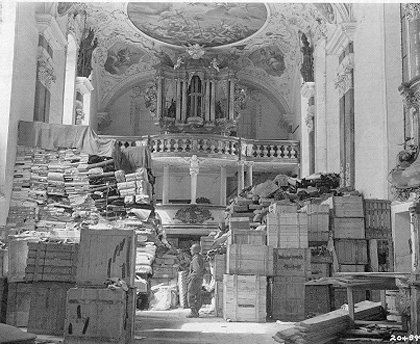
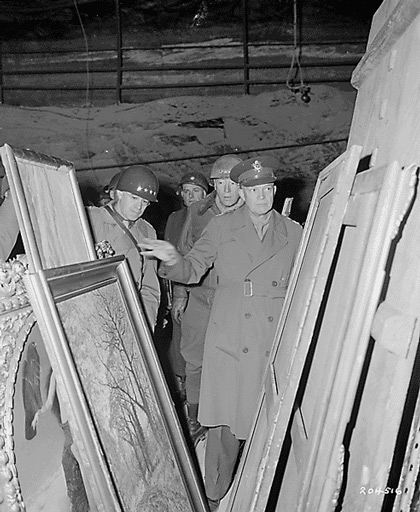 Gen. Eisenhower looks through a cache of stolen Nazi art; below, an American soldier in a church full of loot in Germany. Both images from the National Archives. Gen. Eisenhower looks through a cache of stolen Nazi art; below, an American soldier in a church full of loot in Germany. Both images from the National Archives. |
 |
This week the art world is abuzz by the revelation that a $1.3 billion cache of 1,500 stolen artworks has surfaced in Munich. European investigators are hunting for yet a second treasure trove right now. It could be just the tip of the iceberg given the extent of Nazi looting during World War II.
Approximately 20 percent of the art in Europe was stolen by the Nazis in a determined and methodical campaign that stretched from 1937 to 1945. Through a series of German laws, the Nazis devised an art strategy intended to destabilize nonconforming cultures, especially the Jewish, which justified and regulated the legal confiscation of cultural and personal property.
The Nazis' first "purified" their own museums, galleries and private collections, establishing a standard for what was acceptable art. They defined "acceptable" as art that was essentially of Germanic origin, while labeling most modern art as "degenerate." Degenerate art of every kind was to be sold off, traded or tossed on massive bonfires at Third Reich rallies.
The Nazis exported that policy in their conquest of Europe. It was a deliberate attempt by Adolph Hitler, aided by Hermann Goering, an avid art collector, and Goebbels, Hitler's propaganda minister, to pillage the very best in what they deemed to be acceptable European art and historical artifacts (think "Raiders of the Lost Ark").
No sooner had Hitler's army crossed the border into Poland, for example, than the Einsatzstab Reichsleter Rosenberg (ERR) and Hitler's private art outfit, the Sounderauftrag, spread out conducting a systematic pillaging of 13,512 paintings and 1,379 sculptures in Warsaw alone. As the German war machine invaded and annexed country after country, Europe's art treasures flowed the other way in boxcars headed for German fortresses, castles and even underground mines and bunkers.
After Germany's defeat, the U.S. and British Monuments, Fine Arts and Archives section worked to uncover the sites where the Germans had hidden their plunder. Artworks of every conceivable form, value and size were unearthed in barns, railroad cars, in attics and even under mattresses. Hundreds of thousands of pieces, a truly priceless collection of cultural treasures, were recovered and returned to their rightful owners but much, much more has never been found.
This week's revelation of a cache of "degenerate" art confiscated from Jewish owners was actually discovered two years ago but German authorities sat on it "pending the completion of their investigation." Paintings by Picasso, Matisse and Chagall are among the collection that experts believe was part of the Nazi-confiscated art during the purification of German culture prior and during WW II.
The paintings were discovered stacked between dirty plates and cans of food in a decrepit apartment owned by the 80-year-old son of a museum curator-turned-art dealer who worked for the Nazis. The son, Cornelius Gurlitt, has disappeared without a trace. Authorities presume that there is a second cache of artworks. They believe it is a source of funds that Gurlitt has been selling off piecemeal and stashing the money in a Swiss bank account.
How much more of this plundered art exists and how much could it be worth? No one knows, but it could easily amount to more than the gross domestic product of several countries. Take the disappearance of the Amber Room as just one example. This famous room, located within Catherine the Great's summer palace, was one of the largest works of jeweled art ever made. An entire room lined with of tons of high-quality amber, accented with diamonds, emeralds, jade, onyx and rubies. During the war, it was dismantled, crated and shipped back to Germany where it was placed on display. British air attacks in 1945 forced the Nazis to once again dismantle and pack the room into 27 crates. It remains hidden to this day.
Rest assured these treasures are there to be discovered. Who knows, in the years to come, how many will be returned to us. And for everyone discovered, the world will be that much richer.
Editor's Note: For those interested in the subject, we highly recommend 1994's "The Rape of Europa: The Fate of Europe's Treasures in the Third Reich and the Second World War," by Lynn H. Nicholas. More locally, the late Williams College art professor S. Lane Faison was assigned to the OSS's Art Looting Investigation Unit and literally wrote the book on Hitler's stolen art, "Linz: Hitler's museum and library," which is available in the college's library.
Bill Schmick is registered as an investment adviser representative with Berkshire Money Management. Bill’s forecasts and opinions are purely his own. None of the information presented here should be construed as an endorsement of BMM or a solicitation to become a client of BMM. Direct inquires to Bill at 1-888-232-6072 (toll free) or email him at Bill@afewdollarsmore.com.
