North Adams City Council Candidates: Robert Cardimino
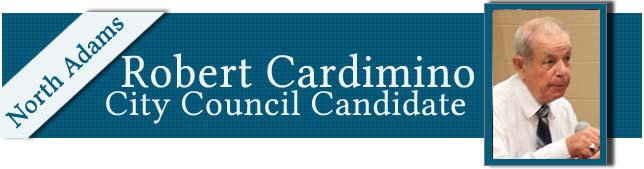
I am a lifelong resident of North Adams, a homeowner and veteran of the Korean War. I am semi-retired, working as a part-time landscaper, but worked as an auto body man for 10 years, as a welder and inspector for GE for 25 years, and ran two small businesses.
Married Louise Scarpitto and raised two daughters. Louise passed away and I remarried to Maria Myrna Ogoy and life with a stepdaughter, Charity Ogoy.
Graduated from Drury, McCann and Pittsfield Trade schools; member of the American Legion, North Adams Legion Riders of Dalton, NAACD Pittsfield, former member of the North Adams Lions and past president of Boy Scout Troop 35. My hobbies are hunting, fishing and riding my motorcycle.
I am interested in city government and participated in council meetings for 30 years. Now I want to become more involved and have a vote, because I am not satisfied with the way the city is going. I want to be a voice for the residents, taxpayers and businesses and bring their ideas, suggestions and complaints for discussion before the City Council.
1) What do you consider the city's greatest asset?
The city's greatest asset in my opinion is Mass Moca and the arts community.
2) What do you consider the city's greatest challenge?
Our greatest challenge is to bring our city's finances under control, reduce spending and get our city solvent again. I think taxes and fees are too high. Yes, spending is too high, we can't keep borrowing money and we must stop giving out huge raises.
3) How do you perceive the taxation question: Do you think they are too high/too low/just right? If the city has a spending problem, what should it cut? Should the commercial rate ($32.95, second highest after Pittsfield) be raised again?
Commercial and residential tax rate should be the same.
4) There are a number capital needs on the horizon, not least a new fire station and police station. How should the city address these needs? Should it forge ahead or wait until better economic times? If it waits, how can it manage in the interim?
I don't think we need a new fire or police station right away. I don't hear any complaints from either director. Water and sewer pipes should be the priority.
5) The North Adams transfer station has been operating without a permit for years and needs costly upgrades. Should the city fix it or close it?
The transfer station can become complaint with stricter management and run the same way Williamstown and Adams does, with compacting trailers and stricter recycling roll-off trailers.
6) Education: The design for the Conte renovation project is nearly complete. What do you think of the project? Should the city reconsider?
I'm not impressed with the design of Conte. It's not complete and already over budget. Cutting things from the design is no the design that was voted on. We should have built a new school or refurbished our neighborhood schools.
7) Housing: As a councilor, what measures would you support to prevent or remediate blight? Some residents feel there is too much low-income housing that is making the problem worse. If so, how could the council address that?
Perhaps a tax incentive for landlords who rehabilitate their property, plus stricter building and health inspections.
8) Public Safety; The city has suffered through a number of high-profile crimes this summer. What can be done to make the city safer? Would you support spending more to hire more officers? Are there other ways to make it safer without spending?
Organize crime watches and community policing, training and hiring of more police officers. Timely publishing where crime is being committed. More commitment from the DA's office and harsher sentences from our court system. Also, lockable classroom doors in our schools, plus teacher's with panic buttons.
9) The city has a "Plan A" government with a strong mayor and limited council. How do you see the role of the council in the city's government? Should it be more proactive or more questioning of the mayor? Or should it focus on more of an advisory role as the voice of constituents? Can it be both? Or should the city's government be changed?
Plan "A" government works fine. The council should be more proactive and also question the mayor so he's more transparent.
10) The council instituted limited speech from citizens as a way to prevent disruptions. Do you agree with the rules or should they be revisited? If the council allows more speech, how can it prevent disruptive behavior?
If rules are changed to allow more speech, the council and the president need to set the example. There have been disruptions on both sides of the rail. Just because they don't like what's being said, doesn't necessarily mean it's disruptive.
11) How can the council help to attract and retain businesses? Should it allow or limit the number tax-increment financing (letting businesses phase in property taxes) agreements? What realistically do you think the council can do in terms of ordinances and other measures?
To help business whenever there is money appropriated to buy something that doesn't have to go out to beid, they should encourage the mayor to buy local if possible. Short-term tax incentives would be one way, less regulation
12) Should the city create an economic development department, similar to Pittsfield and Adams?
The already has economic development.
13) A national drugstore chain has shown interest in the former St. Francis Church. The council passed an ordinance that would delay any demolition of older buildings until plans could be reviewed. Do you agree with that? Or should the city allow historic buildings to be demolished after a certain time? Should the city attempt to save St. Francis for other uses?
At the direction of the mayor, the council did pass an ordinance that delayed the demolition for one year. Yes, I do agree. The mayor tried to save St. Francis but never got any takers to buy and preserve it. I don't know what other uses St. Francis could be used for, because of the cost of repairs seems prohibitive.
14) The Redevelopment Authority is considering a long-term lease with private developers to turn Western Gateway Heritage State Park into "Greylock Market," an artisan studios and residences. Do agree with the plan? Should the city actively help the current nonprofits in there - the local museum, theater company and television station - relocate?
No, I don't agree with the plan for Heritage Park. It needs to help the museum, theater company and TV station stay where they are. All three are important to our city.
15) Resident question: Do you think municipal employees salaries should be posted online like the state employees are? Why or why not?
Salaries should be posted, they are public record. Who can disagree with transparency.
Tags: candidates, city council, election 2013,