Climate Change Expert: Keep Heat on Banks, Insurers
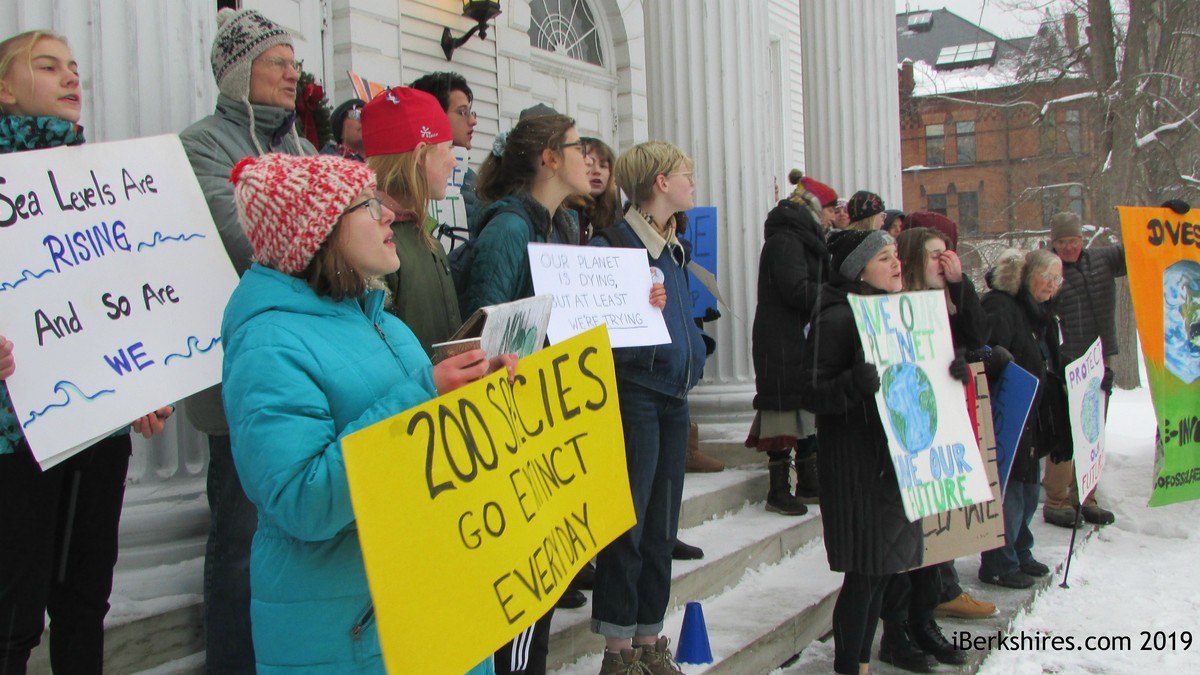
About two dozen protesters demanding action on climate change gather on the steps of Williamstown's First Congregational Church on Friday afternoon.
Big banks and big insurance play their part.
"The four banks in the world that fund most of the fossil fuel industry are big American banks," Bill McKibben said during his appearance at MCLA for the Elizabeth and Lawrence Vadnais Environmental Issues Lecture. "Chase Bank is the biggest by far and the biggest with a bullet. Chase Bank lent over the last three years $196 billion to the fossil fuel industry. They’ve increased their lending 30 percent since the Paris Climate Accord was signed.
"Every bad pipeline, every dumb idea I’ve talked about tonight, they’re funding. And, no wonder, because the guy who was the CEO of Exxon, back when it was inventing climate change denial, a guy named Lee Raymond, when he retired, his retirement job was to become chair of the board of Chase Bank, where he has earned $480 million over the last decade helping lead this conflagration."
Liberty Mutual, meanwhile, underwrites pipelines while telling California homeowners they can’t have insurance because everyone knows their houses are going to burn, he said.
"These people are arsonists," McKibben said.
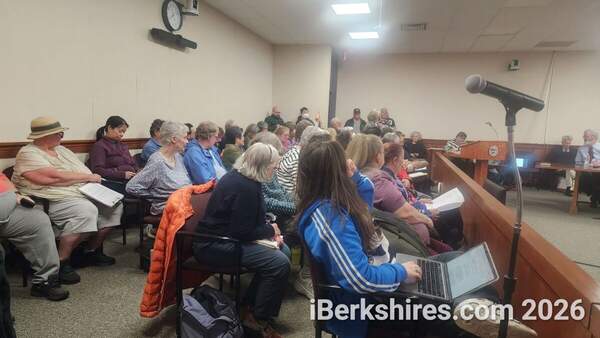
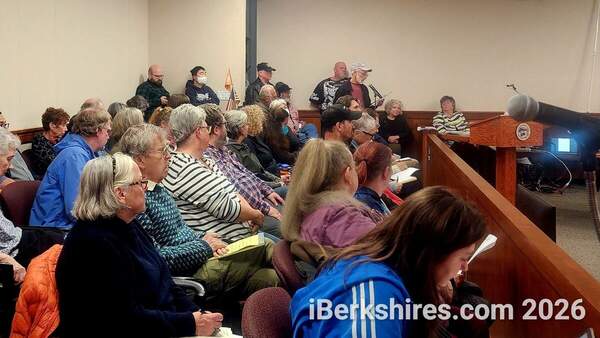
And their victim is the human species, as McKibben laid out the case in a disturbing hour-long lecture in MCLA’s Church Street Center.
Looking past the immediacy of the winter weather that arrived earlier in the week, the ongoing, long-term and likely irreversible warming of the earth’s atmosphere is a proven reality with dire consequences, McKibben explained.
"So far, we’ve raised the temperature of the planet 1 degree Celsius," he said. "That doesn’t sound like an enormous amount, but it turns out that in energy terms, it’s a lot. The extra heat that we trap each day because of the carbon we put in the atmosphere is the heat -- each day -- of about 400,000 Hiroshima sized [atomic] bombs."
That’s enough heat to cause the loss of 70 percent of the summer sea ice in the arctic, which raises sea levels and threatens vulnerable populations. It also is enough heat to throw off the hydrological cycle of the planet -- the means by which the earth recirculates water.
"If you want one fact to hold in your brain to understand the century we’re in, it’s simply that warm air holds more water vapor than cold," McKibben said. "That means in very hot places, you get more evaporation and more drought. And we see that all over the world. And one way we can tell this is because we see fires breaking out all over the world, many in places far more than we’ve ever seen them before.
"California isn’t the only example. There are huge fires on every continent."
Meanwhile, all that water evaporating in warmer areas has to come down somewhere, increasingly with tragic consequences of its own.
"In our neck of the woods, we’re seeing a 70 percent increase in the last 50 years in the number of storms that drop more than 2 inches in a 24-hour period," he said. "I’m looking at Sam and Elizabeth Smith out there, two of the better farmers I’ve ever known, and they’ll tell you that a storm that drops 2 inches of rain in the course of the night is the kind of storm that does no farmer any good at all. That’s the kind of storm that washes things into the river, soil included."
McKibben has been on the front lines in the fight against climate change for decades.
On Thursday, he talked about the origins of the grassroots group, 350.org, that he founded with a handful of Middlebury undergrads in 2008. The nonprofit spurred its first International Day of Climate Action in 2009, helping inspire a movement that has penetrated all corners of the globe.
McKibben talked about how some of the most enthusiastic and persistent climate activists live in parts of developing nations that are acutely threatened by the effects of global warming, a fact that he called both, "beautiful to see and sad to see."
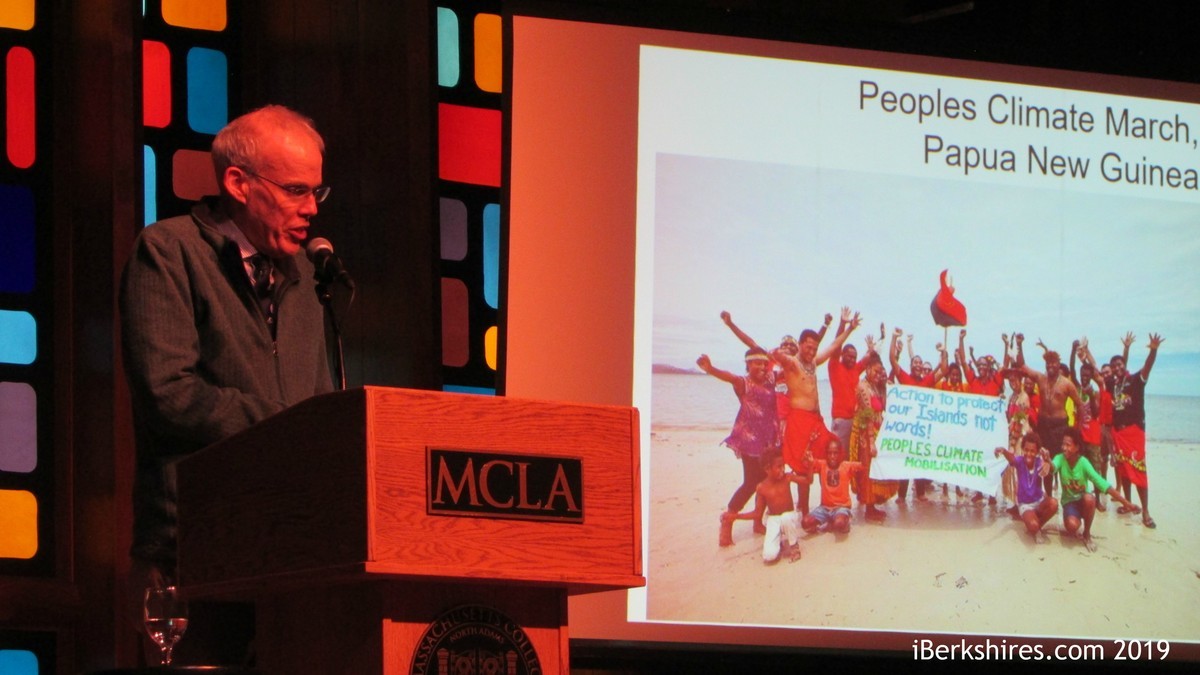
"I’ve always told that environmentalism was something rich white people did, and if you didn’t know where your next meal was coming from, you wouldn’t be an environmentalist, and yada yada," McKibben said. "It took about 20 minutes watching these pictures come in from around the globe [from the 2009 event] … to realize that most of the people we were working with around the world, almost all the leaders in this fight, were poor, black, brown, Asian and young -- in some combination.
"Because that’s who almost everyone on earth is. And, oddly enough, they’re exactly as interested in the future as anybody else, maybe more so because the future bears down really hard on you when you’re in vulnerable places."
As he showed the audience slides of children protesting in some of those vulnerable places, McKibben reminded his listeners why the photos are so sad.
"The iron rule of climate change is the less you did to cause it, the more and the quicker you suffer," he said.
In the lifetimes of McKibben’s younger listeners, those vulnerable populations will be driven from their homes by some combination of rising sea levels and drought-induced famines, he said.
"The current U.N. estimate for climate refugees that we can expect if we allow emissions to keep rising on their current track, a high end estimate is a billion refugees this century," McKibben said. "It took about a million people showing up on our southern border -- many of them farmers fleeing a very deep drought in the uplands of Honduras and Guatemala -- to discombobulate the politics of this country.
"Now multiply that by a thousand. A billion refugees. And try to imagine what kind of world we leave behind."
What is particularly galling about the current climate crisis is that the people who caused it -- the fossil fuel industry -- privately knew it was coming before the rest of the world and publicly mounted a public relations campaign to deny the phenomenon, McKibben said.
He pointed to internal studies at Exxon and Shell dating back to the early 1980s to show that the management of these energy giants knew about the greenhouse effect and tried to hide it.
A November 1982 memo to Exxon executives posted on the website climatefiles.com reads, in part, "Our best estimate is that doubling of the current concentration [of CO2 and other gases in the atmosphere] could increase average global temperature by about 1.3 degrees Celsius to 3.1 degrees Celsius. The increase would not be uniform over the earth’s surface with the polar caps likely to see temperature increases on the order of 10 degrees Celsius and the equator little, if any increase."
McKibben said in the early days of public warnings about global warming, there was less division than there is today about the need for action.
"Thirty years ago, the Republican president of the United States, George H.W. Bush, greeted with the first data about climate change, reacted in the way you would expect a normal person to do so," McKibben said. "He said, ‘We’ve got to get to work on this.’ He said, ‘We will solve the Greenhouse Effect with the White House effect.’
"Now, we’re at the point where the President of the United States maintains that climate change is a hoax manufactured by the Chinese -- an idea odd enough that if you were sitting next to Amtrak next to someone muttering that, you’d get up and change seats."
McKibben’s lecture had few such lighter moments and little in the way of optimism, but he did offer that, "engineers have been doing their job as well as politicians have been doing theirs poorly," and one of the most positive trends is the ever decreasing cost of fossil fuel alternatives like solar and wind power.
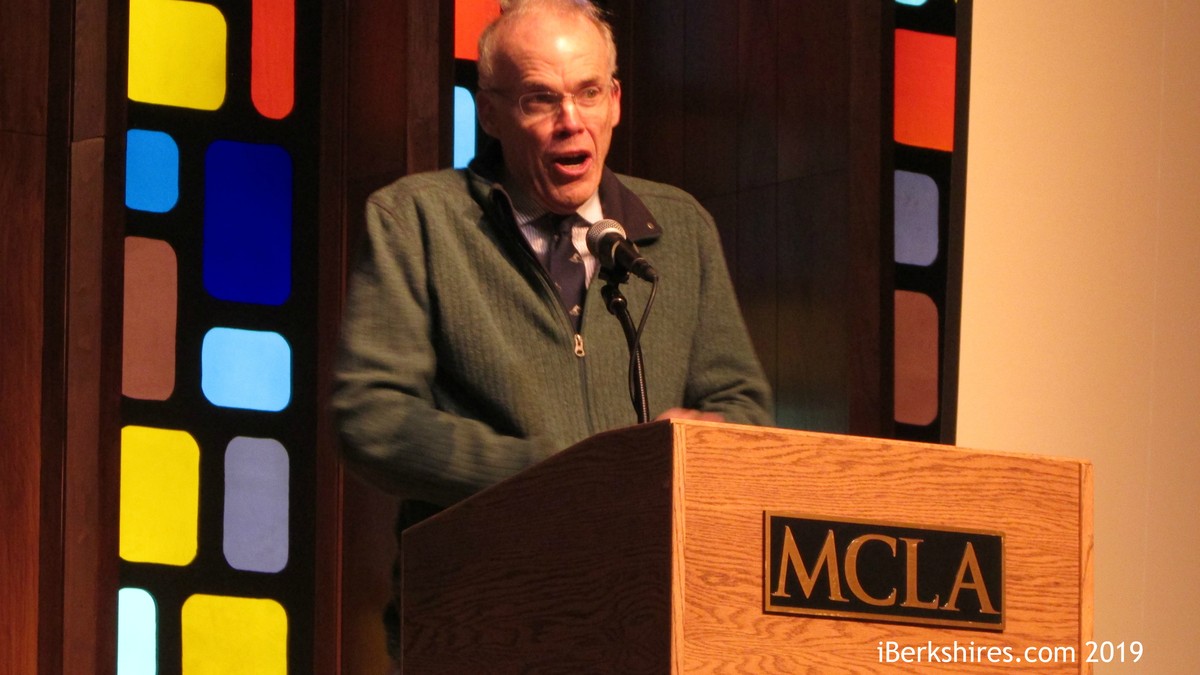
Bill McKibben delivers the Vadnais Environmental Issues lecture at MCLA on Thursday evening.
And he had a specific call to action for his host and liberal arts college next door.
A movement to push endowments and portfolios to sell off stock in fossil fuel companies passed the $11 trillion mark in November, he said. And presidents of big oil companies earlier this year complained that they cannot expand because no funds would invest in their efforts.
But some institutions still need to get on the divestment bandwagon, he said.
"That’s why we need MCLA to divest from fossil fuels, its foundation," he said to applause. "And I know enough about the comparative economics of colleges in this part of the world to say that what goes for MCLA goes about 100 times for Williams College.
"It’s not OK in 2019 to be trying to make money off the destruction of the planet."
Tags: climate change, lecture, MCLA,