Medicare For All Bill Slowly Building Support in Massachusetts
PITTSFIELD, Mass. — There's a group working hard to make Massachusetts the Saskatchewan of the United States.
State Rep. Lindsay Sabadosa, 1st Hampshire District, sees the potential for the Bay State to follow the Canadian province's groundbreaking example in 1962 of being the first to provide single-payer health care to its citizens.
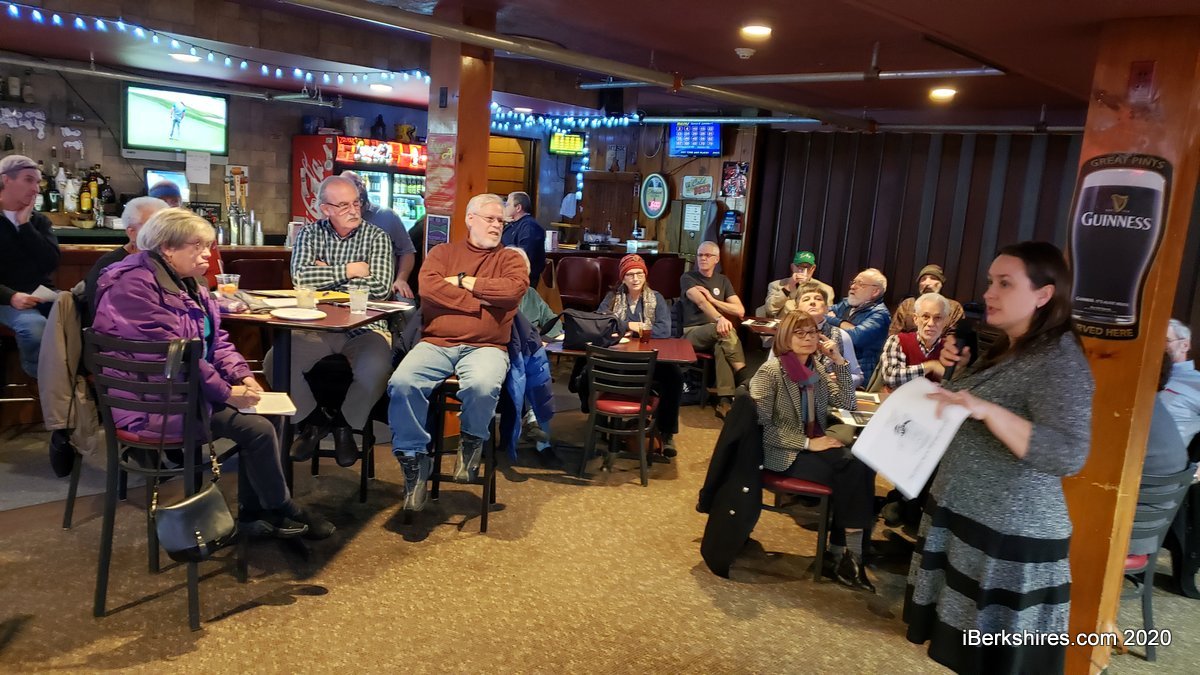
"Health-care costs are rising by 3 percent every year ... we know we're in an untenable situation where health care costs keep rising, where people are paying more and more every year," she told more than three dozen people gathered at the Tavern on the A on Thursday night. "We need to really come up with something bold and dramatic that isn't based on corporate insurance."
The Northampton Democrat, joined on Thursday by state Rep. Paul Mark, is now the lead sponsor on a Medicare for All bill that's been bouncing around the State House for two decades. And they both see growing support for government-run health care in recent years.
Mark said the idea was once "pegged as being too extreme," and noting that the election of Scott Brown to the Senate was seen as a vote against the federal Affordable Care Act — better known as ObamaCare and based on state's health care reform. But over the past decade, the number of sponsors has increased and the concept of single-payer or Medicare for All has become a talking point in gubernatorial and presidential campaigns. And Sabadosa, who made Medicare for All a key issue in her successful first election in 2018, is now a founding member the Medicare for All Caucus.
Sabadosa says there are a lot of misleading information and unfamiliarity with how a single-payer system would work — that people would lose their doctors or be prevented from getting care.
"It is not a system where we tell you how to get health care," she said. "It is simply a system where we change how we pay for health care."
The bill — House bill 2974 — as it is currently structured would create a health care trust funded by a employer payroll tax of 7.5 percent (the first $30,000 exempted) and an additional .44 percent on organizations with more than 100 employees; an employee payroll tax of 2.5 percent; a 10 percent payroll tax on self-employed (first $30,000 exempt); and 10 percent tax on unearned income above $30,000 (Social Security, SSI, unemployment and pensions exempt). Federal Medicare dollars would also go into the trust.
The trust would be overseen by an executive director and by a board of 23 directors appointed from a broad spectrum of stakeholders including health-care professionals, senior citizens, unions, state officials and one citizen from each of the Governor's Council districts. The organizational chart would have operational divisions with a director for each.
All Massachusetts residents would be able to opt in to the trust as would non-state residents who work 20 hours or more per week in Massachusetts and pay state taxes. Non-residents requiring emergency care would also be covered, although the trust would try to recoup expenses.
The lawmakers say Bay Staters are already paying about $5,000 a year now toward health care — and they're paying for the costs of people who can't afford health care through higher premiums and charges at health care facilities.
"Per person, we pay more in taxes for people's health care than any other countries around the world that have access to universal services," Mark said. "We are already paying more, so in theory this would make our taxes go down and we would be paying for fewer people."
Sabadosa said the state would be in a strong position to negotiate with health care facilities and pharmaceutical companies because it would be covering the entire state. She also thought single-payer would provide equity in payments across the board that could help retain doctors in more rural areas.
"We spent a lot of time modeling this, this is not just done as pie in the sky," she said. "We've actually looked at the numbers and said we can afford to cover all of these things under this system."
Still, there are a number of challenges ahead for any attempt at a single-payer for Massachusetts at the state and federal level. Vermont floated an attempt at universal health care but came up short when in the end.
Sabadosa and Mark answered questions about the proposed bill for more than an hour from the largely supportive group and encouraged feedback. Sabadosa said she's been holding public information sessions because it was important to hear from a variety of people and perspectives.
"We're trying to make sure we're not just telling people what they want to hear, we're not just telling people this is how it should work," Mark said. "We're trying to find out what will work at a state level for the most people possible."
Tags: medicare for all, medicare/medicaid,