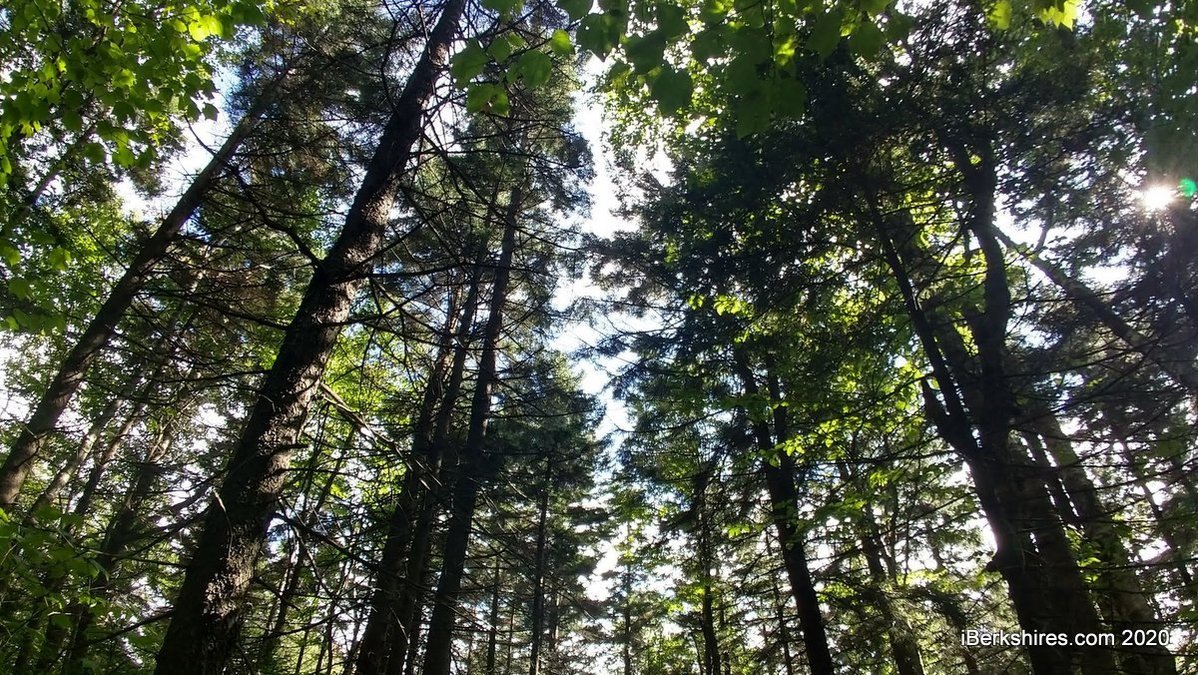
NORTH ADAMS, Mass. — The newly established Mohawk Trail Woodland Partnership's grant program has received $260,000 in funding from the state to support forest stewardship, nature-based tourism and climate education.
The funds were announced last week by Gov. Charlie Baker and will build on the shared stewardship agreement signed last November between the U.S. Department of Agriculture's Forest Service, the 10 of the participating municipalities and the Franklin Regional Council of Governments.
Each community will receive $20,000 toward projects and programming and the FRCOG is getting $60,000 for a regional tourism assessment.
"Improving the stewardship of our forests makes them more resilient to the impacts of climate change, strengthens local economies by encouraging nature-based tourism, and benefits rural communities," Baker said in the announcement. "These grants are a terrific example of the collaborative spirit we've worked to foster here in the commonwealth, and we are proud to partner with these communities to preserve our forests and natural resources for generations to come."
The woodland grant program offers opportunities for communities in the region to realize the objectives of the partnership by providing funding to assist towns in the commonwealth's most rural and forested region to plan for the care of forests in the face of climate change, prepare forest offset projects, and improve nature-based tourism through connected trail networks and educational exhibits.
The Mohawk Trail Woodland Partnership encompasses 361,941 acres of state and private land across 21 communities in the northwestern corner of the state. About 28 percent of that land is permanently protected. The partnership was created to enhance conservation and forest research and provide technical support for businesses that depend on the region's natural resources such as tourism and forestry products.
Of the 21 communities eligible to join the partnership, 14 communities are now members, while seven more will vote on whether to join the partnership in the coming months. The Shared Stewardship Framework provides a critical step in the transition from a locally led vision to a long-term initiative and national model program to conserve and steward the forests, support rural economic development, and strengthen the vitality of these small communities.
It is being seen as both an economic development partnership as well as a tool for conservation and stewardship.
Environmental Affairs Secretary Kathleen Theoharides, who signed the agreement with the Forest Service on behalf of the state and the partnership, said, "healthy, resilient forests are critical ecosystems that help us reduce greenhouse gas emissions and meet our ambitious climate goals."
Earlier in February, Adams and the Mohawk Trail Woodlands Partnership was awarded a $1.5 million action grant to support a regional adaptation climate resilience project through the Municipal Vulnerability Preparedness Program. The grant was part of $11.6 million in grant funding to more than 80 communities across the commonwealth to identify climate hazards, develop strategies to improve resilience, and implement priority actions to adapt to climate change.
"The investment awarded to towns in my district through this grant program is a great step forward in showcasing the natural beauty of Western Mass, while providing opportunities for economic development through promoting and conserving our natural resources," said state Sen. Adam Hinds of Pittsfield. "It remains important for the communities to come together to define an agreed path forward for the partnership and I look forward to engagement on this."
State Rep. John Barrett III thanked the administration for the awarding the environmental grants to communities in the First Berkshire.
"These grant funds will benefit the nature-based economy of the region, as well as address the critical climate change issues we are facing in Northern Berkshire," he said.
Receiving funding are:
Adams
To promote environmental education and natural resource-based tourism by expanding the partnership among the town, MassAudubon, the Massachusetts College of Liberal Arts and Williams College to design the exhibit space for the Greylock Glen Education Center to focus on forests and climate change.
Ashfield
The project will design and build a 1.5-mile Sanderson Elementary School Loop Trail from the school through a diverse, town forest and include educational kiosks and brochures for school children, town residents and the visiting public.
Conway
Forest stewardship plans that will include an inventory, assessment and plan for two town forests, including education of and collaboration with residents in regard to forest stewardship, which is especially important as forests face the impacts of climate change.
Heath
Design and construction of the Catamount Trail development on Burnt Hill that will include a new trail and picnic area connecting the 350-acre town forest to the 1,300-acre state forest to the benefit of both town residents and visitors. The project will benefit from many hours of local volunteers and produce forest stewardship educational kiosks.
New Ashford
Complete forest stewardship plans for town forests and focus trail repair work on important trails for access by hikers, snowmobilers and hunters.
North Adams
A city trail mapping project will compile a comprehensive map of all the trails on various ownerships in the city and produce and market the trail map to connect both tourists and residents with the outdoors.
Peru
A project to improve access to hiking trails and attractions will rehabilitate a section of Curtin Road and install wayfinding signage from Route 143 so the public can access Peru State Forest and hiking trails to Garnet Peak and a cultural site.
Rowe
Outreach and stewardship plan for the town forest that will gather input from meetings and a survey about the management of the 1,408-acre town park and forest and complete an assessment and plan for the property that will improve the climate resilience of the forest.
Shelburne
The Mahican-Mohawk Trail Village project will design and construct a trail from Shelburne Falls village to this 100-mile regional trail along the Deerfield River that will connect the Connecticut River to the Hudson River and include trail signage and kiosks.
Williamstown
A forest assessment project will complete an inventory and assessment of 1,800 acres of town forestland in several separate parcels for carbon offset and include public outreach with the community to agree on next steps for this project.
Franklin Regional Council of Governments
The regional tourism assessment will inventory and map the nature-based tourism infrastructure in the 21-town MTWP region (outdoor recreation trails and sites, information centers, parking areas, etc.) and prepare recommendations for tourism infrastructure that is needed to expand regional nature-based tourism.
If you would like to contribute information on this article, contact us at info@iberkshires.com.
Your Comments
iBerkshires.com welcomes critical, respectful dialogue. Name-calling, personal attacks, libel, slander or foul language is not allowed. All comments are reviewed before posting and will be deleted or edited as necessary.
No Comments
Cheshire Debates Transfer Station Blue-Bag Abundance
By Breanna SteeleiBerkshires Staff
CHESHIRE, Mass. — The town is trying to remedy the transfer stations pay-as-you-throw model as the trash tonnage per permit is significantly higher than what it is supposed to be because of an abundance of blue bags last purchased in 2021.
Resident Mary Ellen Baker brought up at a prior meeting that she saw on Facebook that the transfer station will be requiring extra stickers for the 33-gallon blue bags starting July 1.
The town had switched from color-coded bags to stickers four or five years ago; one sticker was good for an 11-gallon bag and three trash tags for 33-gallon bags. But the blue bags were still being accepted as one trash tag.
"We paid for those blue bags in good faith, and it seems that those of us who do more composting, recycling, reusing are being penalized, because we don't bring as much down as those who used them up faster. So I really would like you to reconsider that," she said.
The board noted that it was not aware of the decision and brought it forth at their April 7 meeting.
At that meeting, Department of Public Works Director Corey McGrath gave the board comparable numbers from other towns based on their permits and tonnage reported in January from Casella Waste Management.
He said Adams has 500 permit holders and reported 13.12 tons of solid waste. Dalton has 600 permits and 22.8 tons, and Williamstown had 1,043 permits and reported 15 tons, noting it is a very strict pay-as-you-throw community.
He said Cheshire has 600 permits and reported 36.10 tons.
After compiling a list of permit holders, he found 39 percent of residents did not purchase tags with their permits because they had leftover tags from last year or blue bags. He was unsure how many blue bags there could be left over. The first three days of April, he counted how many blue bags were tossed.
"That's a total of 63 blue bags, which is also a total of 187 allowable 11-gallon trash bags. Right? You're allowed to put 33-gallon blue bag, that's three 11 [gallon] kitchen bags. So that's the allowable. So it's 187 kitchen bags on a blue bag that was included with a permit. So, our numbers are absolutely horrible, and we've adopted the pay-as-you-throw but we don't abide by it," he said.
Northern Berkshire Solid Waste Program Director Linda Cernik was able to give the history of the blue bags that stopped being sold in 2021.
"You started your pay-as-you-throw program in 1990, $80 per for the permit, 52 free bags, and it was still going on in 2006 so you've never stopped getting free bags. So you have multitudes of free bags out there," she said.
While the bags were not "free" they were discounted and residents have been getting bags for years, most recently through a package deal.
"It was cheaper if you bought it as a package. It was essentially a 50 percent discount. If you think about it, it's an incentive to buy it as a package. If you were a family, we would see it all the time. If you're a family that knew that you were going to go through more than 52 bags a year, or the equivalent bag tag amount, they would just buy it in one fell swoop and that was an additional $100," said Board of Health Chair Christopher Garner.
"So we would do the permit is $100, $150 for the permit and the year's worth of bags or tags. And if you needed more, you could buy them at that time or anytime in the future you could come down and spend another $100 and buy an additional year's worth of bags or now tags."
He also said since they never put an expiration date on the bags, they are just going to have to try and deal with that.
Some board members were shocked by the amount of blue bags still out in the community.
"I was always under the assumption that if you buy your sticker, you get 52 bags, one per week. That's what you're allowed. That's what we allow. How we've allowed it to get to this point is insane," said board member Raymond Killeen. "We haven't given out bags since 2021 and I understand there's a chance where you could have a few bags left over and carry them over, but we have gone so far where we still got the blue bags going on."
Cernik also finds it hard to believe there are that many blue bags out there, but that people need to be more educated on diverting their waste into the many different programs at the transfer station.
It's suggested some are abusing the blue bags and stuffing them as much as they can in them.
Baker said she is worried about being penalized because she does recycle, donate, and compost, using not that many blue bags.
"You're a very rare case. Mary Ellen, I had somebody say to me, I have yellow stickers. And when I have my kitchen bag, I put one sticker on it, I take it down. But if I have five or six of them, I throw them in a blue bag," said Town Administrator Jennifer Morse. "People are jamming those blue bags, and they're abusing the system. And unfortunately, not everyone is doing what you guys are doing."
Cernik said the station is losing grant money because of the program is not really a pay-as-you-throw anymore. Based on a point system the station gets when applying for grants, the transfer station only receives around $3,000, when it could have gotten around double.
It was also suggested some of the employees let people throw bags without a sticker on them.
"Obviously there's still certain people that work there that enforce things that others don't, and that's an internal issue. But you know, aside from that, and we obviously have to do a better job. So with a deficit of $61,000.15, 100 households, that's $41 per household," said board member Michelle Francesconi, noting Cernik said it will go up next year. "So even a household that doesn't have anything to do with the transfer station, which is 900 households, and 900 households are paying $41 per household for trash to be discarded that they don't have anything to do with."
The board members debated on how they should go about the change, whether to do an exchange program for the bags, have a set date where the bags are no longer allowed, and what costs they should set for permits, tags, and stickers.
It was repeatedly mentioned that people accurately reduce waste and increase recycling to save money.
"We have to get a handle on this, because in five years, I'm gonna be retired, but you guys are going to be paying, I don't even know … it's gonna be out of control. You won't be able to afford it," said Cernik. "I'm serious, it's $130 now we have a five- to three-year contract, and then you have to go up two years, and we'll renegotiate, and it's going to go up because the trucking, everything has to go to another state, because we don't have vehicles."
The board tabled the discussion to get more numbers on how much it waste disposal could cost and how much they should be pricing the permits, and how many tags must be on a 33-gallon bag as currently it is two (although the change in 2021 stated three).
The town is trying to remedy the transfer stations pay-as-you-throw model as the trash tonnage per permit is significantly higher than what it is supposed to be because of an abundance of blue bags last purchased in 2021. click for more
Like many public safety organizations in the Berkshires, the Adams Fire District is looking for ways to address its building's deteriorating condition.
click for more
The building is a total loss but firefighters were able to prevent the flames from reaching another nearby barn and the house at Stoney Brook Farm. click for more
The town is preparing to submit an application for Community Block Grant Funds following the designation of its blighted area on Route 8. click for more
The Board of Selectmen last week approved the closures of the street between Pleasant and Dean Streets from Wednesday through Saturday, April 1 to 4, to allow for the Crewdson's production company to set up for his complex and intricate shots. click for more