Williamstown Planners Recommend Outdoor Pot Bylaw
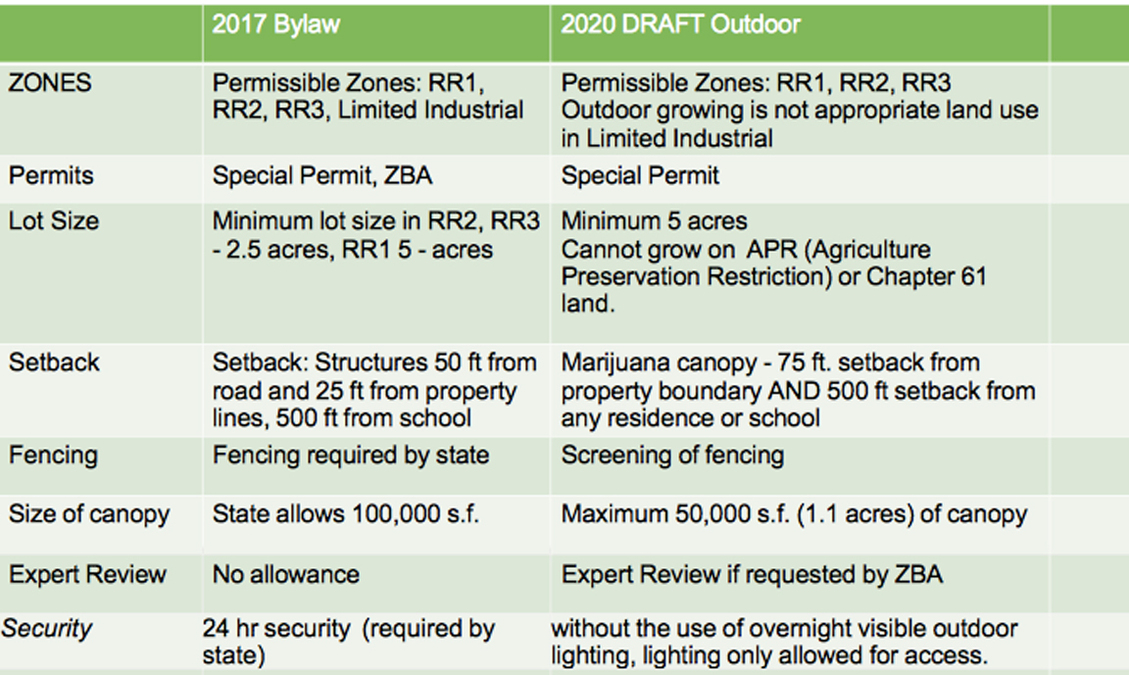
A chart prepared by Chair Stephanie Boyd compares the current 'state of play' under a 2017 zoning bylaw and the rules that would be in effect if August's town meeting passes a bylaw on the warrant via citizens petition.
Although the board itself has a draft bylaw amendment on the annual town meeting warrant that prohibits outdoor production for commercial purposes, the panel by a vote of 3-2 recommended passage of a bylaw on the warrant via citizens petition.
And although the vote was just 3-2 to recommend the citizens petition, the discussion among the planners indicated that some of the objection was due to technical deficiencies in the citizens petition draft that makes it incongruous with the regulations on indoor pot production, testing and manufacture of marijuana products in the Planning Board's own bylaw.
Subsequent to the split decision on recommending residents OK outdoor pot growth, the planners voted 5-0 to include in their report to town meeting a recommendation that the citizens petition drafted by the town's Agricultural Commission be amended on the floor of the meeting to bring it in line with the indoor regs.
The majority of the board seemed persuaded by testimony from members of the Ag Commission and their allies during nearly two hours of a public hearing that led up to the votes.
Although the board heard from both proponents and opponents of outdoor production during the hearing, it was clear that the winning argument came from the farmers: Marijuana is a legal cash crop that can potentially make their operations more economically viable.
Many of the opponents who testified in Wednesday night's virtual hearing were familiar voices at town hall over the last two years. They successfully beat back an effort from a Colorado-based company to build a new indoor/outdoor pot growing complex on Blair Road in 2019. This year, many of those same residents from the Blair Road area convinced the Planning Board to draft a bylaw that allowed only indoor production with strict air filtration controls to prevent smells that are nuisances and, some studies say, unhealthy.
Before voting in favor of the citizens petition, Planning Board Chair Stephanie Boyd explained her reason for advising the town take a step the board was not willing to take in March.
"Unfortunately, the whole year, we never had anyone speak in favor of outdoor growing," Boyd said. "That influenced where I was. Given the way our community was, it seemed indoor was the more acceptable way to go. I strongly believe we're a farming community, and it's been great to have the farmers come and speak to us at this meeting and other meetings. … That [argument] speaks to me.
"If growing marijuana or hosting a wedding helps a grower grow food, we should support them in that."
Earlier in the hearing, the Planning Board unanimously recommended town meeting adopt a separate bylaw amendment drafted by the Ag Commission which increases the number of permissible on-farm events (weddings, parties, etc.) from six per year to 10 per year.
Boyd was joined in voting yes by Chris Winters and Peter Beck.
Dante Birch and Susan Puddester both voted against recommending passage of the citizen's petition, though the reason they emphasized was that the citizens petition draft lacked some of the language regulating indoor marijuana operations.
The inconsistency was noted late in the hearing by Anne Hogeland, who suggested that the Ag Commission did not mean to leave out that language but had simply "copied and pasted" language from an earlier version of the Planning Board's draft bylaw.
Hogeland argued that the omission made the citizens petition "not ready for prime time" and showed why bylaw amendments should be drafted by the board itself.
Birch seemed to agree, arguing that the solution would be for town meeting to take no action on the citizens petition — rather than rejecting it, which would mean the same issue could not come back for two years — and allow the Planning Board to come back with its own outdoor growing bylaw, either in a special town meeting or the 2021 annual town meeting.
"Who doesn't want to support local farmers?" Birch said. "I want to do that. I don't feel like this, as it stands, I can support. It hasn't gone through the proper channels, in my mind.
"I think we can continue to refine it, the outdoor portion. I don't see how we can support the citizens petition. It worries me making bylaws on the floor of town meeting. I don't think that's the best place to do it. I think it would make sense to recommend [town meeting members] do not vote on this but table it so we can work on it next year."
Boyd and Best argued that the Planning Board should make an advisory vote that said the board "recommends the passage of the article with amendments," or words to that effect. But Winters and Birch both argued that a "clean" up or down vote was preferable.
After twice hearing from Town Planner Andrew Groff that there was nothing to prevent the board from including additional language in its report to town meeting, the board went forward with the second vote to recommend an amendment to the citizens petition. Winters noted that, ideally, the original drafters of the amendment will be the ones to propose the amendment on the floor of town meeting since the board — and Hogeland — said the missing language on indoor facilities was an unintentional oversight.
As for the substance of the citizens petition, the lengthy testimony on Wednesday reiterated many of the arguments the Planning Board — and before it, the Zoning Board — heard in the past about the potential negative impact on residents from having outdoor marijuana production next door to their homes.
Proponents of the the citizens petition did not contest the point that pot plants can be malodorous but they argued that the potential impact was being overstated and the setbacks in the bill — at least 500 feet from the marijuana canopy to any residence not owned by the grower — was sufficient protection.
Advocates for outdoor growth said that the period when marijuana plants give off offensive odors is brief, that conifers produce more of the odor-causing chemicals known as terpenes and that all farming activity causes the occasional unpleasant smell.
"Talk to Jay Galusha about how many complaints he gets about spreading manure," said Averill Cook, a member of the Ag Commission. "It is horrific. I get screams. But it goes away."
All zoning bylaw amendments need a two-thirds majority vote for passage at town meeting.
If the citizens petition-generated warrant article allowing outdoor pot production passes, growers would need a special permit from the Zoning Board of Appeals in addition to a license from the state in order to grow commercially.
Tags: agriculture, marijuana, Planning Board,