image description

Clarksburg Boards Discuss School Renovation Needs

By Brian RhodesiBerkshires Staff
Print Story | Email Story

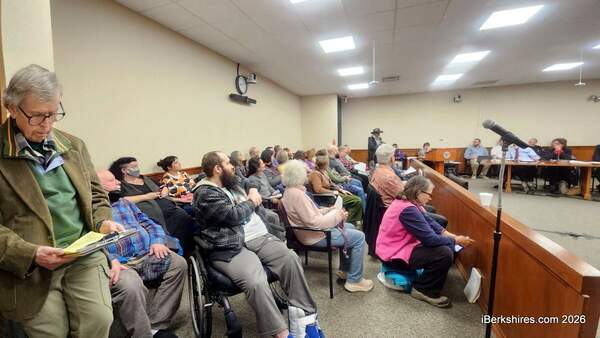
CLARKSBURG, Mass. — In a joint meeting with the Select Board and the Americans with Disabilities Act Commission, the School Committee discussed building renovation needs. 


The most significant upcoming renovation is the installation of a chair lift, for ADA compliance. The lift will allow access from the main floor to the lower level of the split-level school, including the cafeteria, gymnasium and playground. 


"We haven't sat down all together. So, before we go and spend this money, let's make sure we're all in agreement and it sounds like we all are, so that's great," said Superintendent John Franzoni. "Thank you very much, because that was a big problem for the school." 


Town Administrator Carl McKinney said there is already funding available, via American Rescue Plan Act funds, to almost entirely pay for the lift project. He said he is working on a draft request for proposals and will do whatever is needed to work around summer programs. 


"The company that does make [the lift] will install it. And they would like to come and see it, but ultimately, I need to know what your time window is going to be," he said. The project, he explained, is expected to cost about $110,000. "Financially, we're good with that. We're using ARPA funds for the fact that the money's in the bank, we already have it. So if you have the time, we got the money." 


McKinney also suggested possibly putting solar panels on the roof of the school. He said the payments from a lease for the roof space could help finance a more significant roof renovation. 


"We do understand it's rather vital," McKinney said of the school's roof. "If we were to do a request for proposals to lease the space on the roof for a solar panel company, you're looking probably about a quarter to a third of an acre of land on the roof and get a 20-year lease agreement where the lease payments would pay for the roof." 


The group also discussed the end-of-year report required by the state Department of Elementary and Secondary Education. Franzoni said communication has been better recently. 


"I think the fact that we're talking face to face, and we're talking on the phone, that's the only way this is gonna get solved and move forward so that we can get all the funding that we need for our school and get all the grants everything else that we need to keep the school going," he said. "We need to do that, we need to work together. Otherwise, it's not going to work."  


Newly installed committee member Mary Giron said creating a schedule of important events would be helpful for communication between the school and the town. 


"If we had a schedule, I would think that everyone would know the schedule. The Select Board would know the schedule, the School Committee would know the schedule," she said. "... We can check in to make sure things are being followed, and we would just have a clear approach for all of us. And I think it would be helpful." 


In other business: 


• Giron was recognized as the committee's newest member after her appointment at the last meeting. 


Giron is the third member on the board, replacing former member Eric Denette, who stepped down recently after moving out of Clarksburg. Denette had declined to run for a second term last spring but accepted after winning through write-in votes.


Tags: Clarksburg School,   

If you would like to contribute information on this article, contact us at info@iberkshires.com.

McCann Making Progress Toward MCAS Targets

By Jack GuerinoiBerkshires Staff

NORTH ADAMS, Mass. — McCann Tech Principal Justin Kratz told the Northern Berkshire Vocational Regional School District School Committee last week that because the school is making substantial progress toward its 2026 MCAS targets, there will be no Massachusetts Department of Elementary and Secondary Education (DESE) intervention.

"So long story short, we are not on DESE's radar for MCAS performance," he said. "At the end of the day, that is what is what we are after."

Kratz said McCann scored "a ton" of points, showing growth in most categories. He said they earned 75 percent of total possible points for all students and 83 percent of all possible points for lowest-performing students.

Kratz noted that DESE tends to change targets and formulas every year. But he drew attention to the year 2025, when a passing MCAS score was no longer a graduation requirement. In 2025, McCann received 33 percent of the possible points and 7 percent for the lowest-performing students. This equaled a score of 20 percent.

"That was the year where everything went off the cliff," he said. "We didn't do very well. This year was 79 percent, and that is knocking it out of the park. ... If we followed up with another 20, we would have been in rough water."

Kratz added this drop was typical across the state, saying he assumed students just took the test less seriously. He wanted to demonstrate how the scores and targets are "reshuffled" and gave a closer look at English scores over the years.

In 2024, the school had a target of 499.3 (average scaled score). The school scored 500.4. In 2025, McCann's new target was 502.5, but McCann scored 485.6. McCann's 2026 target was 487.7, and they scored 486.8.

Kratz said McCann is not scoring as high as they were in 2024, but they are getting more points. He said sometimes the scores needed to be taken with a "grain of salt."

He underlined that although MCAS is important in a vocational education, it only represents half of what a student does in a given school year. 

"There is no MCAS for 50 percent of their time here, which is their trade area," Kratz said. "They [DESE] don't assess that ... so this one little pocket is important, but it doesn't show the entire picture of a student."

Kratz moved from what he called the "good" section of his presentation to the "awesome." He said McCann was recognized as one of 55 schools that drastically improved chronic absenteeism by at least 5 percentage points. He said the school received a letter from DESE congratulating them that included a survey that asked how the school did it.

"It was a nice letter, but we kind of laughed and asked, 'What did we do?' " he said. "I say that sort of tongue-in-cheek because we didn't do any sort of targeted attendance improvement initiative."

He said the more he thought about it, the more he attributed the change to standardized grading and improving the school environment physically and culturally.  

"We didn't do all that wanting to improve attendance. We did it because we wanted to create more equity, and ... I think that is a byproduct of that," Kratz said. "Kids are more likely to want to go to school if that 62 they got on a test does not bury them for the rest of the year. They know they can dig their way out of it. And they are more likely to go to school if the building is a little brighter when they walk in in the morning."

Also, the importance of attendance is baked into the vocational school experience.

View Full Story

More North Adams Stories