PIttsfield School Committee Endorses 'Aggressive' Timeline to Decide on Middle School Configuration
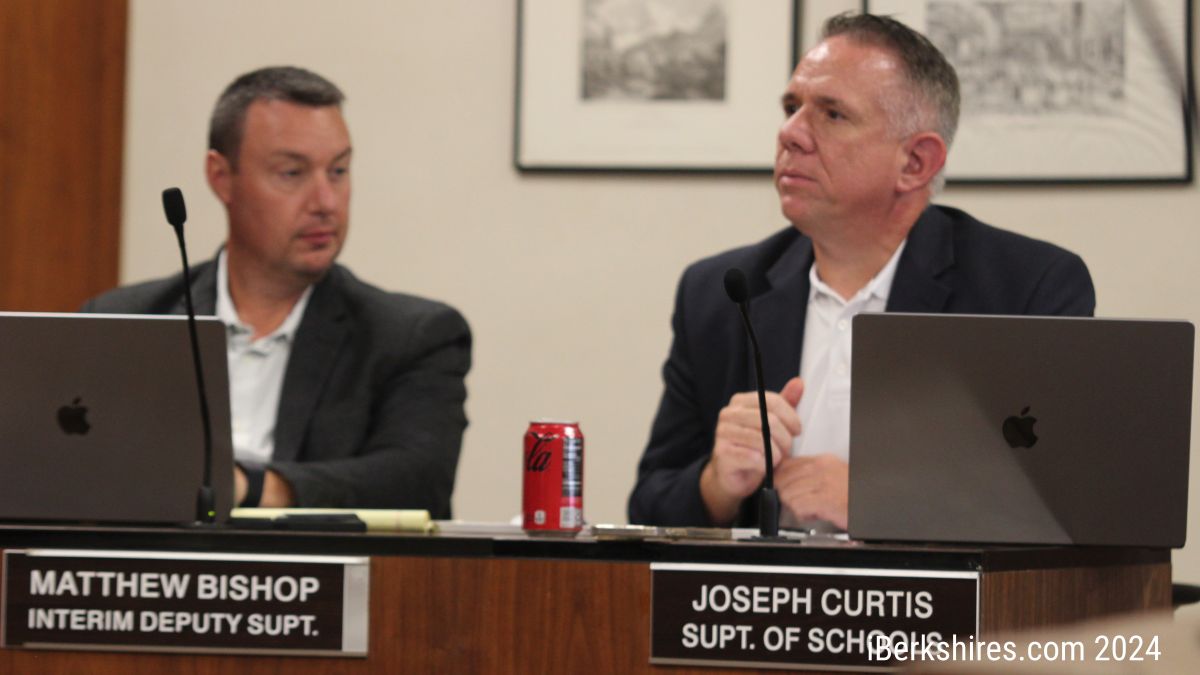
Superintendent of School Joseph Curtis addresses the School Committee on Wednesday night in City Council chambers.
On a vote of 6-0 with one member, Diana Belair, absent, the committee accepted the proposal of Superintendent Joseph Curtis that would see a Middle School Restructuring Committee organized later this month.
That committee would continue studying possible grade configurations, assess data on student performance and gather feedback from stakeholder groups before presenting a final recommendation on reconfiguration to the School Committee in January 2025.
If all goes according to plan, the School Committee would make its final decisions on grade spans and the educational models for the, potentially, newly configured schools in February. The administration would work out an implementation plan in March.
Before voting to agree to the timeline, School Committee members agreed with Curtis that the plan was "vigorous" and that action was sorely needed to find solutions to long-term concerns about the current middle school structure.
"I think it's brave and appropriate that we are taking on the issues around middle school," Sara Hathaway said. "This isn't something that has suddenly exploded into a problem. Middle schools around the country have this issue."
And, Hathaway said, she has seen that issue hit very close to home.
"When I served on this committee a little over 20 years ago, I remember Dr. [William] Travis saying, 'We lose [students] in middle school,' " Hathaway said.
Vice Chair Daniel Elias said that last year he visited the city's middle school classrooms at the beginning of the school year and found teachers who were upbeat and optimistic.
"I was able to go back at the end of the year, and they were, for the most part, mentally defeated," Elias said. "I thought the school leadership did a good job, and the staff, despite being defeated, felt the leadership did a good job.
"That left me with the thought that it is an unattainable goal in the current configuration. We have to do something, because what we're doing now is not working. I've gotten a lot of feedback from a lot of people. They were just relieved that we were finally taking this on."
Curtis' presentation on Wednesday walked the committee through a couple of different potential paths — from maintaining the status quo (prekindergarten through Grade 5 elementary schools, 6-8 middle schools and high school) to a five-school model with students split by PK-1, Grades 2-4, Grades 5-6, Grades 7-8 and high school.
He stressed that none of the configurations he showed the committee were his recommendation. That recommendation will come from the Middle School Restructuring Committee that the elected officials on Wednesday authorized the superintendent to create.
Curtis said that, ideally, he would like to see the committee include about 25 members who would do much of the work in smaller working groups.
Given the compressed time schedule, Curtis will be asking for a major time commitment, with the MSRC meeting, initially, at least twice a month.
"I'm envisioning … once a month will not be enough to make this decision," Curtis said. "We'd start to meet right in September. I'd predict we'd meet at least every other week. That may be accelerated toward the end."
Curtis said he will create an invitation that will be well publicized to seek volunteers to serve on the comittee. His hope is that it will include: parents, guardians and caregivers; school staff and leaders; central office officials; elected officials; and union representatives. In answer to a question from School Committee member William Garrity, Curtis said the committee could include high school students who have the recent lived experience of the city's current middle schools; either way, he said he envisions focus groups to gather feedback from current students in the city's system.
"We'd invite roughly 30 people to participate, making sure we have representation from the groups I've outlined," Curtis said. "For example, we wouldn't have 30 staff members and no families. I would hope to have even participation from the groups I've mentioned."
The School Committee members were enthusiastic in their endorsement of Curtis' proposed timeline for taking action.
Elias noted that Curtis' presentation included a mention that six Massachusetts school districts already have gone to a grade 5 and 6 configuration for their middle school; regionally, that group includes Westfield, which operates Westfield Intermediate School. He suggested that the MSRC could benefit from the lessons learned in other districts.
"Most people are content and happy with the job we do at the elementary level," Elias said. "We see now at the high school level, some kids do come back. But we're losing them at the middle school. It's well past the point of having to do something."
"You're right," Cameron told Curtis, "this is an aggressive timeline. But it's been a problem for years, and I'm glad we're finally dealing with it."
Tags: grade reconfiguration, Pittsfield Public Schools,