Dalton Zoning Officer, Board in Stalement Over Dig Site
DALTON, Mass.— The Select Board still wants Berkshire Concrete's unauthorized dig site fully mitigated, but are at a standstill due to concerns from the town's building commissioner and zoning enforcement officer.
For nearly nine months, residents have attended numerous meetings urging action to prevent sand from leaving property, owned by Berkshire Concrete, a subsidiary of Petricca Industries.
In drone photos, taken by a member of the Clean Air Coalition, a group established to provide updates on the situation, it can be seen that part of the area had been mitigated.
A newsletter from the coalition claimed that the section of the parcel was left untouched because Berkshire Concrete plans to apply for a special permit to continue excavating on lot 105-16, located toward the backside of Raymond Drive.
Berkshire Concrete mitigated part of the parcel by putting down erosion control fabric and hydroseeding. However, part of it is still exposed.
The board wrote a letter to Brian Duval, the zoning enforcement officer, during its meeting in early July, requesting his office direct Berkshire Concrete to loam and hydroseed all previously mined areas, as mandated in the town's bylaws.
During the meeting, Duval raised concerns about the sections cited in the letter drafted by town counsel during a Zoom meeting with Pagliarulo and Henry "Terry" Williams III, interim town manager. However, he agreed to meet with the town's lawyer to discuss the matter.
Now that he has met with the town attorney, his opinion remains unchanged.
"After confirming with the town's legal counsel, it's been decided that this course of action would not be appropriate. Therefore, respectfully, this office will not be taking action on this matter at this time," he wrote to the board in a letter read aloud during Monday night's Select Board meeting.
Duval was not present during the meeting on Monday but the letter was read by board Chair Robert Bishop, who characterized it as "upsetting."
"If you are aggravated by my determination, you may appeal it to the zoning board of appeals as stated in section 350-18 such appeal must be exercised within 30 days of this receipt," Duval wrote.
"We should appeal this," Bishop said, highlighting his experience on the Conservation Commission. If someone was doing something illegally, the bylaws get enforced.
"What we do is usually condition them to fix it, not just let it sit there, 'cuz the worst thing you can do is let it sit there. So, we do have something else going on right now, but we can't speak to that," Bishop said.
Select Board member Antonio "Tony" Pagliarulo, who is also the chair of the Clean Air Committee, motioned to have Duval provide a list of reasons not to enforce Berkshire Concrete, as stipulated in the previous letter. This was subsequently approved.
"He's provided no reasons why he doesn't choose to enforce and the bylaw, as I read it, indicates that you have to provide reasons. So, I don't see any reasons there," Pagliarulo said.
In a follow-up with iBerkshires, Duval explained that he drafted a letter to the Select Board detailing his reasoning for declining the board's request.
The letter will likely be read during the next Select Board meeting, he said.
"Basically I felt that the sections they had cited in the Zoning Bylaw were not applicable for this situation. After speaking to town council it was decided the best course of action was to have the Board of Health continue with their enforcement order," Duval said.
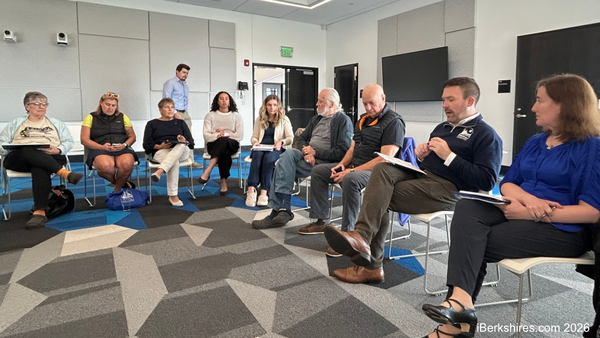
An ad hoc Clean Air Committee (established by the town and not to be confused with the neighborhood coalition) has met twice to review Berkshire Concrete's special permit and ensure compliance.
The committee meets the second, and fourth Thursday of each month at 3:30 p.m. in the Callahan Room of Town Hall.
The town has contracted Berkshire Environmental Consultants Inc. to conduct an independent assessment of the Berkshire Concrete's mitigation efforts.
During a site visit, there was a side conversation with its chief operating officer, where it was indicated that they believed the original special permit dating back to the 1990s is the only document that is legally enforceable, Williams said.
The town is waiting on the town attorney to review that.
The committee is also investigating whether asphalt, concrete, and brick is classified as recyclable or solid waste because of how it is regulated by the town's bylaws.
The state Department of Environmental Protection review Berkshire Concrete's material and found it to be "coated and clean," Williams said.
The department requires that no piece of ABC be larger than six inches. Berkshire Concrete's material is being processed down to a smaller size, he said.
However, there is a question as to whether Berkshire Concrete has a permit with the town for a ABC processing, which must go through the planning board, Pagliarulo said.
"My discussion with [Janko Tomasic] is he's not aware of any permit and that permitting has to go through the planning board. So there's another issue," he said.
The committee has also been considering the use of air monitoring to document dust blowing from Berkshire Concrete to residential properties. However, the data will not be definitive in demonstrating the particles are coming from Berkshire Concrete's property, Pagliarulo said.
Pagliarulo emphasized the need for logging complaints to build a paper trail for enforcement.
"Basically our committee is focused on having BCC mitigate the entire property and our house is divided here because we have an agent who works for the select board, but as our attorney has pointed out, he has discretionary powers and the prerogative not to enforce. So we're at a quandary. That's a real issue," he said.
Tags: dust, debris,