BRTA Board Balks at Route Changes, Asks for Re-Evaluation
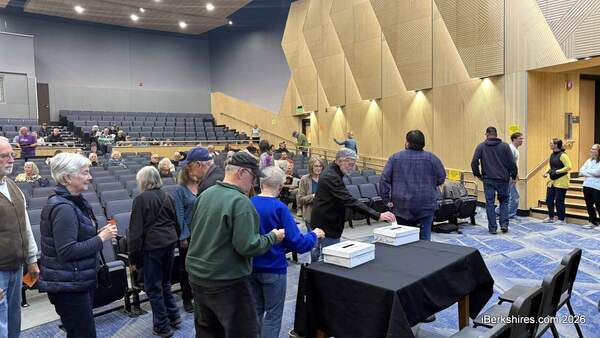
PITTSFIELD, Mass. — The Berkshire Regional Transit Authority Advisory Board Wednesday tabled a vote on the proposed route realignment.
BRTA currently operates 36 weekday runs with 26 available drivers, leaving 10-13 open runs available for coverage each day. The proposed plan reduces weekday service to 30 runs between the 26 drivers, reducing open runs available for coverage to about five per day.
Service change proposals:
-
Elimination of Routes 1A, 2A, 21A, and 921.
-
Evening service reductions on select routes, using data-driven decisions, where ridership declines.
-
Elimination of Route 14, now serviced as an extension of Route 12 to 8:55 PM.
-
Route 21(B) operates as an all-day South County Loop with extended evening service.
-
Route 34 added to end of Route 3
-
New route, Route 999, would go through Pittsfield, North Adams, and Great Barrington and operate the Pittsfield Walmart Express (Route 912) a couple of times a day to serve high-demand places. Designed to replace the 1A and 2A trips and have limited stops.
The most up to date route realignment proposal can be found here.
"I just want to start off by saying that, you know, this is not something that we look at as a permanent solution, rather than this is something that we can work with for the time being, until we get to something a little bit more permanent that makes any sense. I just don't want anybody to think that this is our final solution to our issue here," said Deputy Administrator Ben Hansen.
Member Sarah Fontaine asked how many drivers they need to get to for the routes to be what they are currently.
Administrator Kathleen Lambert said there is currently 26 drivers and one who will retire next month. She said they are hoping to hire 10 to have extras to fill in when people are sick.
"We have a strategy for redeployments. So when we get more drivers, the first thing we're going to do is add that extra bus to the 999, to support that whole county ride. The next we're going to do is we're going to add drivers to the end schedule to the 34, 12, and 21 and, depending on how we can work out with the union, try to get the regular people with regular licenses trained in house, operating a vehicle and then working on their CDL so they can learn and earn at the same time," Lambert said.
It was also brought up that Berkshire Community College will be offering CDL [commercial drivers license] classes and Lambert said BCC agreed to locate its new bus-driving simulator at the BRTA facility. At least on of BRTA's trainers will be there to support the Passenger Endorsement training.
"We think that the simulator is going to generate and support itself eventually, because we can have students coming from New York and Connecticut and Vermont coming in to train in that center, which is simulated there." said Lambert. "It's a no-brainer, and we'll always have access to it, so that'll be great."
Fontaine said this new proposal seems to be a lesser of all evils.
"Nobody here wants to reduce bus service. I think that's pretty obvious. None of us want to do in the face of what the reality is. It sounds like it might be better off to have a. Reliable service every two hours, rather than an unreliable service that is still every two hours, that's what I'm assuming," Fontaine said.
Lambert said what they are going for is reliability and safety. Chair Douglas McNally also added that the unreliable service does not have the mitigation of Route 999 as an option.
Lambert also said she does not want anyone stranded and that by having a route without cancellations, no one will be, and those who are still on the bus at the end of the day will be dropped off at the Intermodal Transportation Center (ITC).
Member Rene Wood said she was worried about the people who will be left at the ITC.
"I don't live in Pittsfield, but I am concerned that we're kind of thinking that somehow people who get back to ITC, which is a good place to get back to, are somehow going to be able to afford a taxi or Uber, or somehow to get home every day or every time that they come back. I'm going to pick on a BCC student. I don't know if there is an agreement with a taxi firm to be here at that time to kind of support people who may need that type of thing, or really, if, in fact, they're going to end up, they're here, but they're dumped," she said.
Mayor Peter Marchetti echoed the same concerns.
"While we were sitting here, I went on my Uber app and I have a 12-minute wait for one Uber that is working in the city of Pittsfield right now, at 4:30 in the afternoon, when it's work time. And I'm going to guarantee you at nine o'clock tonight, if I go to here and say, I want to go home. There's no Ubers available. That's a reality, a taxicab, even worse. So I'm a little bit concerned that we're just gonna dumb people in the middle of the city," he said.
It was suggested that anyone still on the bus could be dropped off on the way to the Downing Industrial Park garage or the bus could even take a slight detour for drop offs in Pittsfield.
"We will stay in service as long as we have buses driving back to the garage. I do want to make sure that everyone knows that currently we do do that. We're just doing it from Allendale, which isn't very far, if we do end at ITC, then we can reach out as we get back to Downing, you know, we can drop them off along, you know, Tyler Street, East, what have you I mean, because why not stay in service if we're driving already," Hansen said.
Wood then asked about those who might be going to BCC and live in another town other than Pittsfield.
"I don't think there have been sustained conversations with South County Connector. So we're going to drop people in Pittsfield," she said. "How can we pay you to pick up those people that live in Stockbridge, live in Lenox, live in Lee, all the way down the route, so that these people can continue their education? I mean, that's workforce development. So I have to agree with what the mayor said, I think there's a lot of this that still needs to be resolved."
Marchetti also spoke about the Link 413 service and if it is taking drivers away that they need.
The mayor said he has spoken to other community leaders and has heard negative reactions to the new proposal. There needs to be more discussion with city and town leaders, he said.
"I take the job seriously, and I have to worry about what my counterpart up in North Adams thinks. And I spoke with Mayor [Jennifer] Macksey earlier today, she's not in favor, and it could possibly be because we're talking about reductions, and we don't have the information. So the whole dumping them here at the ITC doesn't work for me, so that's a reason for me to vote no."
Lambert and retired administrator Robert Malnati said they have hosted countless public meetings and have offered to talk to anyone with concerns or they could have called.
"I've offered to anybody who's been on a meeting with us, I will go anywhere, go any place, to try to explain why we're doing this," Lambert said.
Great Barrington Director of Public Transportation Tate Coleman said he has raised a number of concerns and wanted to know more about the data behind the changes and these decisions were collaborated with Town Manager Liz Hartsgrove.
"I'd like to ask whether it may be possible, echoing Mayor Marchetti's comments, to propose an alternate motion that would direct the BRTA administration to re-evaluate, acknowledging that service changes and reductions are necessary, to re-evaluate work with Berkshire Regional Planning Commission more comprehensively before going to public input and show clearly how the changes are based on publicly available data about ridership, cost performance data developed collaboratively with stakeholders, again before the public comment period, in terms of developing that proposal and then coming back to this board within 30 to 60 days," Coleman said.
Lambert said it would be tough to do a re-evaluation as they don't have the money for a study and that this is just to solve an acute problem right now. She did suggest that they applied for a Build Grant from the U.S. Department of Transportation of upwards of $6.1 million for software and money to support new drivers and microtransit, and money to support readjustment and planning.
Coleman reiterated his suggestion saying he is hoping for a redesign of the current proposal not the current system.
He also asked since they are losing a driver, will a new route be proposed again with more loss of drivers to which Lambert said they will not.
McNally said he is worried that if this is pushed any longer, they will become an unreliable service that will lose ridership and reiterated that it is not long term. Lambert said it has caused a loss of ridership of up to 6 percent.
"I'm just worried that if we go into the hurry up and wait two weeks or a month or 60 days down the road, we're going to start being so unreliable were going to start losing ridership," McNally said. "People are going to stop using the bus the third time we get out there. And that's happening on a regular basis now. So this is not going to be the long term solution."
Member Mary Reilly asked what would be a reasonable time after implementing this plan to judge its effects; Lambert said six months.
"We'd be circling back in the fall, and when we get drivers on board and get the workforce stabilized, as we can add service back. We will continue to do that, but it's going to be a good six months before. Remember, it's six weeks to train one person. We need at least five or six to start with, and we're hoping for 10," Lambert said.
Marchetti brought up how Lambert spoke at a Pittsfield City Council meeting but did not extend the same courtesy to North Adams and thinks everyone needs to start working together to have the right information for the county as a whole.
"I'm a no because I don't think we followed a process that was efficient enough to gather information. And if we want countywide efforts, and we want us to be working as a county, whether it's transportation or housing or mental health issues or addiction issues, we have to start working together and not in silos," Mayor Marchetti said.
After some more deliberations Marchetti said there is a Berkshire County Municipal Association meeting with all of the town leaders on Thursday and invited her to speak there. Lambert also said she plans to have a meeting with the South County Connector as well to discuss schedule coordination.
"If we're not ready, I understand, but it's not going to change the situation. So I want everybody to be aware of that," Lambert said.
The board decided to table the vote and come back on March 26 to have more discussions on the route proposal.