MassDEP Talks Pollution Plans for Pontoosuc Lake
LANESBOROUGH, Mass. — The state Department of Environmental Protection has some options for restore a polluted Pontoosuc Lake back to health.
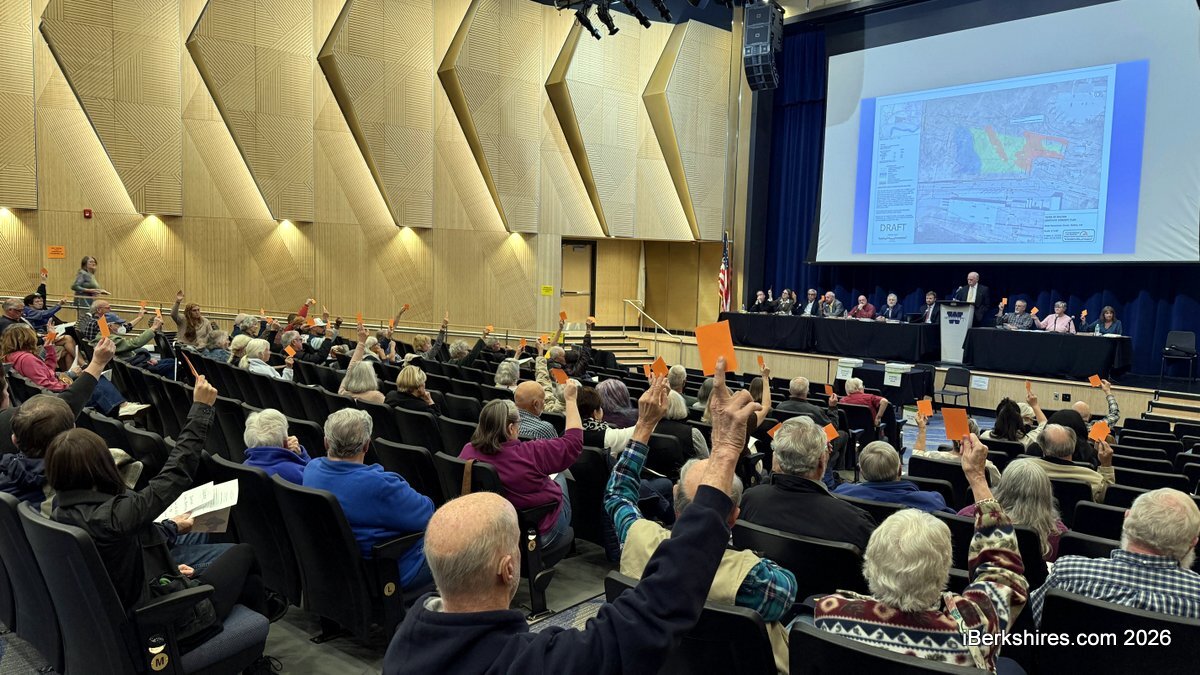
These were reviewed last Wednesday at a public information session.
Holly Brown, an analyst with MassDEP's Watershed Planning Program, said the lake is showing signs of nutrient pollution and eutrophication — a condition which promotes algae blooms, fish kills and dead zones — and cited recent algae blooms that resulted in public health advisories.
Matt Ladewig, principal scientist with TRC Companies of Windsor, Conn., explained the two different avenues Pittsfield and Lanesborough can take to help restore Pontoosuc Lake.
The two potential avenues include determining the lakes capacity for pollution (Total Maximum Daily Load) and developing a Nine Element Wastershed-based plan.
"The TMDL process is more formal and allocates pollutant loads to contributing point and non-point services in a way that will allow the water body to meet water quality standards," said Ladewig.
A TMDL plan would identify the impairment, the causes and the pollutant load reductions. Following public comments, it would have to approved by the U.S. Department of Environmental Protection Agency to be eligible for grants.
Ladewig said the watershed plan is a voluntary plan. Additionally, if implementation grant applications are planned, having Nine Element Wastershed-based plan may be helpful, as it makes one eligible for potential future grants under Section 319 of the Clean Water Act.
The plan, as its name indicates, looks at nine elements: causes and sources of pollution, estimates of load reduction, management measures, estimates of technical and financial assistance, information and education, schedules for implementation, measurable milestones, criteria for meeting objectives, and monitoring.
"Note that the 319 grant program is competitive," he cautioned. "Having a Nine Element Wastershed-based plan doesn't necessarily assure funding."
MassDEP's Nonpoint Source Program Manager Matthew Reardon explained both can be done but resources are limited, and that plans should be prioritized based on community input.
"I think in an ideal world, we would have both, we do a TMDL and then do a 9-on-1 plan," he said. "Obviously, we don't have unlimited staffing and funds, so part of this is to see what the public wants, and the level of interest in this area, in terms of restoring the pond."
If the communities wanted the TMDL, MassDEP would fund the process but encouraged them to look into the grant opportunities like Clean Water Act Nonpoint Source Implementation Grant (319), Clean Water Act Water Quality Management Planning Grant, and the Municipal Vulnerability Program.
Alison Dixon of Berkshire Regional Planning Commission said there is a written watershed plan and the communities are eligible to apply for 319 grants. But she noted that there's limited capacity to write multiple grants for Berkshire County.
The conversation slipped toward stormwater runoff and the lack of interceptors and if the ones in place are working.
Lee Hauge, president of the Friends of Pontoosuc Lake, who is currently planning to fund raise for weed control at the lake, said there was an installation of stormwater interceptors to capture first-flush, high nutrient runoff before it enters the lake. However, these interceptors have often filled with silt and debris because of the many dirt roads, making them ineffective and costly to maintain.
The Lanesborough Highway Department has progressively paved roads, reducing silt from blocking the interceptors. As paving advances, there is an opportunity to restore or add interceptors to reduce nutrient loads, but Hauge said while they are making progress, it is taking a while.
One resident mentioned their neighborhood came together and paid privately to run a sewer line away from the lake.
"We paid independently to run a sewer line up Narragansett Ave, from the end of the dead end of Narragansett, where it goes into Pittsfield, to the causeway," they said. "About 20 of us hook-tied into the sewer at our own cost. And I know that that had a huge effect on helping clean the lake up."
Pittsfield's Open Space and Natural Resource Program Manager James McGrath mentioned the city would be interested in the TMDL and said Pittsfield is working every day to help the lake.
"Development of a TMDL or a watershed-based plan is something we are interested in pursuing," he said. "We would hope that the commonwealth can help us get to the head of the line. However that might come to pass, we are open to conversations about how we get to the head of the line to get that planning done.
"Secondly, I want to assure everyone on this call, including our partners from the state, and the city of Pittsfield and the town of Lanesborough, we will continue to do the grunt work of managing Pontoosuc Lake."
McGrath said they are staying on top of invasive weed control, and monitoring for cyanobacteria and for zebra mussels.
"We will continue to oversee a robust zebra mussel monitor program at the boat ramp," he said. "We'll continue to work with the Environmental Police to manage recreational boating on the lake."
He also asked if the state would consider bringing back the watershed team approach.
"We did a lot of work, and I think a lot of great things happened, when there was a staffer from the commonwealth working with communities on a watershed-delineated geographic extent," he said. "I would ask the commonwealth whether or not it may be an approach that's worth considering bringing back the watershed team leaders."
Tags: pollution, Pontoosuc,