Pittsfield City Council Preview: Gifts and Parking Orders

By Brittany PolitoiBerkshires Staff
Print Story | Email Story

PITTSFIELD, Mass. — Tuesday's City Council agenda includes a grant to expand fiber-optic internet, a donation for the incoming soccer mini-pitch, and amended parking regulations. 

Fiber internet companies have flooded into Pittsfield over the past year, three in particular: Gateway Fiber, Archtop Fiber and AccessPlus Fiber.

This type of internet transmits data as light through glass strands, and is said to provide symmetrical upload and download speeds. 

The state's Executive Office for Administration and Finance has awarded the city $237,459 through the Community Compact Municipal Fiber Grant program to cover costs associated with expanding existing fiber-optic infrastructure throughout communities. 

It will also allow Pittsfield to place "critical" utility infrastructure circuits on its fiber optic network and monitor them, and provide redundant backup circuit(s) for various locations on the network. 

In a communication to the city, Lt. Gov. Kim Driscoll said the program's demand was once again strong, and the administration added nearly $4 million to the total of available funding. 

"Your application was chosen because it met the overarching goal of supporting the closing of critical gaps in local networks and connecting municipally owned facilities," she wrote. 


Fueling excitement around the World Cup, U.S. Soccer has been working with the Massachusetts Youth Soccer League to make mini-pitch fields available to 20 communities — one of which will be at the park at the intersection of Benedict Road and Springside Avenue. 

The council accepted the gift at its last meeting, valued at over $100,000, and the Mill Town Foundation has submitted a $10,000 donation to ready the site. 

Milltown's Program Director Andy Wrba wrote that they believe this initiative will bring meaningful community benefits by creating a welcoming, active space that promotes health, connection, and vibrancy. 

Decades ago, the Crane Park facility was a wading pool. It closed in 1980, and before the turn of the century, it was filled in and marked for hockey. Today, the roller hockey rink is aging and less utilized; officials believe this soccer pitch will bring new life while still accommodating inline skates. 

Mayor Peter Marchetti has also submitted three traffic orders to amend parking regulations on Church Street, Edwin Street, and West Street that add about 50 new parking spaces in the vicinity of 99 West Street. 

Earlier this year, Pittsfield Cooperative Bank announced that it entered into a conditional agreement to acquire a leasehold interest in 99 West St. and will move its corporate headquarters there. 

The Co-op Bank, currently headquartered on South Street, plans to renovate, modernize, and enhance the West Street facility. 


Tags: council preview,   
If you would like to contribute information on this article, contact us at info@iberkshires.com.

Pittsfield Man Creates Device to Clear Lakes of Algae Blooms

By Breanna SteeleiBerkshires Staff

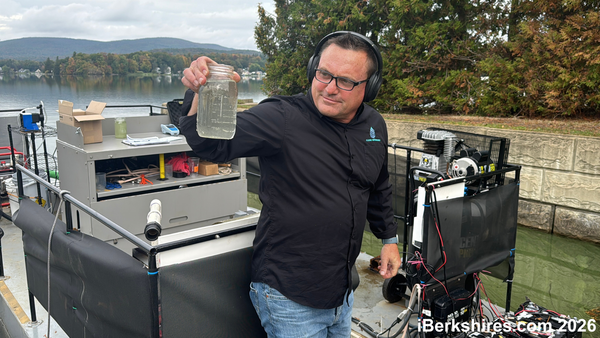
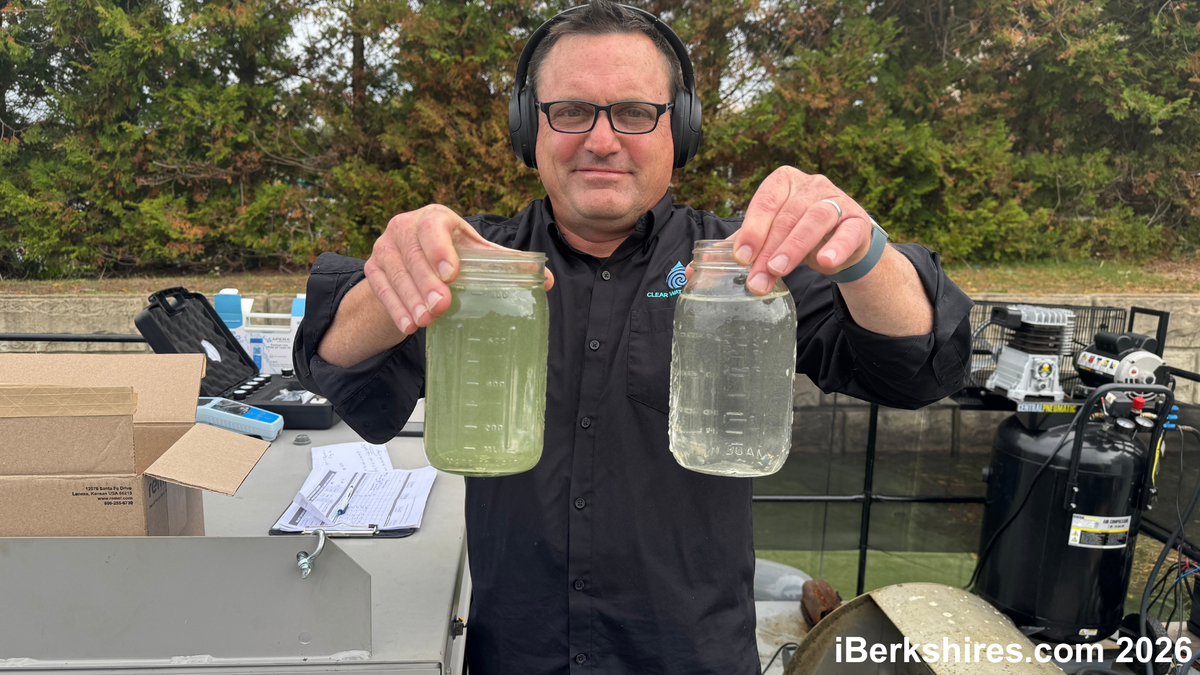
Marc Bellora holds a jar of lake water, left, to compare to water cleaned by his Aqua Clarifier Water System.

PITTSFIELD, Mass. — Marc Bellora has high hopes for a device he's created to treat lakes from harmful algae blooms.

His patented water clarifier can physically remove captured material rather than letting the nutrient-rich material settle back into the lake, which occurs when herbicides are used.

"It's a long-term lake management tool that can be used to reduce legacy nutrients in lakes and ponds over time," he explained. "We built the prototype, this is a prototype. It does approximately 65 to 70 gallons per minute. It's very environmentally friendly. Can be used with air only, or we can use a low-dose potable polyaluminum chloride (PACL) or chemical on board that can help improve results."

The water clarifier barge is based on well-proven technology for water treatment, he said. "It's a self-contained, portable, mobile unit that removes algae blooms, nitrogen, phosphorus, and the associated nitrogen and phosphorus within lakes."

Bellora founded Clear Waterways Group with business partner Mark Simon. They built a prototype mobile unit and are still working out the kinks. It's taken Bellora about five years to bring the project to fruition as he is also a full-time Realtor.

He says the repurposed barge they use has a device that uses air to filter the water to separate harmful bacteria or uses a chemical at low doses. They are testing both to see how well each does at cleaning the water.

"They would do the same thing here, except they would spray it, and it blocks all that stuff together," Bellora said of the use of herbicides. "But then it drops to the bottom. So now all the nutrients that are attached in that plot go to the bottom and contribute to the legacy nutrients only to fuel next year's bloom. Ours removes it."

He said just using air alone has removed 70 to 90 percent of harmful algae where he has been operating on the south end of Pontoosuc Lake.

"Essentially, we take in the bad stuff, we take in the lake water. We separate the good stuff from the bad stuff. Clean water goes back into the lake, and the bad stuff can either be composted, or it can be taken to the wastewater treatment plant, which is what we're doing here," he said. 

Bellora explained that tiny air bubbles attach to particles in the water, making them buoyant so they rise and can be removed. The unit can operate with air alone, or with a low dose of potable polyaluminum chloride.

PACL helps through flocculation: it gathers small particles into larger clumps that are easier for air bubbles to capture. He said this can help remove dissolved nutrients that air alone may not capture as effectively. 

Bellora said he was inspired to build something like this after noticing the lakes he enjoys being shut down because of algae blooms. 

The city issued a health advisory for Pontoosuc in August, warning residents not to swim or come in contact with the lake water because of an algae bloom. The cyanobacteria can cause skin irritations, vomiting and diarrhea and nerve or liver problems. 

Bellora previously worked for a company that used traditional dissolved air flotation (DAF) systems to treat water. In that role, he traveled around the country to work at paper mills and food-processing plants.

That experience gave him a practical understanding of DAF, and while flying between jobs, he would see green ponds and wonder whether the technology could be adapted to treat lakes. 

View Full Story

More Pittsfield Stories