Fitch, Barrett Meet in Debate for State Representative Seat
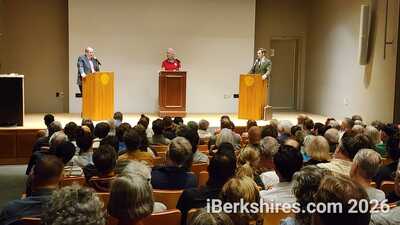 |
| Jennifer Howlett moderates Thursday's debate between John Barrett III and Andrew Fitch. |
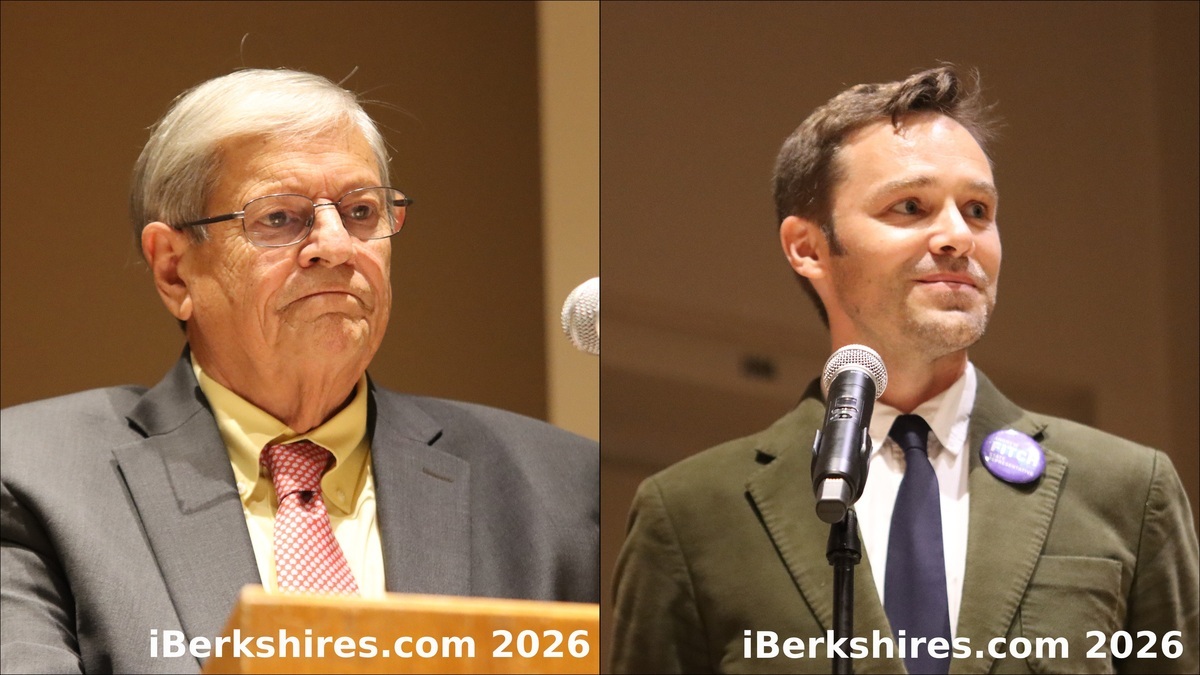
WILLIAMSTOWN, Mass. — The two candidates for the Democratic nomination to represent the First Berkshire District on Beacon Hill found a lot of common ground Thursday on some issues but differed on what is needed to get things done in their only scheduled debate leading up to the Sept. 1 primary election.
The incumbent, John Barrett III, and Andrew Fitch, a North Adams city councilor, met in a theater at Williams College's Paresky Center in a forum sponsored by the town's chapter of the League of Women Voters, fielding questions submitted by the public and posed by moderator Jennifer Howlett for just less than an hour.
The pair agreed at least in part on issues ranging from same-day voter registration to assisted suicide to the statewide ballot initiative to repeal the legalization of cannabis in the commonwealth.
But they parted ways when asked whether they would support efforts to institute a single ballot primary and whether the current Legislature has been responsive enough to respond to a 2024 ballot initiative to have the state auditor audit the House and Senate.
Barrett argued that the Legislature already conducts audits and puts the results on the state's website. He further pointed to a lawsuit brought by Auditor Diana DiZoglio over the issue.
"She went to court, and the court asked her, are these the four things you wanted [from an audit], and she said yes," Barrett said. "We gave her legislation that gave her the four things she wanted."
Calling himself a "big fan of audits," Barrett argued that he participated in them as mayor of North Adams for 26 years. He called efforts to have the state auditor conduct the audit of the Legislature a "Republican thing" and a "sad game."
Fitch noted that a lot of Democrats around the commonwealth supported the 2024 ballot measure, which was approved by 72 percent of voters. But he said he is sensitive to the constitutional concerns about one branch of state government overseeing another.
"I'm in favor of an audit of the Legislature," Fitch said. "I was one of many who signed the petition [to get it on the 2024 ballot]. I voted in favor of it. And it has not been done. … I do agree the Legislature can agree to audit itself."
In a rebuttal to Barrett's answer, Fitch said, "There is room to be more communicative, more transparent with our voters. They're not getting what they want."
Another point of disagreement came when Howlett posed a question about a top-two primary system like the one used in California and Washington, where all the candidates appear on a single primary ballot and the top two move on to the general election.
Fitch said he needed to look more closely at the issue, but he agreed with it in principle, having experienced that system while living in California. He said a single primary system would bring more voters to the polls.
"We should continue to allow more access for more kinds of folks to help make choices in the commonwealth," he said.
Barrett said he believed in the party system and noted that California's recent primary, where it took 10 days to determine a winner, is an example of why the current system has its advantages.
"In the climate we're in now, people don't want to wait that long," Barrett said.
One of the night's more pointed exchanges came in a discussion about infrastructure — specifically the commonwealth's Northern Tier Passenger Rail Study.
Fitch began by acknowledging Barrett's advocacy for passenger railroad service in the Route 2 corridor but said he had a plan to push the commonwealth forward.
"We need more," Fitch said. "We need to pull together all the representatives of the Route 2 communities, find commonalities and pull them together. I'd venture to say we'd pull together 25 percent of the state representatives who were at least partially connected to that corridor. I would dive into that immediately.
"And I'd call Sen. Jo Comerford [D-Northampton] and ask, what's the next step? What can I do to help? How can I collaborate with you?"
Barrett responded that he was a co-sponsor on Comerford's bill and that the elected officials in the Route 2 corridor already are working together. He told the audience that he called the Department of Transportation weekly to ask about the progress of the commonwealth's study, and that the biggest problem is the condition of the Hoosac Tunnel, a critical link in rail transportation.
Barrett said that the process of pushing forward a major project takes time.
"Things don't just happen with the Legislature," he said. "It takes years. But you have to be tenacious. You have to keep after them. And, if you do that, it works.
"We don't need any more damned meetings. We know what our problems are."
Fitch immediately shot back.
"I think we do need more damned meetings," he said. "There is more opportunity for collaboration."
Both candidates said they support Medicare for all in Massachusetts, with Barrett noting that he already co-sponsored legislation that would bring that to fruition.
Fitch agreed that all the Berkshire County delegation has come out in support of Medicare for all but promised to make it a focus if elected.
"A step further will be to dive into the leadership [on the issue]," he said. "It's not just going to take signatures on a piece of paper. It's going to take real leadership. It's going to take real energy and focus to get this thing done."
"Energy" has been a watchword for Fitch, who reminds people on his website that, "Andrew's energy and productivity are boundless."
On Thursday, he hammered at that theme in his opening statement.
"The same old tactics used over past decades are not working," Fitch said. "We need fresh ideas, fresh leadership, and I'm the candidate for that."
Barrett, the incumbent, repeatedly pointed to his record, both on Beacon Hill and as one of the longest-serving mayors in the history of the commonwealth.
"I believe candidates should be judged not just by what they promised but by what they've actually done," he said in his opening statement. "It takes experience. It takes knowing how government works. It takes building relationships, working with people on both sides of an issue. We face serious challenges in the years ahead, and experience does matter."
Fitch took on the experience issue in his closing statement, noting that he has a master's degree in political science, is an entrepreneur with a successful downtown North Adams business and is serving his second term on the North Adams City Council.
"I'm 41 years old," he said. "I'm not 14 years old. … I have the skills, experience, temperament and fresh ideas to succeed in this role."
The primary election is 7 a.m. to 8 p.m. on Tuesday, Sept. 1. Check your town hall or city hall for early voting hours. There is no Republican candidate for the First District seat in the State House of Representatives on the party's primary ballot.
The debate was recorded by Willinet for public access broadcast; check the schedule for showings.
Tags: debate, primary,