

Berkshire Land Trusts Support Farming and Housing
This is the second article looking at the role of publicly oriented Land Trusts. Part 1 looked at Conservation Land Trusts, which focus on protection of open space and natural habitats. This article looks at the other form, Community Land Trusts.
Lillian Zavatsky, board chair of the recently formed Northern Berkshires Community Land Trust (NBCLT), gave a succinct answer when asked to define the purpose of the organization, and the community land trust movement overall.
"It's based on the idea of the community owning land for the benefit of the community," she said.
Publicly oriented land trusts have differing specific priorities and approaches, but they operate on a similar basic strategy, in which a non-profit organization acquires land and buildings, and earmarks them for public needs and goals.
There are two basic types of public land trusts. Their ultimate goals are complimentary, and they often collaborate, but they differ in emphasis and strategies.
Conservation Land Trusts are oriented to protection of open space and natural habitats and sites of historic importance.
Community Land Trusts like NBCLT are oriented to the use of land for affordable housing, community-oriented economic development and other purposes.
"Our organization's focus is on housing, because that's a critical issue," said Zavatsky. "The model is to secure sites for housing priced for affordability rather than the high prices of the real estate market. Ultimately, it's about making housing available for homes rather than speculative investments."
A key strategy of housing land trusts is to provide access to homes in a manner that is affordable, while also enabling homeowners to build equity. They generally include agreements that allow a reasonable return on their investment when they resell the home but within a price range that remains affordable. The same principle can also be applied to farms, business sites and other purposes.
(For more information on the affordable housing issue see the previous Deep Dive series on iBerkshires in April 2026.)
NBCLT was officially launched in 2024. It is currently in the process of preparing its strategic plans and establishing the details of its operations as the groundwork for a larger rollout.
"Creating an organization like this is a long-term process, and we want to ensure it's done right," said Zavatsky. "Things could happen quickly or slowly."
She emphasized that the organization also emphasizes community involvement.
"It's a form of democracy in action," she said. "Everyone is welcome to join and participate, and our actions and policies will be driven by the membership."
She said the organization came about as the result of conversation among friends who wanted to find solutions to the affordable-housing crisis. They initially formed an advocacy coalition named North Adams Community Housing Organization
(NACHO). The land trust grew out of their research into specific strategies.
She added that it was largely inspired by the Berkshire Community Land Trust (BCLT), which is based in the Southern Berkshires. The BCLT is serving as their fiscal sponsor while they apply for their own status as an IRS approved non-profit
organization.
"Someone who was familiar with their work suggested we contacted them," she said. "They met with us and explained the details and have been advising us. They've been extremely helpful, and our organization might not have existed without their assistance."
The BCLT and its affiliated organization, the Community Land Trust in the Southern Berkshires Inc.(CLTSB), are pioneers in the national and regional community land trust movement. Currently varying sources estimate there are approximately 200 to more than 300 community land trusts nationally in urban and rural areas.
CLTSB was established by Robert Swann and his partner Susan Witt and a group of local organizers in 1980. Swann had previously been an organizer of an early community land trust in Georgia called New Communities, which was established in 1969. That was an outgrowth of the civil rights movement to support Black farmers through a collective land ownership model.
Swann became a national leader in the community land trust movement. He also created the Institute for Community Economics, as an educational and advocacy organization to support concepts such as community oriented sustainable economies.
He and Witt were invited by local residents to move from Cambridge to the Berkshires and help to establish a regional land trust here. They also founded the Egremont-based Schumacher Center for A New Economics, which was named for E.F. Schumacher, author of the 1973 book "Small Is Beautiful: A Study of Economics As If People
Mattered."
The trust purchased a 10-acre property named Alvastra. That currently contains three homes, a residence for those with disabilities, and the Schumacher Center's library.
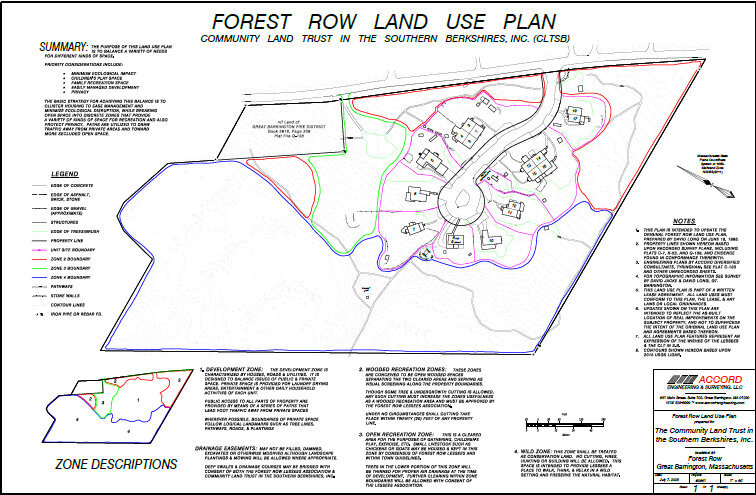
In 1986, Swann and Witt led the development of Forest Row on 21 acres of community-owned land in Great Barrington. It contains a neighborhood of 18 households and preserved land.
In 2015, CLTSB established the Berkshire Community Land Trust Inc. as a separate but affiliated organization to enable it to expand into related activities that are not supported by a single purpose tax-exempt organization The two organizations have differing IRS 501 designations.
BCLT's role is to serve as an educational organization to increase public awareness of community land trusts and encourage land donations. It serves as a regional center of expertise for other emerging trusts, providing education programs, technical support and administrative services, as well as fundraising capacity. The CLTSB holds and manages the land, including leases and other transactions and administrative affairs.
Currently the trust has some 130 acres, with 23 homeowners. Its holdings also include Indian Line Farm and is working to finalize the preservation of River Run Farmstead.
In terms of housing, their strategy is to sell homes to residents, while retaining ownership of the land. Their specific model is to price the homes at prices working people can afford. The buyers own their homes and lease the land below from the
trust for 98 years at a modest rent to cover administrative costs and other land-ownership expenses. The homeowner can sell the structures at any time.
"This makes home ownership affordable by removing land from the equation," explained Beth Carlson, executive director.
There are many variations of initiatives that are designed to make housing affordable, based on differing models, and whether a project is officially designated as "affordable" according to government programs or other requirements.
Unlike programs that require buyers to be below specific income levels, the trust dies not currently have restrictions for eligibility, other than the normal qualifications for financing. The trust also sets the prices. It does require that the home will be the buyer's primary residence.
"We don't have income restrictions," she said. "It tends to self-select naturally to people with lower-middle and middle-income levels We may consider income requirements in the future, but the system we have has worked well. And we want occupants to build equity in their homes."
If an owner sells a home, there are established agreements that it be priced at a level where the seller can earn a reasonable gain on their initial investment and benefit from any improvements, but are still within the range of buyers with moderate income levels.
Carlson said the organization is currently investigating about five potential acquisitions and actively seeking additional sites to acquire and is encouraging donations of land. They also hope to develop partnerships with other housing organizations.
"We'd love to do more housing," she said. "Finding more ways to make housing available at affordable prices is so important."
She added that they are also open to sites for affordable offices and operational facilities and retail space for community-oriented businesses and artisans, and other activities.
"Land can be put in trust for a variety of productive purposes that benefits the community," she said.
Preserving farmland and farms is another priority. The goal of protecting farmland is a priority for both conservation and community land trusts and other organizations, which often collaborate on projects.
"This is especially critical because Massachusetts is losing an average of 13.5 acres of farmland everyday," said Carlson.
Their efforts include acquiring farmland and houses and other facilities to make farming financially feasible.
Although there is a strong and growing demand for locally produced food, farming is a very difficult business because of escalating land values. This is especially true for young people who want to become farmers.
The CLTSB made its first foray into farm preservation in 1997, following the death of Robyn Van Eyn, who operated Indian Line Farm in Egremont as the nation's first Community Supported Agriculture farm.
The land trust worked with a farming couple, Elizabeth Keen and Alex Thorp, and The Nature Conservancy, a national organization, to acquire the land and place conservation restrictions easements on the property to permanently limit future development. The trust provided the couple with a 99-year lease on the property.
The land trust expanded this in 2021 with a new initiative, Farmsteads for Farmers. Its purpose is to acquire land for farmsteads which includes a home, barns, sites for greenhouses, plus flat land for growing or grazing. The land is rented to small-scale sustainable farmers, with a 99-year leasehold. The farmer own the structures and infrastructure, and can build equity in improvements. They can sell it at a price that is affordable for the next farmer.
Its first project in this initiative is River Run, a 79-acre parcel with a single-story house in Great Barrington. This project is in its final stages, and fundraising is continuing. Anna Houston and Rob Perazzo, who have operated on scattered rented sites are the designated leaseholders.
Other organizations are also working to preserve farming and farmland independently or in collaborations. In addition to outright acquisition of land, they also help farmers and other landowners arrange for government agricultural programs. In Massachusetts, for example, this includes the voluntary sale of an Agricultural Preservation Restriction, in which a farmer can sell the difference between the "fair market value" and the "agricultural value "of a property in exchange for restricting its future use to farming.
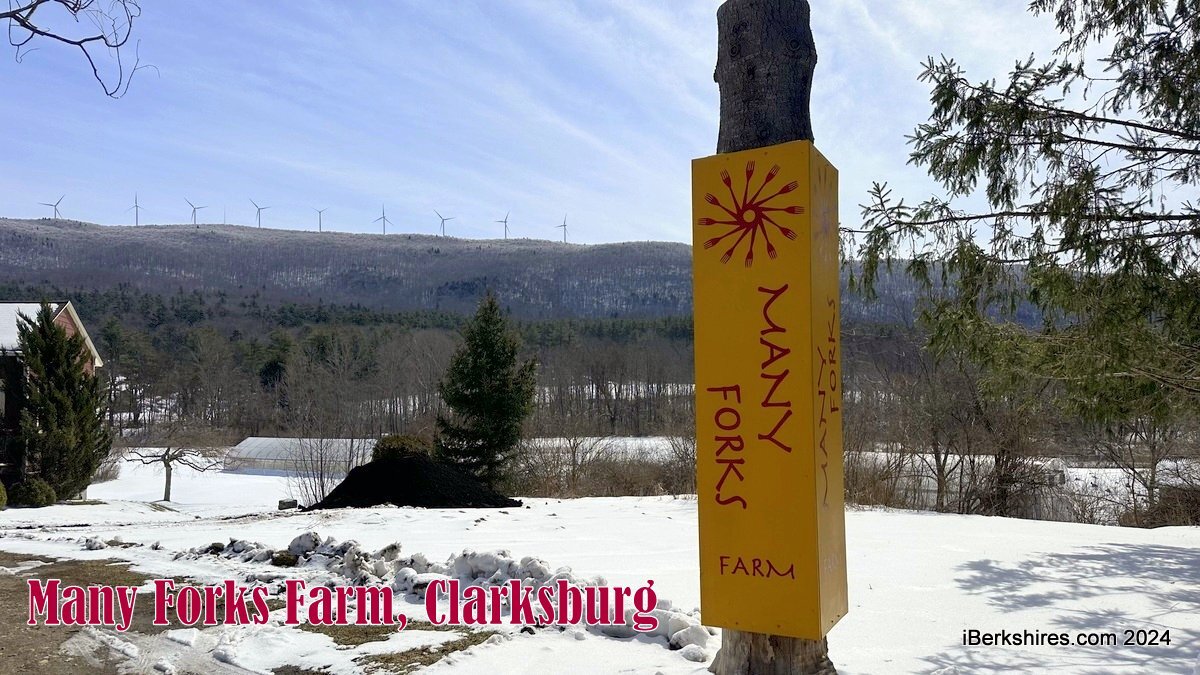
The Berkshire Natural Resources Council (BNRC) a conservation organization, has also stepped up its involvement in preserving farmland in collaboration with other organizations. In 2024, for example, BNRC purchased the Many Forks Farm in Clarksburg from its retiring owner Sharon Wyrrick at a below-market-rate price and placed it into legal conservation status as a farm. They leased it to Molly Comstock, with an agreement to sell it to her at an affordable, preservation-reduced price within a few years.
Public land trusts are different than private trusts that individuals or businesses set up for tax management, estate planning, or other financial benefits. They are separate from public benefit trusts.
However, public land trusts can combine pragmatic asset management with philanthropic motivations, such as a landowner who wants to find practical ways to make preserving their land financially feasible. Among other roles, community and conservation land trusts work with property owners to implement such goals into their financial planning.
Overall, public land trusts are one tool in conjunction with other strategies to provide land for conservation and other purposes that can benefit communities as a mix of practicality and philanthropy.
Tags: deep dive, farming, housing, land trusts,