Reverend: Christian Nationalists Make Jesus Victim of 'Identity Theft'
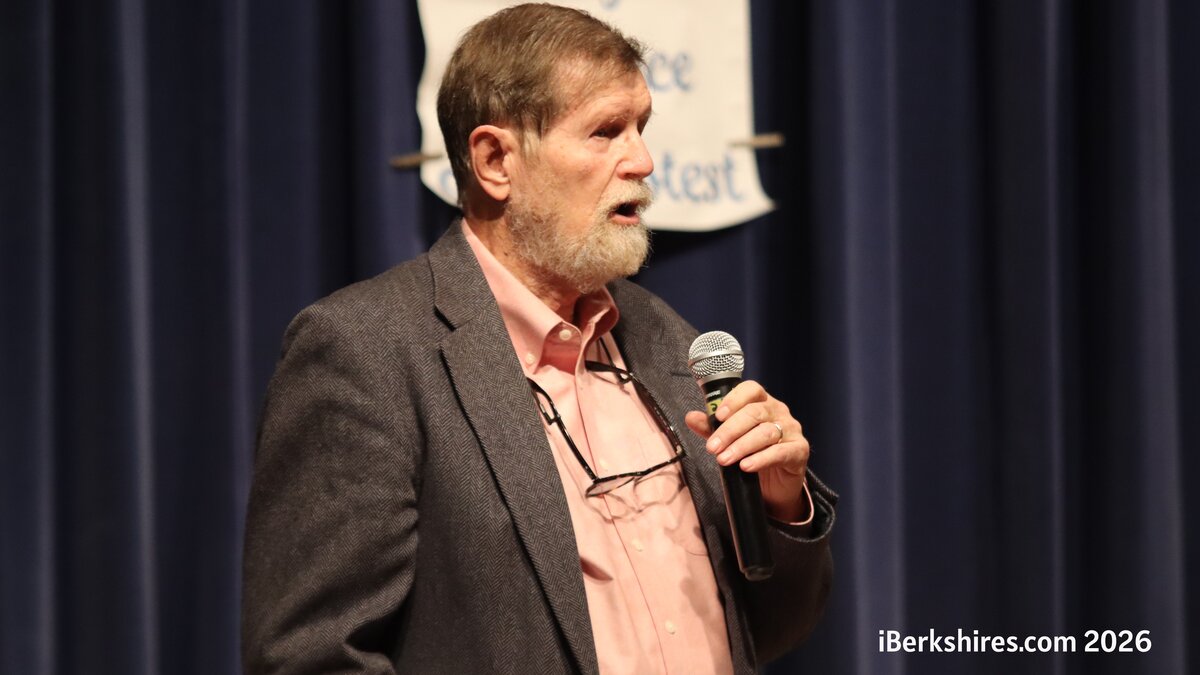
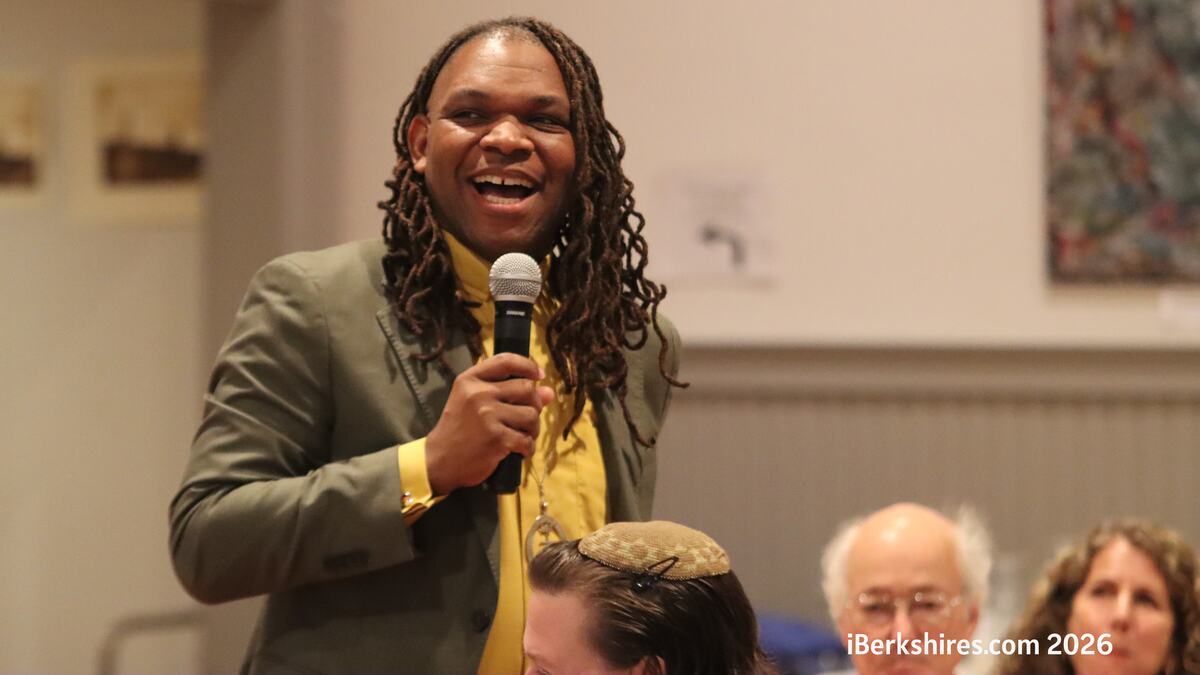
David Langston introduces the Rev. Darrell Goodwin on Wednesday morning.
"Sometimes prayer causes us to be in deep reflection," Goodwin told the group gathered at the Williamstown Meetinghouse. "And years and years and years pass, and we've actually done nothing about it.
"Our physical belief system is somehow: Say the words to God, and it becomes God's responsibility, and we've done our part because we've told God exactly what to do."
Goodwin, the president of the United Church of Christ's Southern New England Conference, was invited to Williamstown by First Congregational Church to speak on "The Challenge of Christian Nationalism."
And Goodwin challenged his listeners to take meaningful action to confront and address the ideology in their daily lives.
Christian Nationalism, which Goodwin referred to as White Christian Nationalism, is a perversion of Christ's teachings, he said.
"What does it mean to be spiritually grounded but practically committed?" Goodwin asked rhetorically. "This morning I've been asked to come here to talk about Christian Nationalism, but I think it would be remiss if I didn't say White Christian Nationalism. I want to name all three of these words because each tells us something that we must do.
"We must confront the racial hierarchy, challenge the religious justification and resist the claim that this country belongs more fully to some of its people than others. By White Christian Nationalism, I mean a vision of this country that is rooted in whiteness and a particular expression of Christianity established to say, 'Some people truly belong. There's only one country that's truly dominant. And if we know better, we would exercise that power over and against the "other." '
"That vision can operate even when its supporters do not explicitly use racialized language. That's why White Christian Nationalism, my friends, is not only a 'white problem,' it's a national problem. It's a systemic problem. And, if we're not careful, it will become a world problem."
Talking about the atrocities of White Christian Nationalism among like-minded friends or voting against candidates you perceive as espousing the ideology is not enough, Goodwin told the attendees.
The reverend laid out five concrete steps that people can take to fight against White Christian Nationalism: challenge the theology that makes domination sound so holy; build relationships strong enough to support the coordinated actions you believe in; organize where public decisions are made; examine racial habits of your own institutions; give this work resources, responsibilities and a rhythm you can sustain.
Goodwin dove deep into each of those five steps to explain how they can be implemented.
Even people who don't subscribe to the separatist, elitist ideas inherent in White Christian Nationality can live lives that exclude the "other" if they don't make an effort, Goodwin explained.
"We must interrupt and examine those racial habits in our institutions," he said, elaborating on his fourth strategy. "We need to get in touch with who gets believed when they describe their experiences, who is immediately asked to provide more evidence, who can make a mistake and remain trusted, whose leadership is welcomed until it changes what makes us familiar, who is asked to soften their language so other people can be comfortable, who is asked to be quiet and who is asked to speak up, who is told, 'It's not your turn,' or who is told, 'It's OK. One day it will get better for you and your group.'
"Our progressive identity does not relieve us of the responsibility to examine our conduct. Here are some practical things: The organizations you're a part of, look at your governing board; who sits on them. Look at your budget, hiring practices, partnerships and people whose counsel shapes major decisions. My siblings, look at your birthday party. Who is seated around the table and who is not. Look at the weddings you attend and the social gatherings you're a part of. Look at your theater buddies and your shopping buddies and your sewing buddies and the people you call friend.
"Are there people who don't look like you?"
And if there are not, he said, make a change, even if you live in a town like Williamstown, where 80 percent of the population — including the college student population — identifies as white, according to the U.S. Census Bureau.
"I'm not suggesting that all of you go around people of color who are otherwise shopping," Goodwin joked. "I'm asking you, if your commitments are centered in a level of diversity that you crave in your life, then everything in your life should mirror that."
Some might say that's not possible because of where they live, he continued, but he noted there's something called the internet and other opportunities. It's a matter of being willing to put oneself in "that place of discomfort."
Confronting Christian White Nationalism in a politically fragmented society — or in your politically fragmented family — can be uncomfortable. But it is needed, Goodwin said.
"Here's a practical beginning for our churches: Gather people around the religious claims they are actually hearing," Goodwin said. "Bring a public statement, a sermon, a social media post, read it carefully along scripture. Ask, 'What does this claim say about my version of God?' Ask, 'Who does it invite us to fear, to worry about, to cross the street from when we see them?' Ask, 'Whose power does it protect?' Ask what would happen to our neighbors if we put that kind of behavior in practice. We have to equip people to respond in their own words.
"They may say, 'My Christian faith does not give me greater ownership of the country than anybody else.' They may say, 'My belief in religious freedom must protect my Muslim neighbor as fully as it protects me.' Or they may say, 'I cannot reconcile the humiliation of vulnerable people with the way my faith calls me to live.' My friends, these are public statements of witness. They are not just things we've written in our diaries."
During a question and answer session that followed Goodwin's prepared remarks, he was asked how it was possible that the Christian gospel has become contorted to justify the White Christian Nationalist ethos of exclusivity and domination.
"What's so hard about, 'Love your neighbor?'" the attendee asked, referring to what Jesus calls the "greatest commandment" in Mark's Gospel.
"The definition of neighbor," Goodwin said. "If I've been socialized — back to the hierarchy — to believe that these people are not my neighbor and these people are, I'm going to go to heaven because I'm loving the people who look like me, talk like me, think like me and are like me. And I can reject all these other people because they're not my neighbor.
"Our philosophical framework is: Everyone is my neighbor. So it's re-teaching language. I believe the entity that is most affected by identity theft is Jesus, because it's been co-opted, the faith, the language, the narrative. And we are struggling with whether we can say the name, while someone else is saying it too much."
Tags: Christian, religious event,