Historic buildings in East Arlington to reopen as antique center

Print Story | Email Story
In 1764, three years after East Arlington, Vt. was chartered, the village laid the groundwork for its growth as an industrial center. That year a gristmill- the first in Vermont — was built to harness the water power of the roaring Peter's Brook and turn grain into flour and livestock feed. Built by a member of the Green Mountain Boys, the gristmill — as well as three adjacent buildings — reveals a fascinating story of the birth and early development of America. These buildings served a variety of functions: as a hiding place for Tories in 1776, as a sawmill, and most recently, as Candle Mill Village. Vacant for several years, the complex will be reborn this spring in the form of two antique centers: Gristmill Antiques and Hayloft Collectibles. After purchasing Candle Mill Village in October 2001, Verrall Keelan and Patricia Spaulding began a careful restoration of buildings recognized as significant by the National Register of Historic Places. Some of the remarkable objects uncovered in this restoration — including large wooden wheels and iron cups used to transport grain — will be displayed in Gristmill Antiques. To bring this rich history alive for shoppers, Keelan's husband Donald, a certified public accountant and author of historical books and novels, has spent time pouring over village records and documents. On a tour of the nearly completed antique centers, Keelan described the vital role these buildings - in almost continuous use for 240 years — have played in East Arlington. He said that in opening the centers, "we look at ourselves as stewards." Like the previous owners of this piece of American history, "we're here temporarily and then we'll pass it on to the next people." A brief history Vermont was largely wilderness when East Arlington was chartered in 1761. Benning Wentworth, the governor of New Hampshire, considered the land his territory and offered grants to settlers from Connecticut. Recognizing Arlington's prime location on a major north-south route and the availability of water power, Wentworth offered $50 to the first man to build a gristmill. Remember Baker, a millwright from Connecticut, built the gristmill on the border of Arlington and Sunderland. The water powered gristmill passed through a fire and several owners, operating into the late 1920s, said Keelan. The introduction of white bread and other packaged foods forced the gristmill's closing; the building was then used to manufacture wooden ice boxes, caskets, and pegs for the Albany railroad. In 1958 Thomas and Barbara Weakley bought the buildings and established Candle Mill Village, which included a wholesale and retail candle business, as well as several other shops. The Weakleys did a marvelous job of preserving the buildings during their stewardship, said Keelan. Closed for several years before Spaulding and the Keelans came in, the buildings "needed a lot of TLC [tender loving care]," said Keelan. The job of refurbishing the structures, especially the spacious gristmill, might have seemed intimidating to some people. But not to people interested in preservation, said Keelan, the only developer on the board of the Preservation Trust of Vermont. The first step was to remove about 70 cubic yards of excess stuff, mostly carpet and linoleum, he said. With this work underway, historical artifacts presented themselves both as keys to looking back in time and to connecting that past with the future. Grist Mill Antiques The large and airy interior of the gristmill gives - even while the finishing touches are being added — a strong impression the past. Far overhead beams are blackened from a fire in 1769 and a panel from the Arlington Post Office with an iron grated window is built into one wall. While taking care of practical concerns regarding insulation and fire safety, Spaulding and the Keelans ensured that these modern features were integrated into the original building. Grist Mill Antiques will showcase the affordable and upscale antiques of about 50-55 dealers; the furniture, linens, china and other antiques dating from the 1800s and early 1900s. As a creative way to create spaces for individual dealers, old doors, window frames, and shutters hang from the wall as partitions. On the landing of the staircase to the second floor, two comfortable chairs in front of a window offer a beautiful view of the waterfall. This is where people can relax while their spouses shop, said Keelan. A small table with tiny chairs will feature coloring books and other forms of amusement for children bored by parental browsing. Upstairs in the Dish Room shoppers will find china and linens in cupboards painted mint green. The gristmill is so large a person could think they've seen it all before turning the corner to discover the Hidden Room. Looking out over the waterfall, Keelan explained how the gristmill operated. The water, which comes down with a lot of force, ran over a series of cradle-shaped rocks to a pipe into an enormous turbine in the cellar. Wooden wheels held iron cups of grain, and, like a spinning Ferris wheel, moved them upstairs. When a customer came in for processed grain for feed, large wooden chutes on the ceiling released the product. These things will be scattered throughout the store, explained Keelan. Plaques will identify and explain objects; he noted that his wife, a board member of the Bennington Museum, intends to have an historian with expertise in this era appraise the artifacts. Hayloft Collectibles Next door to Gristmill Antiques is a two-story building dating from 1860 where people bought and stored hay. Hayloft Collectibles will feature collectibles from the 1930s through 1970. The bright ground floor of this space is striking: throughout the room beams of oak branches made smooth and barkless, have hook-like twigs. Upstairs, the large room is bright and cheerful with walls painted lemon yellow, peach and pale green. This is from Patricia [Spaulding] - she loves color, said Keelan. A painter, Spaulding also created a mural of East Arlington that hangs in the gristmill. There are two additional buildings dating from the 18th century that the partners intend to make available for lease after restoration. One of the buildings was the home of Isaac Driscoe, a Tory who bought the gristmill from Remember Baker. If the buildings are not rented, Keelan and Spaulding will run an art gallery; it will be a place for artists to exhibit their work without having to pay a large commission, he explained. Gristmill Antiques and Hayloft Collectibles will open in May 2003. Antique dealers interested in renting a space at Gristmill Antiques or Hayloft Collectibles are encouraged to call (802) 375-2500 or e-mail candlemillshops@aol.com to set up an appointment.
If you would like to contribute information on this article, contact us at info@iberkshires.com.

McCann Recognizes Superintendent Award Recipient

By Tammy DanielsiBerkshires Staff

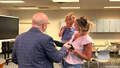
Landon LeClair and Superintendent James Brosnan with Landon's parents Eric and Susan LeClair, who is a teacher at McCann. 
NORTH ADAMS, Mass. — The Superintendent's Award has been presented to Landon LeClair, a senior in McCann Technical School's advanced manufacturing course. 
 
The presentation was made last Thursday by Superintendent Jame Brosnan after Principal Justin Kratz read from teachers' letters extolling LeClair's school work, leadership and dedication. 
 
"He's become somewhat legendary at the Fall State Leadership Conference for trying to be a leader at his dinner table, getting an entire plate of cookies for him and all his friends," read Kratz to chuckles from the School Committee. "Landon was always a dedicated student and a quiet leader who cared about mastering the content."
 
LeClair was also recognized for his participation on the school's golf team and for mentoring younger teammates. 
 
"Landon jumped in tutoring the student so thoroughly that the freshman was able to demonstrate proficiency on an assessment despite the missed class time for golf matches," read Kratz.
 
The principal noted that the school also received feedback from LeClair's co-op employer, who rated him with all fours.
 
"This week, we sent Landon to our other machine shop to help load and run parts in the CNC mill," his employer wrote to the school. LeClair was so competent the supervisor advised the central shop might not get him back. 
 
View Full Story

More North Adams Stories