Is gambling “a losing dream�
There is one thing people on either side of the issue agree on: the need to develop the long-dormant Green Mountain Racetrack in Pownal. Bringing new life to the facility will create much-needed jobs and stimulate the region’s economy. The rift isn’t in the need for development but what form it will take.
On one side are those who see restoration of the track — for thoroughbred racing or as a training and stable facility — as vital. In this view, easing up state restrictions on simulcasting will make Green Mountain more appealing to developers and allow for profit year round.
Those who oppose simulcasting, including animal rights activists and former Governor Howard Dean, have expressed concerns that simulcasting in Pownal will open a Pandora’s box of legalized gambling and inhumane conditions like those that once existed at the track.
Last week Governor James Douglas revealed that his support for the revitalization of Green Mountain Racetrack is not as absolute as statements made during his campaign led many to believe.
Douglas’ press secretary said the governor did not support a piece of legislation put forth by Sen. Dick Sears (D-Bennington) and Sen. James R. Greenwood (R-Essex-Orleans County). This bill would allow simulcasting at the track; current state law prohibits simulcasting at tracks where there is no live racing.
The bill is an attempt, should the developers decide to proceed with racing at the track, to bring jobs back to the Pownal area, said Sen. Sears. The simulcasting will be similar to that offered in Hinsdale and Hoosick Falls, N.Y., he said. He expressed surprise at the governor’s position.
“The critical thing is to bring back jobs,†he said. Because the building is privately owned, the state doesn’t have the ability to make that happen. “I’d like to work with the owners to see what they want there.†The state and private developers need to partner up and work together, he said.
Green Mountain is privately owned by investors, including John Tietgens of Clarksburg, Mass. Tietgens has expressed interest in developing the facility into a thoroughbred racing track or a training facility.
One group, Save the Greyhound Dogs Inc., is pleased with the governor’s stance, especially his vocal opposition to greyhound racing.
“It made me feel good that he knows we're poised for battle,†said Scotti Devens, the group’s founder and director. “Hopefully we can work with new administration but we have an agenda and it's very justifiable.
“Our agenda is certainly anti-greyhound racing, but that's the tip of iceberg,†she said..
Though greyhound racing has not been raised by any developers — and such races are illegal under state law — Devens said simulcasting and horse racing in Pownal poses a real threat. The greyhound racing industry, “with all their money,†might seek to bring more people in and make a larger profit by bringing back greyhound simulcasting or racing, said Devens. If Save the Greyhounds did not speak out against plans for reviving the track, “we would be turning our back on people in other states who want to see this abusive practice ended,†she said.
In 1995, Devens’ group successfully lobbied the legislature to ban greyhound racing in Vermont. Three years prior to the ban, Green Mountain closed; the Racing Commission had threatened to revoke the track’s license if it didn’t improve the greyhounds’ deplorable living conditions of disease, injury and malnourishment.
Sen. Sears noted that, like most representatives and senators in Vermont, he voted for the ban on greyhound racing. He called Devens’ concerns “a leap of logic†— for greyhound racing to return would still require a change in Vermont law, he said. The simulcasting bill he introduced last week, currently in the General Affairs and Housing Committee, is not about greyhound racing, he reiterated.
Still, Devens reservations go beyond concerns about greyhounds; “Thoroughbred racing is a step in the wrong direction,†she said. “History has shown us...it didn’t do well in Vermont.â€
Green Mountain Racetrack opened as a thoroughbred track in 1963. When the owners lost money in the first year of operation, they looked for other ways to turn a profit. They introduced harness racing and then, in 1977, greyhound racing.
The governor has said that the facility is there so why not use it, said Devens. “Isn't that a poor way to back into something desirable and profitable?†Just because the building is there, is that the way to create jobs and put something in for the community to embrace? Devens added that the rundown facility would need a lot of work before it was operational.
Gambling is a “losing dream,†said Devens. She wondered how, with its dismal reputation, anyone could want to revive the track except to create new jobs. She added that racetrack jobs “leave more than a lot to be desired.â€
Devens said she would like to see developers pursue a healthy alternative that would both create good jobs and bring people into the area for extended stays. Two ideas she mentioned were a recreational facility to attract people of all incomes or a facility for concerts.
She added that she respects the need for jobs “but not on the backs and feet of helpless animals.â€
“It’s like building a house with no foundation and no roof to even consider bringing this back,†she said.
Asked about Devens’ charges that reviving the track will be unsuccessful, Sears said, “That's all smokescreen in my view. Her [Deven’s] interest is in making sure greyhounds don't come back.â€
He added that if Tietgens sold the facility to a developer who wished to put in a museum like MASS MoCA, a learning center, or another business, he would be supportive. “These are all possibilities,†he said.
While he expected some opposition, Sears expressed concern about groups like Ms. Devens’ that he said are “jumping to a lot of conclusions that aren't there.â€
“I’ve been clear about opposing slot machines in the future,†he said. “Let me be clear that I don't see greyhound racing in the future.â€
If you would like to contribute information on this article, contact us at info@iberkshires.com.
Your Comments
iBerkshires.com welcomes critical, respectful dialogue. Name-calling, personal attacks, libel, slander or foul language is not allowed. All comments are reviewed before posting and will be deleted or edited as necessary.
No Comments
SteepleCats Shut Out on Road
iBerkshires.com Sports
MONTPELIER, Vt. -- Four Vermont pitchers combined to strike out 11 and allow four hits Tuesday as the Mountaineers beat the North Adams SteepleCats, 11-0, in New England Collegiate Baseball League action.
Evan Meier, Bobby Stang, Tonny Woodie and Chris Diaz each had a hit for the SteepleCats, who used five pitchers in the loss.
North Adams (0-2) comes home Tuesday to host the Mystic Schooners at 6:30 p.m. at Joe Wolfe Field.
Cassidy Flynn scattered five hits in a complete-game effort in the circle as Lenox upset top-seeded Hoosac Valley, 3-2, in the quarter-finals of the Division 5 State Tournament. click for more
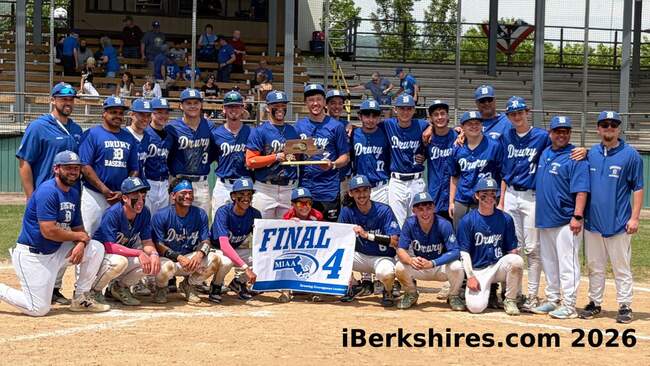
Brayden Durant struck out seven and walked one in a complete-game effort on the mound Saturday to pitch the Drury baseball team to a 6-0 win over Keefe Tech in the quarter-finals of the Division 5 State Tournament at Joe Wolfe Field. click for more