Artist Buchel Taking Mass MoCA Back to Court
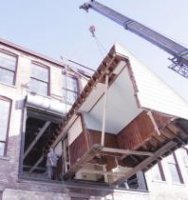 Half a house is loaded into Building 5 for Buchel's aborted exhibit. |
The latest step in the legal battle between the two stems from Buchel's aborted installation project for the museum's Building 5, which ended in acrimony and finger-pointing over budgets and the vision for the work in the absence of a clear written agreement on how to proceed.
The three-judge panel for the U.S. Court of Appeals for the First Circuit in Boston ruled on Wednesday that a lower court incorrectly ruled for MoCA in the dispute on two key points. The first is Buchel's claim that MoCA continued to work on "Training Ground for Democracy" without his consent, in a manner that could "prejudice" the artist's "honor or reputation." The court also found that the U.S. District Court for the Massachusetts District improperly ruled that Buchel could not reasonably claim that his copyright protections were violated when the museum publicly displayed his work.
The case was remanded back to District Court Judge Michael A. Ponsor, who issued the original ruling in July 2008, meaning that Buchel may proceed with the litigation on these two points.
In a statement released by MoCA's director of marketing, Katherine Myers, the museum said it was "pleased that the First Circuit upheld the district court's opinion on the Buchel matter in most respects."
Büchel's lawyers were also pleased with the ruling.
"This is a win for Christoph, and it provides clarity for a murky part of [the Visual Artists Rights Act]," said Elena M. Paul, executive director of Volunteer Lawyers for the Arts, the group that is representing Büchel.
She praised the court for issuing a key finding, that unfinished art works are protected under VARA, and that the court had decided to allow Büchel's case to proceed on two fronts, though they were still uncertain about how precisely they would proceed.
"He has two strong claims," said Sergio Munoz Sarmiento, associate director of Volunteer Lawyers for the Arts. "And we're analyzing the opinion and proceeding with the litigation."
MoCA officials said they were ready to proceed as well. "The court did grant Mr. Buchel the opportunity to return to the district court to try to prove his theory that isolated viewings of the unfinished work in progress may have harmed its integrity or reputation," the statement reads.
"While we had obviously hoped that this dispute had finally been resolved, should Mr. Buchel decide to proceed further with this case, we are confident that we exercised appropriate curatorial care and diligence in our handling of the work in progress — according to recognized practices that we and most other museums and artists follow in creating such works — and we are prepared to demonstrate that again in court."
In 2006, MoCA commissioned Buchel to create a work for the museum's cavernous Building 5. "Training Ground for Democracy" would have been one of the most elaborate works the museum has ever hosted, and would have introduced Buchel to an American audience bigger than his previous gallery shows would have allowed. Buchel envisioned the work as essentially a village ... "containing several major architectural and structural elements integrated into a whole, through which a visitor could walk (and climb)." It would come to include a two-story Cape Cod cottage, several seaship containers, a vintage movie theater and bar, several vehicles, and altogether nearly 150 tons of material.
But disputes soon arose between the artist and museum staff, a fact made worse because neither side had signed a written agreement about what they expected from each other. Arguments soon raged over the budget — which would eventually double the original estimate of $160,000 — and some of Buchel's more elaborate demands, such as for the fuselage of a jet airliner. Buchel was not shy about airing his concerns, as subsequent document releases have shown, and by early 2007 the correspondence between the parties amounted to little more than finger-pointing and tantrum-throwing.
In May 2007, MoCA took Buchel to court seeking a declaration that it was "entitled to present to the public the materials and partial constructions assembled in connection with and exhibit." Buchel responded with five counterclaims against MoCA citing violations of VARA and the Copyright Act.
After filing the suit, the museum officially cancelled "Training Ground" and opened the exhibit "Made at Mass MoCA" that highlighted some of the museum's more successful collaborations. Visitors to the museum could reach the exhibit only by passing through the half-completed Building 5 space, where elements of "Training Ground" remained under tarps.
In September 2007, the U.S. District Court for the District of Massachusetts issued a preliminary ruling in favor of MoCA. Despite the ruling, MoCA chose to take down the exhibit. In July 2008, the written ruling from the court affirmed MoCA's position.
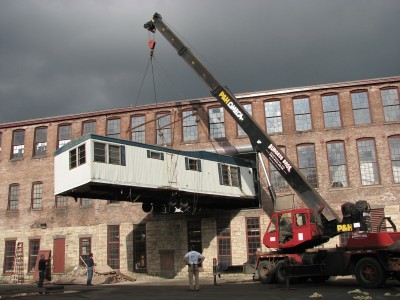 Mass MoCA and Buchel have been fighting over whether the museum violated his rights over the massive installation by showing it to select individuals during its creation. Here's another take on the brouhaha at BerkshireFineArts.com. |
In Wednesday's ruling, the Court of Appeals agreed with two of Buchel's counterclaims against MoCA. The first applied to VARA, a piece of legislation from 1990 with relatively little case law.
The appeal court ruled the district court had erred in its summary judgment for the museum "because material disputes of fact exit concerning the first of Buchel's integrity claims — i.e., that Mass MoCA modified 'Training Ground' over his objections, to his detriment. We further conclude that the record contains sufficient evidence to allow a jury to find that [MoCA]'s actions caused prejudice to Büchel's honor or reputation."
The second claim concerns part of the Copyright Act. Buchel claims the that the museum violated a section of the law by showing the work without his consent. The appeals court disagreed with the lower court's ruling, saying "there is significant record evidence suggesting that the work was repeatedly and deliberately exhibited to numerous individuals." In particular, they claim the work was shown by museum staff to visiting curators and museum directors who were in the area for a conference. "We cannot say that a reasonable jury could not conclude that the Museum violated his exclusive right to publicly display [the work]."
Through the months (and years) that the case dragged out, it sparked a heated debate within the arts community, with some rushing to defend the rights of a difficult and temperamental artists, and others seeking to defend MoCA's efforts to make the best of a bad situation.
"When a museum behaves badly, it's never pretty," wrote Roberta Smith in The New York Times in September 2007. "But few examples top the depressing spectacle at [Mass MoCA]."
"Never underestimate the amount of resentment and hostility we harbor toward artists," Smith continued. "It springs largely from envy. They can behave quite badly, but mainly they operate with a kind of freedom and courage that other people don't risk or enjoy. And it can lead to wondrous things."
But the museum had its supporters as well, including Michael Gordon, David Lang and Julia Wolfe, the founders and artistic directors of Bang on a Can. "The museum's director ... believes in art and artists, and he has shaped his institution to foster experimentation and encourage risk," they wrote in a letter to the Times in response to Smith's article. "It is true that risks don't always pay off — this one clearly didn't. But it is the risk itself that The New York Times should be supporting."
The entire affair has also figured into Büchel's subsequent art. At the Art Basel Miami Beach show in December 2007, he presented "Training Ground for Training Ground for Democracy," a scaled-down installation that featured much of the correspondence about the failed show. It was bought by collector Friedrich Christian Flick for a reported $250,000, and donated to the Hamburger Bahnhof museum in Berlin the next year.