Williamstown Selectmen Presses for Main Street Flooding Fix
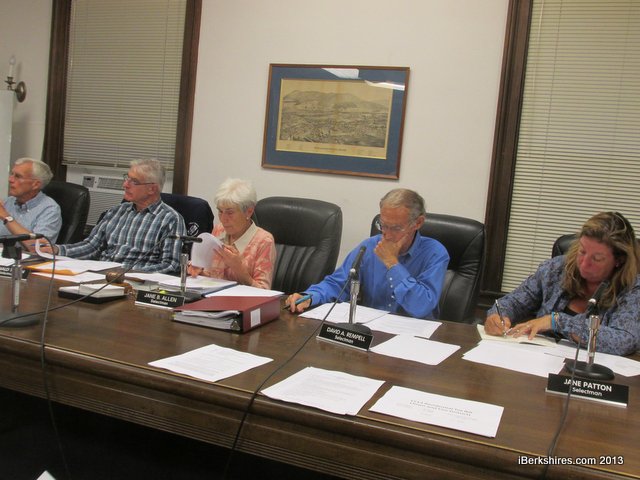 The board heard about flooding problems on Main Street and approved a tax rate that will barely affect homeowners this year. The board heard about flooding problems on Main Street and approved a tax rate that will barely affect homeowners this year. |
Residents Chanda and Mark Shin of 103 Main St. attended Monday's meeting to ask the town to address an inadequate culvert that carries water from the Luce Road/airport watershed.
"Twice in the last four months, [the culvert] has backed up and flooded our property and the highway," Chanda Shin said, reading from a letter addressed to the board. "Our house was forced to act as a dam for Main Street. On Sept. 2, water reached the foundation of our house. On May 29, water flowed around three sides of our house and within 20 feet of our front door. Water came into the basement ceiling and went down the south wall."
Mark Shin elaborated: "Every time there's a forecast of a heavy thunderstorm, we're worried we have to get the sandbags and possibly evacuate our family."
Town Manager Peter Fohlin advised the board that the Massachusetts Department of Transportation, which is responsible for Main Street (also known as Route 2), has a public hearing scheduled for Sept. 26 with the Williamstown Conservation Commission, which ultimately will determine what sort of work is possible under the commonwealth's Wetlands Protection Act.
"The meeting on the 26th is not just a meeting to talk about this," Fohlin said. "It's an application by Mass Highway to upgrade the infrastructure on Route 2. This is the first time Mass Highway has stepped up and offered to address their part of the problem."
Acting on a motion from Selectman David Rempell, the board voted unanimously to send a letter to the Con Comm and Mass Highway asking that they act to address the problem spot — one of many in town that have been affected by recent rains.
Later at the meeting, Fohlin's biweekly Town Manager's Report noted numerous storm damage repair projects that have monopolized the time of the Department of Public Works in recent months, and he said the town continues to receive calls citing previously unreported damage.
"We've done little else this summer other than recover from storm damage," Fohlin said.
Commenting on the Main Street issue, Stratton Road resident Ken Swiatek said the flooding on Main Street and at the Spruces Mobile Home Park across Main Street from the Shins' residence were exacerbated by tree clearing at the Harriman and West Airport a decade ago.
Public Works Director Tim Kaiser said Monday that while work at the airport may have contributed to the problem, it's not the main reason why flooding downhill has gotten worse.
"Storms are happening more frequently and much more intensely than before, and I have no reason to believe that's going to stop," Kaiser said.
In addition to writing the town's Conservation Commission, the Selectmen issued another piece of official correspondence on Monday: a letter supporting a grant application by four agencies partnering to develop subsidized housing on a parcel of land being donated by Williams College.
Elton Ogden of Berkshire Housing Development Corp., one of the partners, was on hand to explain that the group is seeking a loan from the Community Development Assistance Corp. to help pay for "predevelopment planning." At this stage, Berkshire Housing, Higher Ground and their partners are looking to study the site at the end of Southworth Street and do preliminary architectural designs, Ogden said.
 Chanda Shin told the board of the water problems at her home on Main Street; below, Principal Assessor William Barkin talks valuations. Chanda Shin told the board of the water problems at her home on Main Street; below, Principal Assessor William Barkin talks valuations. |
 |
Monday night's meeting also included the relatively familiar and uneventful annual tax rate classification hearing. At no time in recent memory has Williamstown opted to tax commercial property at a different rate than residential property, as it is allowed under Massachusetts law.
The town's assessors were on hand to advise the board. Principal Assessor William Barkin concurred with Fohlin that Williamstown's commercial tax base is so small that a differential rate would have little impact and so precarious that a differential rate would damage the local economy.
The Selectmen followed the advice of Fohlin and Barkin and maintained a single property tax rate. Barkin also reminded the board the town is due for a comprehensive revaluation next year but noted that the assessors have seen a couple of trends already.
"Properties in walking distance to Williamstown Elementary School seem to be garnering higher sales — sales higher than the assessed value," Barkin said. "Properties in South Williamstown are stagnant or going down in value."
For fiscal 2013, the average tax bill in town will increase by $2.44. About half the residential tax bills will go up and half will go down, according to numbers provided by Fohlin. The vast majority of Williamstown properties (2,413 of 2,590, or 93 percent) will see changes in the total bill of plus or minus $10.
"I think that is very close to being no increase in taxes," Fohlin said.
In other business Monday, Fohlin reported that the town is waiting to hear back from the attorney general's office to see whether it will accept a Spruces Mobile Home Park Tenants Association notification that it does not intend to purchase the park.
The residents sent the town a letter on Aug. 19 indicating that the majority of residents had no interest in exercising their right of first refusal to purchase the park. The sticking point may be that the official notification from park owner Morgan Management of its intent to sell the park to the town was dated Aug. 21.
If the AG's office OKs the vote, it would allow the town to schedule a special town meeting this fall to accept ownership of the park under the terms of a federal Hazard Mitigation Grant in which the town partnered with Morgan Management.
If the AG's office says the date discrepancy nullifies the vote, the residents presumably would still be operating under the 45-day window to exercise a right of first refusal created by the commonwealth's Manufactured Housing Community Law.
Tags: affordable housing, flooding, Higher Ground, road work, Spruces,