Cable Mills Developer Believes Housing Start by Next Year

By Stephen DravisWilliamstown Correspondent
Print Story | Email Story
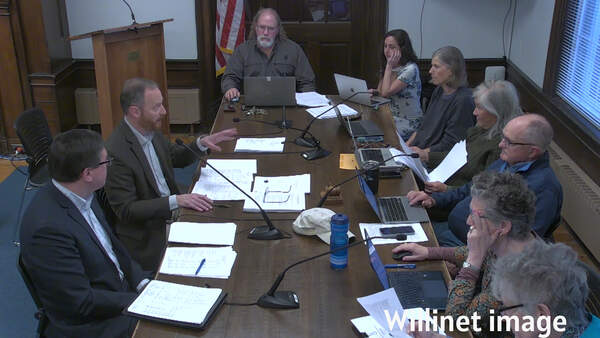
David Traggorth, representing the Cable Mills project, updated the Community Preservation Committee on some hopeful signs for the long-delayed endeavor.

Updated Oct. 18, 2013, at 1 p.m. with more information on the Cable Mills project and the meeting.

WILLIAMSTOWN, Mass. — The director of development for the owner of the Cable Mills complex told a town committee Thursday that the developer hopes to have shovels in the ground as early as this spring.

That is assuming that the Mitchell Properties gets the good news it anticipates from the commonwealth this November.
 
David Traggorth met with the town's Community Preservation Committee to give it an update on the long-delayed housing renovation and discuss some of the reasons why it has taken so long to get started.
 
The good news, Traggorth said, is that he and his employer, Bart Mitchell, are confident that it will have the final piece of its financing puzzle sometime next month. That is when the Department of Housing and Economic Development is expected to announce its next round of affordable housing resources and tax credits.
 
Mitchell Properties has applied to receive $1.3 million from the state program — one small but essential part of the $26 million it needs to create 61 units of housing, including 13 units of subsidized housing, at the historic mill site.
 
"Our [turn] is hopefully due this November," Traggorth said. "That's one of the key pieces we need to get this project going. ... In terms of our experience on all the other projects we've worked on — not only our experience but the experience of our peers."
 
The CPC asked for a meeting with Mitchell Properties in light of the fact that the town committed $1.525 million of Community Preservation Act funds to the Cable Mills project at the May 2007 Town Meeting. The committee hoped to impress upon the Boston developer how that long-term commitment might constrain the town in years ahead and get a status report on if and when the project might get under way.
 
Traggorth thanked the town for its patience and expressed Mitchell Properties' continued commitment to bring the project to fruition.
 
And a member of the CPC was in turn able to give Traggorth some good news to take back to Boston.
 
"When [Undersecretary for Housing and Community Development] Aaron Gornstein was here in late summer ... I told him there's a risk because this money was tied up, this CPA money was tied up for six years, that people were getting uneasy about hearing, 'Next spring, next spring, next spring' and thinking about reversing that commitment," Selectmen Chairwoman and CPC member Jane Allen said. "His words to us were, 'Please hang in there. This project is going to happen.' "
 
Traggorth welcomed that bit of information
 
"He's the undersecretary, he's the best source you can have," Traggorth said. "He has a huge say on the recommendation to Secretary [Gregory] Bialecki and the governor."
 
But a few more recommendations cannot hurt, so Traggorth recommended that town boards and committees and even private citizens call state officials and Sen. Benjamin Downing, D-Pittsfield, to let them know how important the project is. Downing is strong supporter of the Cable Mills project, but an extra phone call from constiuents is never a bad thing, Traggorth said.
 
"They award projects on their merit," Traggorth said. "No one says this project doesn't merit these resoruces, but it doesn't hurt to remind them ... there's a town that supports it. It's one thing to have Bart [Mitchell] and David [Traggorth] telling them. If it comes from you, in that setting, it's a100 times better."
 
Traggorth said if Mitchell Properties gets the news it hopes for next month from the state, it could start work on the project in the spring with a 12- to 13-month timeline for completion. Phase 1 of the project calls for 61 rental units in the three existing brick buildings plus a riverwalk. Phase 2 would call for townhouses along the river, but that new construction would not involve any of the CPA funds.
 
According to Town Manager Peter Fohlin, the remaining $1.375 of the town's commitment to the project (a portion was spent in 2009) would be paid in a lump sum to Mitchell Properties from a bond that would be paid off by the town — using CPA funds — for a period of, perhaps 20, years. Under the scenario of a 20-year bond, the town's payment would be a little less than $150,000 per year, a figure that would eat up more than half the $266,000 the CPC allocates each year.
 

The CPC recommends to town meeting each spring how the town should spend money generated through taxation under the Community Preservation Act, an levy Williamstown adopted in 2002. The town taxes 2 percent on property value (after the first $100,000) to use toward community preservation and receives a partial match from the commonwealth.

The CPA allows those funds to be spent in three areas: subsidized housing, historic preservation and open space and recreation.
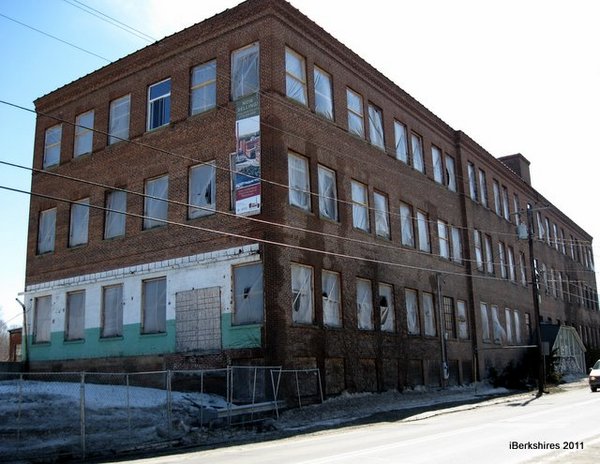
Plans to tranform the former cable plant into housing have been in the works for a decade.
The Cable Mills project checks all three boxes. It preserves historic structures, creates a new recreation area on the Green River and designates 20 percent of the housing units as income-sensitive affordable housing.

On Thursday, Traggorth took the CPC through the history of the project, starting with developer Robert Kuehn's plan for a condominium development. After Kuehn died in 2006, Mitchell, a Williams College alumnus and former trustee of the college, purchased the property for a little more than $3 million, Traggorth said.

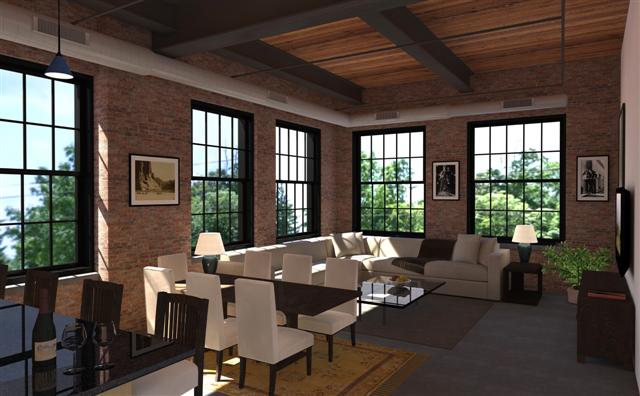
"We realized the development plan he envisioned was difficult ... but we saw a lot of potential in terms of condominiums with gorgeous views on a 9-acre site and units with 16-foot ceilings," he said. "It's just an amazing property."

But after finding the right building contractor and getting cost estimates that made sense financially, Mitchell Properties ran headlong into the financial crisis of 2008. Funding for condominium projects dried up, and it remains virtually non-existent to this day, Traggorth said.

"We've done many condo projects prior to 2009, and we had many in the pipeline at that point ... and all had the same issue," he said. "There were no condominium lonas. We, like many developers,had to step back and say, 'How do we make it work.' "

After receiving indications from banks that presales might help, Mitchell started marketing condo units at Cable Mills. But despite abundant interest in units at the site, the financing did not materialize.

"The bank told us it didn't matter how many you presell," Traggorth said. "[Loan officers] said, 'We cannot say the word "condominium" in the loan committee without, essentially, being fired.'

"At that point, we had already started converting some units to rentals."

Today, the plan is for all 61 units to be rentals, at least for the first five years of occupancy, Traggorth said. The state funding Mitchell is counting on requires the units to be rentals for at least that long, he said.

The full array of government funding Mitchell is pursuing includes up to $6 million in state historic tax credits, the affordable housing resources and tax credits and Williamstown's CPA money.

Traggorth said the town's commitment to the project, while small in the big picture, is vital.

"One of the threshholds for that $1.3 million [from the commonwealth] is you must have local funding to be eligible," Traggorth said.

"They won't even look at us unless we have local funding. They want to know the locality supports the project."

And even though the town's long-term commitment of CPA funds to pay off the bond will limit the funds available for other local projects, the chairman of the town's Affordable Housing Committee attended Thursday's meeting to note that the AHC strongly supports the Cable Mills effort.

"I don't want to have anyone doubt that the Affordable Housing Committee supports this project 100 percent," Catherine Yamamoto said.

Yamamoto pointed out that working with Mitchell Properties allows the town to leverage the CPA funds to create many more units than the town could build using its money alone.

"It's a bargain," she said.

All in all, the Community Preservation Committee appeared satisified with Traggorth's answers and encouraged by his optimism. The town manager made it a point to note that he continues to be pleased with the candor of Traggorth and his boss.

"In listening to David for probably five years and Bart [Mitchell] and Bob Kuehn for however long ... he has been 100 percent consistent over the years in every conversation," Fohlin said. "And I didn't hear anything tonight that wasn't consistent with a year ago and two years ago and three years ago.

"When people are not being candid, they have a hard time being consistent. When they are being consistent, that is the truth. I was very happy to hear consistency from [Traggorth]."


Tags: affordable housing,   Cable Mills,   Community Preservation Act,   housing projects,   
If you would like to contribute information on this article, contact us at info@iberkshires.com.

Williamstown Studying Major Overhaul for Main Street

By Stephen DravisiBerkshires Staff
WILLIAMSTOWN, Mass. — The town is working with a Worcester civil engineering firm to redesign Main Street with an eye toward a major project sometime in the next decade.
 
Community Development Director Andrew Groff was before the Select Board on Monday night to talk about Town Hall's use of a $500,000 state grant to do preliminary design on major improvements to that portion of Route 2 that runs from Water Street west to the Field Park rotary, through the middle of Williams College's campus.
 
Groff introduced the elected officials to Amanda Bazinet of Worcester's Vanasse Hangen Brustlin, who is helping the town to develop a plan for Main Street that would align with the commonwealth's Complete Streets Program.
 
"Our project goals, in addition to the increased pedestrian and bicycle accommodations, is just, in general, improving the sightlines and improving the intersection geometry," Bazinet said.
 
"Complete Streets … has a lot of different facets to it. As Andrew had mentioned, the goal is to improve the safety for all of the roadway users — not just the motorists. We're looking at improving it for pedestrians, bicyclists, anyone using a mobility device. We want to create streets that are safe for all ages and abilities to use. So, while bicyclists will still be allowed, legally, to use the roadway, we want to look at providing a separate bicycle accommodation along the corridor, whether it's a shared use path along both sides of the streets that is a little more accessible to young children or older people with disabilities to look at all transportation options."
 
One goal is to encourage "active transportation." The Massachusetts Department of Transportation, who the town hopes one day might fund the construction, has a "healthy transportation policy," Bazinet said.
 
That MassDOT funding would come through the Transportation Improvement Program, which is managed locally by the Berkshire Regional Planning Commission. The design work underway now is being done with an eye toward going after TIP funding years down the road.
 
View Full Story

More Williamstown Stories