Berkshire House Reps Lay Out 2014 Agenda
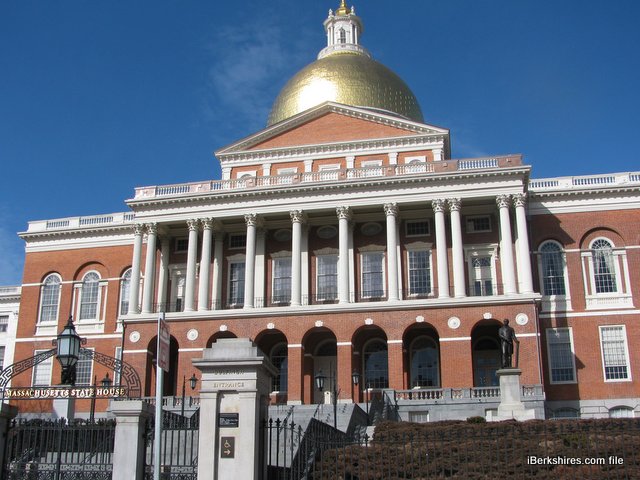 The county's delegates to the House of Representatives spoke about what they hope to accomplish in the final months of the session. The county's delegates to the House of Representatives spoke about what they hope to accomplish in the final months of the session. |
PITTSFIELD, Mass. — After a North County woman was assaulted, she attempted to buy pepper spray or Mace to protect herself in the future. But she was denied because Massachusetts laws prohibit ownership without an firearms identification card — and that takes months.
State Rep. Gailanne Cariddi, D-North Adams, hasn't forgotten that story and filed a piece of legislation earlier this year to reverse those laws. When she returns to the State House in the new year, Cariddi says she believes that change will happen.
"That bill has been rolled into the upcoming legislation on firearms," Cariddi said.
Cariddi's bill would remove the FID requirement and, in its place, require that purchasers be over the age of 18 and implements fines for those who use pepper spray or Mace for something other than defense.
The bill is wrapped into the larger gun legislation report that is expected to come out in the upcoming weeks and is expected to be voted on in the next year. Cariddi says she is confident that her provisions won't change.
The Public Safety Committee has formed a commission to investigate gun violence and narrow down 61 different pieces of legislation into one comprehensive report, which should be on the House floor in 2014.
"It's complicated and has a lot of emotion behind it," said state Rep. Tricia Farley-Bouvier, D-Pittsfield.
Farley-Bouvier particularly is looking for the state to join others in sharing mental health records through a federal database. She hopes that not only can mental health checks be part of the requirements for buying a gun but also that local police chiefs, who issue gun permits, are privy to that information and can say no to certain applicants.
"We want to give local control. We want the chief to use his good judgement," Farley-Bouvier said.
But debate over guns isn't the only hot topic issue on slate for 2014. Almost immediately, Farley-Bouvier expects debate on raising the minimum wage. The state Senate passed a bill linking the minimum wage to inflation and sets a goal of raising it to $11 an hour from the current $8. The House is expected to craft is own piece of legislation.
"Once we get back, we will probably be getting into the minimum-wage debate," said Farley-Bouvier, who has been working with progressive Democratic groups and representatives in crafting the bill. "It is on the ballot [by citizen petition], which gives, us leverage that we didn't have before."
Rep. Paul Mark, D-Peru, said the ballot question will be the spark to push both the House and the Senate to pass a bill.
"I think the minimum wage is going to be an interesting debate," Mark said. "I think ultimately we are going to pass a minimum wage increase."
While Farley-Bouvier is in full support of raising the minimum wage, saying it will help stem the tide of poverty, in Southern Berkshire County, Rep. William "Smitty" Pignatelli, D-Lenox, is cautious about following the footsteps of the Senate.
"I think what the Senate did took us by surprise. My hope is the House takes a broader look at it," Pignatelli said, adding he wants the bill to also protect employers.
Coupled in the wage bill is reforms to unemployment insurance, another sticky issue that Farley-Bouvier wants to be careful of because of the possibility of "unintended consequences." There have been proposals to reduce benefits from 30 weeks to 26 weeks while raising eligibility from 15 weeks to 20 weeks, Farley-Bouvier said. She does not support either.
Instead, Farley-Bouvier wants to lower the rate employers pay for insurance. That would benefit small businesses that seldom use the unemployment system, she said.
 |
|
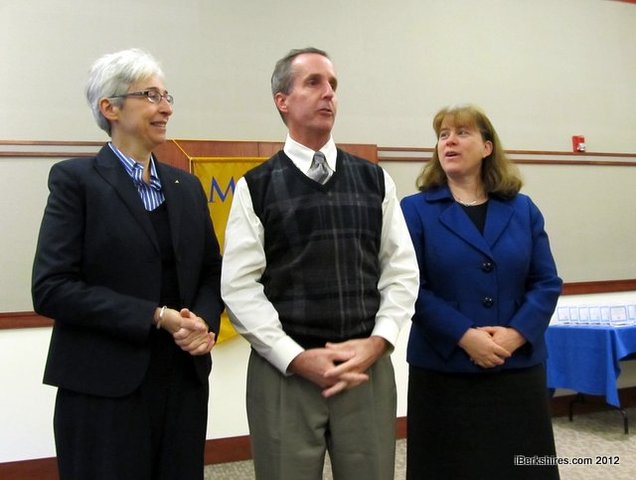
.JPG) Higher education costs are a priority for state Rep. Paul Mark, in the file photo at right. Above Reps. Gailanne Cariddi, left, William 'Smitty' Pignatelli and Tricia Farley-Bouvier, at an MCLA event last year, are looking at minimum wage, firearms legislation and PILOT funds. Higher education costs are a priority for state Rep. Paul Mark, in the file photo at right. Above Reps. Gailanne Cariddi, left, William 'Smitty' Pignatelli and Tricia Farley-Bouvier, at an MCLA event last year, are looking at minimum wage, firearms legislation and PILOT funds. |
Cariddi says she will be advocating for more money in the budget for food pantries. With unemployment numbers still high, she said food banks are even more important and she wants them to have all of the resources they can get.
Gov. Deval Patrick will release his budget by the third week in January. That will show the representatives where revenues are projected and where the governor's priorities in his final year in office.
"It's going to be an interesting year. The governor will be releasing his last budget so I expect there to be some legacy items in there," Pignatelli said. "Our focus is going to continue to be on the economy and getting people back to work."
Pignatelli said the Ways and Means Committee, which he sits on, has been reviewing revenues on a monthly basis and so far, "I'm optimistic." When the governor's budget does come out, Pignatelli wants to make sure local aid and Chapter 90 road funding is "protected."
Mark, too, will be keeping and eye on those funds but also wants to ensure towns get reimbursements for Hurricane Irene damage, increases in regional school transportation funding and support for "buy local" campaigns. He's alos trying to up the payment in lieu of taxes the state gives to town, noting his district has a lot of state-owned land.
But Mark's No. 1 focus will be extending the so-called 50/50 deal, which increases funding for public colleges and universities in exchange for freezing of rates and fees.
"For me the focus is going to be higher education," Mark said.
Mark led a subcommittee studying higher education costs and various bills about how to reduce student debt. The group just finished a series of hearings across the state and will have until March to finalize a report and craft bills.
Pignatelli is hoping a bill he already filed to forgive student loans for social workers receives a positive recommendation from Mark's committee.
"My loan forgiveness bill has already received favorable remarks from committee," Pignatelli said. "We need to recognize how expensive higher education is."
Mark said the hearings and study has pushed a bill to encourage co-operative business ownership to the back burner so he hopes to get back to pushing for that. That bill just recently had a committee hearing and Mark is hoping it will end up on the floor in the new year.
"It's to promote co-operatives as a business model. If the employees own the business they are less likely to sell out and move it to China," Mark said.
Cariddi says she will be pushing for additional funding for education because "education helps everything." From being able to freeze college tuition rates to helping Head Start programs, Cariddi believes education is the proactive way to fight major issues facing the county — such as poverty and teen pregnancy.
"I want to see education continue to increase in funding on all levels," Cariddi said.
Farley-Bouvier agrees with preserving funding for cities and towns but will also be pushing for the human services reserve fund to help those organizations working with elderly and disabled people.
As for revenues, Pignatelli said he will continue to push for a bill to reduce the toll amount for Berkshire residents using the Massachusetts Turnpike. With tolls going back onto the Western end of the turnpike, Pignatelli said he is working with state Sen. Benjamin Downing and legislators from the Cape to advocate for a discounted rate for residents who use it often.
The revenue picture isn't entirely clear but most of the state representatives said revenues are looking up. However, the state income tax rate, which is tied to tax revenues, is expected to drop from 5.25 percent to 5.20.
"The income tax is going to come down so there is $60 million that was expected to be in the budget that is now missing," Mark said. "The revenues have been coming in higher than everyone expects but the result of that is the income tax."
The governor's transportation bond bill passed last year will be debated with each of the representatives advocating for construction projects in their own districts. The Legislature decreased the size of the governor's proposal so competition for those funds will be increased.
"I'll be advocating for projects in towns like Dalton but so will everyone else for their districts," Mark said.
Pignatelli will also be pushing his health care parity act, which is eyed to force insurance companies to extend health care payments to those being treated for substance abuse.
"It comes down to cost. We're getting push back from insurance companies because they don't want to pay out," Pignatelli said. "They barely pay for detox and don't pay anything for care afterward. It sends the wrong message. ... We need to treat substance abuse the same way we treat someone with a broken leg."
Substance abuse, especially of heroin, is a major issue in the Berkshires, Pignatelli said, and this bill will help pay for the treatments drug users need to become sober. He said insurance companies only pay for five to seven days in rehabilitation units when the patients needs longer times.
Related to health care, Cariddi has filed a bill that would require central service technicians to be certified. Those employees are responsible for cleaning and sterilizing surgical instruments but require no training, which Cariddi says is a danger to anyone getting surgery.
"Right now the profession is not regulated in Massachusetts," Cariddi said.
Cariddi is also looking to file a bill that would require companies hired to solicit donations by phone to answer honestly how much of the donation actually goes to the charity. Cariddi says charitable organizations that do fundraising with local volunteers won't be affected but rather companies hired to solicit donations that are paid a percentage of what they raise.
"It helps people who get fundraising calls and right now if you have a conversation with someone asking for money, and you ask them how much goes to the charity, they can tell you 100 percent when it's not," Cariddi said.
The issue is complicated and has ended up in the Supreme Court, Cariddi said, but she hopes the bill will come to a vote and be passed.
Cariddi is also the co-sponsor of a bill on genetically modified food requiring that information be clearly explained on ingredient labels.
Meanwhile, Farley-Bouvier has filed a bill that would allow illegal immigrants to receive drivers' licenses. Farley-Bouvier said the bill is eyed to improve safety on the roadways.
"The goal of that is to have all drivers in Massachusetts trained, licensed and insured in Massachusetts," she said. "It'll help make the roads safe."
Another bill she introduced is receiving mixed results so she doesn't know where it will go in the next year. Farley-Bouvier has proposed a pilot program to look into switching the gas tax out with a tax on miles driven. The program recently had a committee hearing.
"I think there is a lot of misunderstanding about it," she said, emphasizing that the bill creates a pilot program only to investigate the possibilities; it would have to be implemented to replace the gas tax. "I really believe this will protect rural drivers."
Also on the docket for the upcoming year is welfare reform. Both the Senate and the House have passed their own reform bills and a conference committee is sorting out the difference.
Farley-Bouvier hopes to increase the limit on vehicle assets, which is current $5,000. She says if a recipient owns a vehicle worth less than $5,000, they are likely spending money to repair it often. Allowing recipients to have a better vehicle will help get them back on their feet quicker, the same reason she supports a provision allowing recipients to save money without it affecting their benefits.
Formal Legislative session is scheduled to begin right after the new year. The governor must introduce a budget by Jan. 21 and the two-year legislative session ends in the summer — giving the representatives just about five months to push all of their bills through the system. This upcoming year is also an election year.