Consultants Peg Pittsfield Road Maintenance at $3.5M Annually
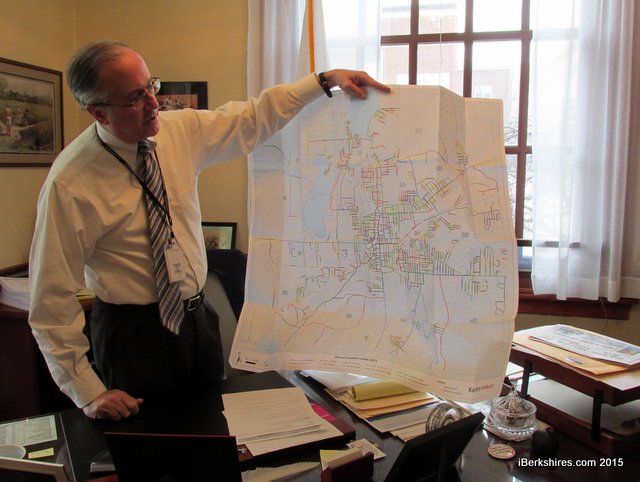 Mayor Daniel Bianchi says consultants ranked the condition of each of the city's 858 roads to help decide when they are repaved. Mayor Daniel Bianchi says consultants ranked the condition of each of the city's 858 roads to help decide when they are repaved. |
Consulting firm Kimley Horn and Associates surveyed every road in the city, categorizing them as in "fair" condition.
But to keep them from deteriorating, the report is recommending spending upward of $3.5 million per year on maintenance.
"It is recommended that the city increase the annual pavement maintenance budget to a minimum of 3.5 million dollars to address more critical repairs and maintain/improve the current network condition," states the report, which was completed in July and updated in October.
The company, along with the city's engineering department, assessed each and every one of the city's 858 roadways and their 31,300,876 square feet of pavement. Each road was ranked on a zero to 100 point weighted scale. The weights give main thoroughfares extra points and residential areas with low density fewer.
"We completed an analysis of each and every street in the city and we did core samplings. We cut into the street with a big auger in four-foot sections of roads so we know what is underneath there," Mayor Daniel Bianchi said. "We rated each and every street in the city."
The company says overall, the city's roads rank 57.99 on the scale, which puts them in the "fair condition." However, it identified that the "critical point" for any one road is 57.
"The 'critical point' of 57 on the curve is considered the threshold where preventative maintenance measures become less cost-effective. Some form of rehabilitation is required for pavement to restore serviceability when pavement falls below the critical point and typically requires more costly repair," the report reads.
Essentially, the company's opinion is that the lifetime of the roads can be extended through a management plan that mixes the types of repairs.
"The basic philosophy of pavement management is to apply preventive maintenance treatments at appropriate times to retard the rate of pavement deterioration. Both preventative maintenance and rehabilitation techniques should be applied at times when they are cost-effective instead of letting the pavement deteriorate to failure, which requires more expensive reconstruction," the report reads.
The mayor said, "people just assume that you take the absolute worst road. But if you do nothing but that, very quickly the roads in a fair condition will deteriorate into poor condition. Believe it or not, you have to spend money on roads that are rated fair. You should, theoretically, have to spend less money per road and in the long run."
The company analyzed the typical spending amount the city has been putting forth at $2.1 million per budget year and says that's not enough. If the city spends that much per year, in five years the roads overall will fall to a 52.42 level.
"The declining trend in [ranking] after year 1 indicates that the current budget is not sufficient to maintain the current condition," the report reads, later making the suggestion for at least $3.5 million annually.
Already, Kimley Horn believes the city is already behind with $45,000 in backlogged work.
"We probably should be spending about $3 million every year to keep our roads in good condition," Bianchi said.
This year, the city is hitting close to the $3.5 million target. The City Council approved borrowing $3 million for pavement projects and that work is expected to be bid in the coming month. But, Bianchi says he won't be asking for that much again.
"We can't continually borrow $3 million a year. We just can't afford to do that. I'm going to ask that the City Council be understanding about that. So I think it will be a little bit less this year but we have to have a better handle on where Chapter 90 is going to be," Bianchi said.
The mayor says he gave a copy of the report to Gov. Charlie Baker in hopes for increases in Chapter 90 funding, the state assistance for pavement projects. And the mayor has been talking the right language for the new state administration because Baker's first move was to release $100 million in Chapter 90 funding.
"I am pleased that one of the first acts of this administration is to fulfill our commitment to ensure local governments have access to the infrastructure funds they have been promised for transportation upgrades," Baker said in a statement. "The release of these funds represents a step towards creating better jobs and building stronger communities in Massachusetts."
The city's engineers are currently crafting the plan to use the city's $3 million borrowing approval and will use the Kimley Horn report to help guide which roads receive work. Bianchi hopes to use the report to start building a database of road conditions.
"This is what every community should be doing because it will allow them to really quantify what they need to do," the mayor said, holding up a large map of roads and color-coated by condition.
Meanwhile, Bianchi said he is working closer with Berkshire Gas to plan roads work. The mayor had looked to do areas off Springside Avenue, such as Brown, Sadler and Roland streets, last year — until Berkshire Gas informed the city it would be replacing lines in that neighborhood this year.
"Those were the streets that were high priority for me. If we didn't do this coordination, we would have went ahead and spent millions of dollars to fix them up and then had to gas company come along and rip them up," Bianchi said. "So, we're going to do a better job [communicating]."
The mayor says he plans to hold a public meeting to explain the new management system.
Pittsfield Pavement Management Report by iBerkshires.com
Tags: Chapter 90, consultant, paving, road project, road work,