image description
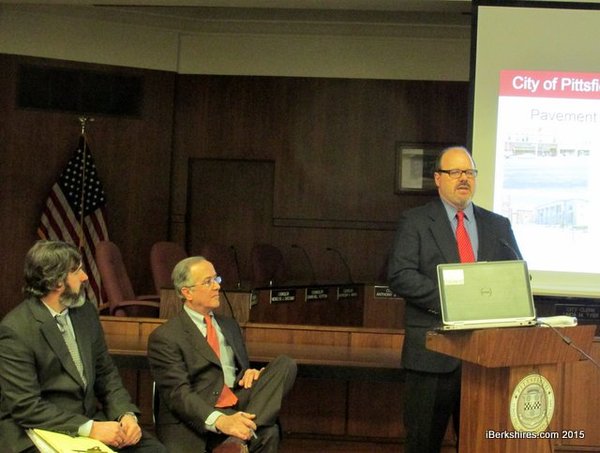
City Engineer Matthew Billetter, Mayor Daniel Bianchi and Mark Balon from Kimley Horn discussed the new prioritization system.

Pittsfield Implementing New Pavement Management System

By Andy McKeeveriBerkshires Staff
Print Story | Email Story
Mark Balon from Kimley Horn presented the consultants findings on the city's paving issues at City Hall on Thursday night.
PITTSFIELD, Mass. — Consultants Kimley Horn is telling the city to break the habit of fixing the worst roads first.
 
Instead, they suggest a plan that mixes maintenance of some of the better roads, rehabilitation of the mid-level conditions, and total resurfacing of the worst. By creating a plan that includes a bit of everything, the city gets the most value for its spending, the consultants say.
 
"It is more cost effective to repair pavements with a pavement management system," said Mark Balon, who presented the company's findings on Thursday night.
 
Overall the city's roads are ranked at 58 on a scale of 100, according to a rating system the company did on each of the city's 858 roadways. That is "fair" condition and above the "critical point," Balon said.
 
The price per square foot for pavement work increases dramatically once the road drops below 57, he said.
 
The goal of the company's recommended approach is to keep roads above that critical point through a series of preventative maintenance projects to extend the life of each road. Above the critical point, repairs are 43 cents per square foot or lower but when it dips below, repairs jump to more than $2.50 per square foot.
 
"You get a lot of life on these types of pavements and the goal is to continue to maintain these pavements," Balon said. "We want to maintain it above the critical point."
 
Now that the roads have been assessed and ranked, city engineers need to plan accordingly. The company's programs prioritize through a weighted scale to help direct when projects should be done.
 
"We had some good systems in place but we really wanted a tool for longer-range planning and that's what this will do for us," said City Engineer Matthew Billetter. 
 
Mayor Daniel Bianchi added that the city is now working even more closely with Berkshire Gas Co. to plan out when projects will be done to avoid conflicts. He hopes to have long-term plans posted on the city's website that will give dates as to when each road will be done so residents will know what to expect.
 
"We have to take a much more scientific approach," he said of the system. "We have to be more economical. We have to be more economical in our approach and we have to make every dollar count. ... It is a scientific approach that makes sense and that we think has great value to us." 
 
However, the city currently isn't budgeting enough to improve the roads over time. At the current spending level of about $2.1 million, the company says the overall score will drop to 52, which still keeps the roads in "fair" condition but doesn't improve them.
 
"We used $2.1 million and we saw that by doing that we lose the overall condition index," Balon said. "I really think $3.5 million would probably be at that point if you were trying to budget every year."
 
At $3.5 million, the city will start to have less money being spent on full reconstructions and more on maintenance projects. But, there will still be full reconstruction projects.
 
The inventory and condition assessments that Kimley Horn created need to be kept up, Balon said, and the company will still be available to help.
 
For more details on the report click here.

Tags: maintenance,   paving,   road work,   
If you would like to contribute information on this article, contact us at info@iberkshires.com.

West Nile Virus Confirmed in Mosquitoes From Pittsfield

Staff Reports

PITTSFIELD, Mass. — The Massachusetts Department of Public Health (MDPH) announced today that West Nile virus (WNV) has been detected in mosquitoes collected from Pittsfield.

The City of Pittsfield has confirmed two isolations at the Pittsfield-Richmond town line on Route 41 and the other at Garland Avenue.

WNV is most commonly transmitted to humans by the bite of an infected mosquito. The mosquitoes that carry this virus are common throughout the state and are found in urban as well as more rural areas. While WNV can infect people of all ages, people over the age of 50 are at higher risk for severe infection. 

At the time, there are no confirmed human cases of WNV, but residents are encouraged to take the following actions:

Avoid Mosquito Bites

  • Apply Insect Repellent when you go outdoors. Use a repellent with DEET (N, N-diethyl-m-toluamide), permethrin, picaridin (KBR 3023), IR3535 or oil of lemon eucalyptus [p-methane 3, 8-diol (PMD)] according to the instructions on the product label. DEET products should not be used on infants under two months of age and should be used in concentrations of 30 percent or less on older children. Oil of lemon eucalyptus should not be used on children under three years of age. Permethrin products are intended for use on items such as clothing, shoes, bed nets and camping gear and should not be applied to skin. 
  • Clothing Can Help reduce mosquito bites. Although it may be difficult to do when it’s hot, wearing long-sleeves, long pants and socks when outdoors will help keep mosquitoes away from your skin.
  • Be Aware of Peak Mosquito Hours - The hours from dusk to dawn are peak biting times for many mosquitoes. When risk is increased, consider rescheduling outdoor activities that occur during evening or early morning. If you are outdoors at any time and notice mosquitoes around you, take steps to avoid being bitten by moving indoors, covering up and/or wearing repellant.

Mosquito-Proof Your Home

  • Drain Standing Water – Many mosquitoes lay their eggs in standing water. Limit the number of places around your home for mosquitoes to breed by either draining or getting rid of items that hold water. Check rain gutters and drains. Empty any unused flowerpots and wading pools and change water in birdbaths frequently. 
  • Install or Repair Screens - Some mosquitoes like to come indoors. Keep them outside by having tightly-fitting screens on all your windows and doors.

While the City of Pittsfield and Berkshire County Mosquito Control project continue to work closely with the MDPH and other agencies, locally we are taking the following actions: larvicide application, conducting targeted education programs, distribution of fact sheets on WNV and on reducing exposure to mosquitos and treating catch basins.

Additional information about WNV and reports on current and historical WNV virus activity in Massachusetts can be found on the MDPH website at: www.mass.gov/dph/mosquito.

View Full Story

More Pittsfield Stories