image description
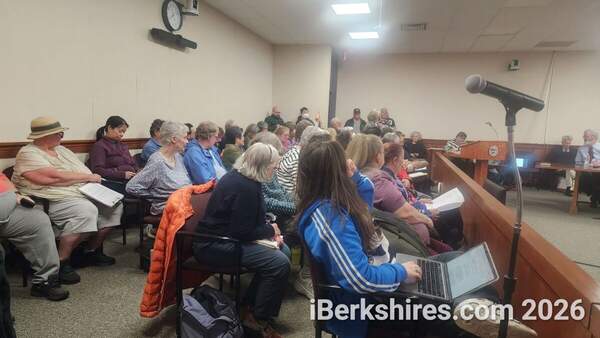
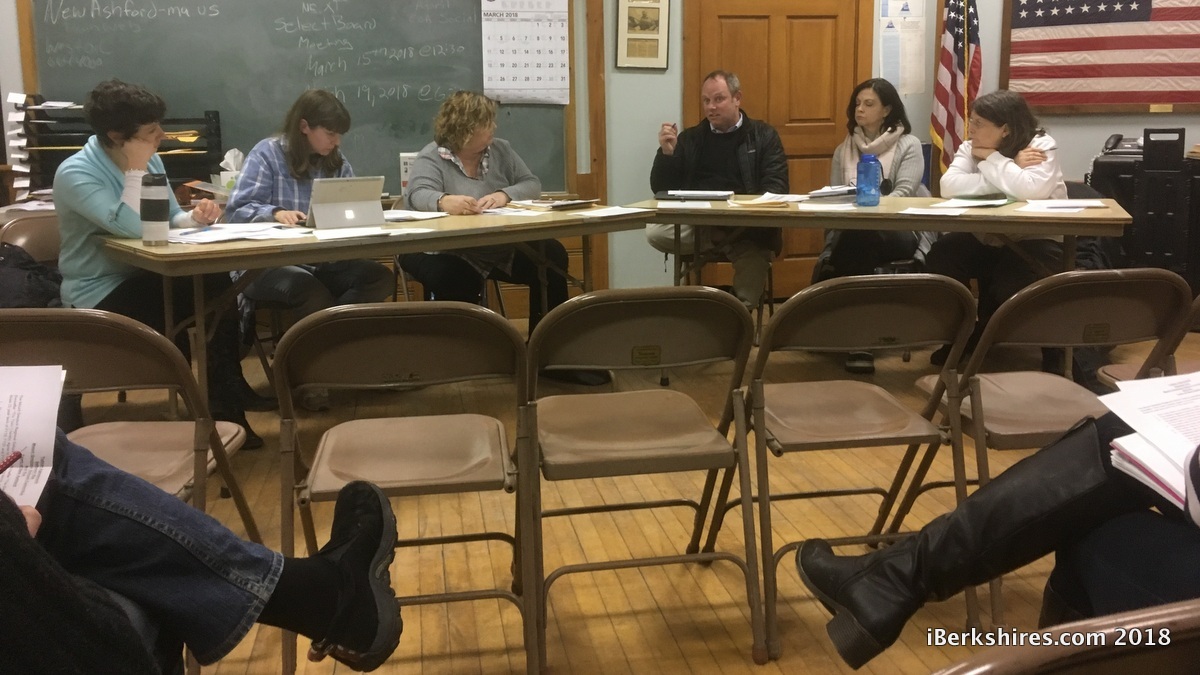
The three-person New Ashford School Committee, left, meets Wednesday night with their superintendent, business manager and special education director.

New Ashford School Committee Wants Another Negotiation on LES Tuition

By Rebecca DravisiBerkshires Staff
Print Story | Email Story

NEW ASHFORD, Mass. — The School Committee on Wednesday night voted to accept a tuition agreement to send its seventh- through 12th-graders to Mount Greylock Regional School but asked its chairwoman and its superintendent to try again to negotiate a lower tuition rate to be able to continue sending its younger students to Lanesborough Elementary School.

The three-person committee agreed to recommend that the town approve at town meeting the increased rate of $14,477 for its middle and high school students, contingent upon some clarifications in the language about special education students and transportation costs.

But after nearly two hours of fielding questions and listening to impassioned pleas from a current Mount Greylock student and several parents of students in town, and after acknowledging that the town likely would not approve such a large budget increase at town meeting, the committee decided not to accept the $17,314 per-pupil rate set for Lanesborough Elementary. That figure is nearly double the current tuition rate New Ashford pays to send its kindergarten through sixth-graders to Lanesborough.

The new Mount Greylock Transition Committee earlier this month agreed to set a split rate next year in the new school district — $14,477 for New Ashford and Hancock students attending Mount Greylock Regional School and $17,314 for New Ashford students attending Lanesborough Elementary.

School Committee member Jennifer Welch, also the mother of two current Lanesborough Elementary students, said she was under the impression that the Transition Committee had wanted New Ashford to come back with a figure the town could afford in an effort to assure the district that it could count on the revenue attached to the town's students as it developed its own budget.

"They were expecting us to come back with a figure. They were expecting us to negotiate," she said.

But Peter Dillon, superintendent of Shaker Mountain School Union 70, which comprises New Ashford, Hancock and Richmond, said he was not optimistic that any new negotiations would be welcome. While the Transition Committee might have been willing to negotiate further on its own, it has decided to honor the decision the Lanesborough School Committee made last spring to charge New Ashford the Department of Elementary and Secondary Education per-pupil rate, despite his efforts to broker a better deal for the small town.

"We made what I thought was a compelling argument that it should be phased in," Dillon said. "They said it was their obligation to honor the previously negotiated rate.

"It's my deeply held belief that the Lanesborough piece of this is not going to change," he said. "My sense is it's very clear they are not budging."

The New Ashford School Committee decided, however, that it should make that argument again, authorizing a counter-offer of $12,477, which represents a $3,500 per-student increase, for this year, with step increases over the next two years to reach the DESE per-pupil rate by the end of a three-year contract.

"I think this shows a good faith," Welch said.

While it appeared the majority of the residents who attended Wednesday's meeting approved of trying again to negotiate with the Transition Committee, Dillon shared information he had gathered about three other options for the town's kindergarten through sixth-grade students. 

One was the town of Hancock, which has its own elementary school and also tuitions its older children into Mount Greylock. Dillon said Hancock would charge New Ashford $10,000 per student. Dillon said this was the option that makes the most sense geographically, and Hancock's principal, Jay Merselis, who attended the Wednesday's meeting, said he would be happy to talk more with the town about what his school could offer.

"We would welcome you with open arms," he said.

Dillon also received preliminary estimates from both North Adams for $11,945 per student and Pittsfield for $13,316 per student. Neither of these options seemed to garner much enthusiasm, so Dillon said he would focus on getting more solid numbers from Hancock for "extras" the town might have to pay for over and above the $10,000 per student, including helping fund the addition of a full-time nurse at the school to assist with a New Ashford student with medical needs.

The committee decided to set another meeting after it has more information about possible negotiations with the Transition Committee and more detailed numbers about Hancock so that it could prepare a budget in a timely manner to present to the Select Board in advance of town meeting.

They also discussed when to approach the Mount Greylock School Committee — once it is past its transition phase — about having New Ashford join the district.


Tags: LES,   MGRS,   new ashford,   tuition,   

If you would like to contribute information on this article, contact us at info@iberkshires.com.

Youth For The Future: Adwita Arunkumar

By Breanna SteeleiBerkshires Staff

PITTSFIELD, Mass. — Williams Elementary School fourth-grader Adwita Arunkumar has been selected as our April Youth for the Future for her mentoring of a younger child.

Youth for the Future is a 12-month series that honors young individuals that have made an impact on their community. This year's sponsor is Patriot Car Wash. Nominate a youth here

Adwita has cortical visual impairment; she has been working with her teacher, Lynn Shortis, and her, paraprofessional Nadine Henner.

"My journey with CVI means that I learned in a different way. I work hard every day with Miss Henner and Miss Lynn, to show how smart I am," she said.

"Adwita is a remarkable student. She's a remarkable child. She has, as she shared, cortical visual impairment, which is a brain-based visual processing disorder, which means the information coming in through the eyes is interfered with somewhere along the pathways, and we never quite know what's being interpreted and how and how it's being seen," said Shortis.

"So she has a lot of accommodations and specialized instruction to help her learn."

Recently Adwita has chosen to mentor 4-year-old Cayden Ziemba, who is also visually impaired.

"I decided to be a mentor to Cayden so that she can learn some new things. I teach her how to walk with the cane, with the diagonal and tap technique, I am teaching her Braille," she said. "I enjoy spending time with Cayden, playing games and being a good role model."

Shortis said the mentoring opportunity came up when Cayden was entering preschool at Williams, and they introduced her to Adwita. 

"Adwita works really, really hard academically. She's very smart, but there are a lot of challenges in that, because of the way that it's so visual and she's a natural. She's just, it's automatic," Shortis said. "It's kind of like a switch is turned on and she becomes this extremely confident and proud person in this teacher role."

Adwita also has been helping Cayden on how to use her cane on the bus and became a mentor in a unexpected ways.

"Immediately at the start of this year, she would meet Cayden at the bus. She has taught Cayden how to use her cane to go down the bus stairs. Again, Adwita learned that skill, so it wasn't something I had to say to her, this is what you need to have Cayden do. She just automatically picked that up and transferred that information," said Shortis. "Cayden is now going down the bus step steps independently with her cane. And then she really works hard with Adwita in traveling through the hallways, Adwita leads her to her class every morning, helps her put her things away and get ready for her morning."

Adwita said she hopes Cayden can feel excited about school and that other students can feel good about themselves as well.

"I want them to know that Braille is cool to learn. You can feel the bumpiness with your fingers. I want people to know how you can still learn if your brain works differently sometimes. I need to have a lot of patience working with a 3-year-old. I need to be creative and energized," she said.

She hopes to one day take her mentoring skills to the head of the class as a teacher.

"I want to become a teacher and teach other students when I grow up. I might want to teach math, because I am great at it," she said. "I also want to teach others about CVI. CVI doesn't stop me from being able to do anything I want to. I want students to not feel stressed out and know that they can do anything they want by working hard and persevering."

Her one-to-one paraprofessional said she likes seeing the bond that has grown between the two girls, and can picture Adwita being a teacher one day.

"I do see her in the future being a teacher because of her patience, understanding and just natural-born instinctive skills on how to work with young children," Henner said.

Shortis also said their bond is quite special and their relationship has helped to bring out the confidence in each other.

"The beauty of it, there's just something about it their bond is, I don't even really have a word to describe the bond that the two of them have. I think they share something in common, that they're both visually impaired, and regardless of the fact that their visual impairment differs and the you know the cause of it differs," she said.

"They can relate. And they both have the cane. They're both learning some Braille. But there's something else that's there that just the two of them connected immediately, and you see it. You just you see it in their overall relationship."

 
View Full Story

More New Ashford Stories