image description
The Zoning Board of Appeals delayed the public hearing for another month.

Adams ZBA Reschedules Cumberland Farms Hearing

By Jack GuerinoiBerkshires Staff
Print Story | Email Story
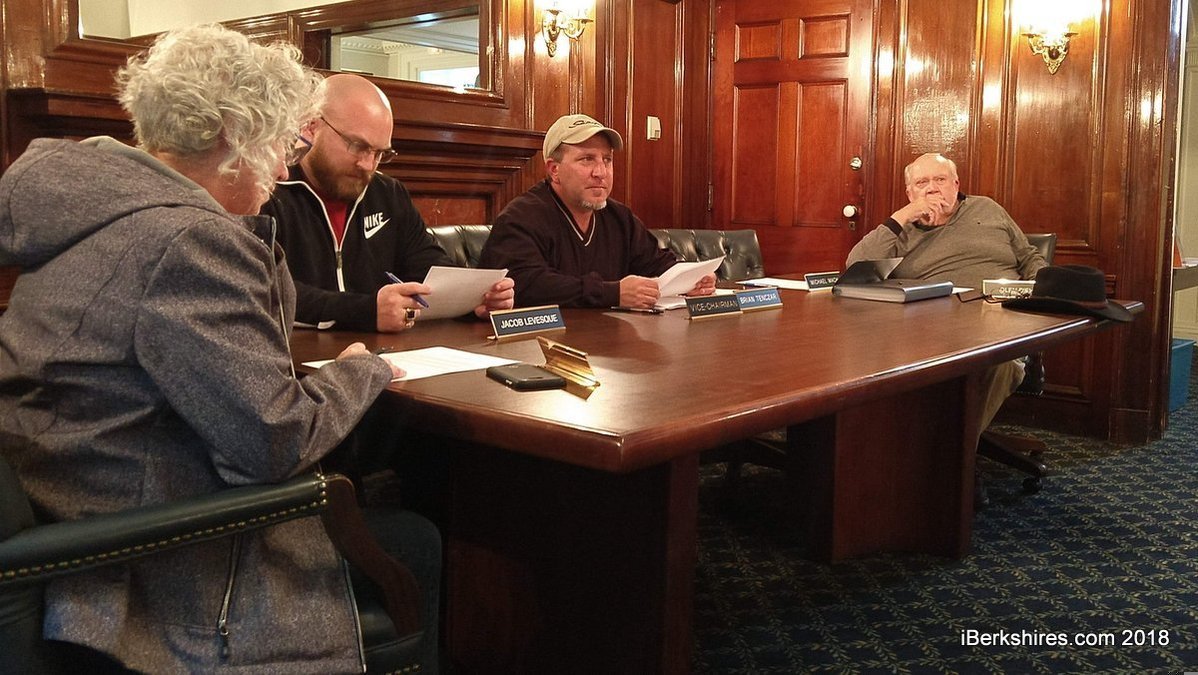
ADAMS, Mass. — The Zoning Board of Appeals continued its public hearing with Cumberland Farms to next month but still heard from some concerned residents.
 
After receiving a letter from Cumberland Farms asking to reschedule the hearing, the ZBA voted Tuesday to reschedule for June 7 and used the rest of the meeting to answer questions from the nearly 20 residents that attended the meeting. 
 
"I know that you are feeling stressed and you are feeling like you are being railroaded but the truth is these things take time and your voices will be heard," board member Francie Anne Riley said. "Nothing will be decided tonight, and we don't even have the materials."
 
Cumberland Farms wants to build a gas station and convenience store at 95 Commercial St. The facility would sit on three parcels one of which contains Al's Service Center.
 
Acting Chairman Brian Tenczar said the letter stated that Cumberland Farms asked for more time to prepare its plans further and board member Glendon Diehl added that company representatives did come before the Selectmen with plans.
 
"What they had at the select board meeting was pretty thorough … and they are working to make it more complete," Diehl said. 
 
The members of the crowd began listing off their concerns, some having to do with the layout, lighting and other physical attributes proposed in the plan but Tenczar cut them short noting that the ZBA has no say on those matters.
 
"We are going to discuss these three things and nothing outside of these three topics because it is not relevant to us. We can only pass judgment on zoning laws," he said. "I think we are getting a little ahead of the ball here; they are not here to present themselves."
 
Cumberland Farms is asking for three variances: one to demolish three structures at 95 Commercial St. and redevelop the land, one to allow two curb cuts, and one to allow the store to be opened 24 hours in an R-4 zoning district.
 
This was a concern of some of the attendees who did not think it was appropriate to have a business operating 24 hours in a residential zone.
 
Riley said the board will take in residents' input but at the moment members don't have complete plans themselves.
 
"You will have a say, we will listen and take into consideration your thoughts and feelings," she said. "They have a right to ask for these variances in order to open a business in a place where a business already is and there are a lot of things we need to discuss."
 
She added that they can place conditions on their decisions and noted in the past they were able to compromise with businesses in a residential zone.
 
"We walked the property, took input from residents and in a meeting, we discussed it and made some changes that made everybody happy," she said. "This is not something we just say yes to."
 
There was also a concern that the upcoming meeting would give Cumberland Farms the go-ahead but Building Inspector Don Torrico said the company would still have to go before the Conservation Commission and the Planning Board for a site review. He added that the Planning Board meeting would be a good place to discuss concerns with the actual design.
 
The Zoning Board of Appeals did say it would provide anyone interested with Cumberland Farms' application as well as set up a map of the proposed project in Town Hall, so abutters and residents can receive all of the information they are looking for.

Tags: ZBA,   cumberland farms,   
If you would like to contribute information on this article, contact us at info@iberkshires.com.

Berkshire Towns Can Tap State Seasonal Communities Resources

BOSTON — Governor Maura Healey announced that 18 additional municipalities across Massachusetts have been designated as Seasonal Communities, opening up new tools, support and grant funding to help them manage seasonal housing pressures. 
 
Created as part of the historic Affordable Homes Act signed into law by Governor Healey in 2024, the Seasonal Communities designation was designed to recognize Massachusetts communities that experience substantial variation in seasonal employment and to create distinctive tools to address their unique housing needs. The law also established the Seasonal Communities Advisory Council (SCAC).  
 
The Affordable Homes Act identified several communities to automatically receive the designation, including:   
  • All municipalities in the counties of Dukes and Nantucket;   
  • All municipalities with over 35 percent seasonal housing units in Barnstable County; and   
  • All municipalities with more than 40 percent seasonal housing units in Berkshire County. 
  •  
To identify additional communities, the Executive Office of Housing and Livable Communities (HLC) reviewed available data, specifically focusing on cities and towns with high levels of short-term rentals and a high share of second- or vacation homes.
 
In Berkshire County, Egremont, Great Barrington, Lee, Lenox, New Marlborough, Richmond, Sandisfield, Sheffield, West Stockbridge and Williamstown have been designated. 
 
"Our seasonal communities are a vital part of Massachusetts' cultural and economic fabric, but they're also home to essential workers, families, seniors, and longtime residents who deserve a place to live year-round," said Governor Healey. "That's why we're committed to supporting these communities with innovative solutions like the Seasonal Communities designation to meet their unique needs, and I'm thrilled that we're offering this opportunity to 18 additional communities across the state. Everyone who calls these places home should be able to live, work and grow here, no matter the season." 
 
As with the statutorily identified communities, acceptance of the designation for municipalities is voluntary and requires a local legislative vote. HLC will open an application for newly eligible communities that haven't accepted the Seasonal Communities designation to request consideration. 
 
The Affordable Homes Act created several new tools for communities who accept the Seasonal Communities designation to be able to:  
  • Acquire deed restrictions to create or preserve year-round housing 
  • Develop housing with a preference for municipal workers, so that our public safety personnel, teachers, public works and town hall workers have a place to live 
  • Establish a Year-Round Housing Trust Fund to create and preserve affordable and attainable housing for year-round residents 
  • Create year-round housing for artists 
  • Allow seasonal communities to develop a comprehensive housing needs assessment 
  • Permit tiny homes to be built and used as year-round housing 
  • Permit year-round, attainable residential development on undersized lots 
  • Increase the property tax exemption for homes that are the owners' primary residence 
 
View Full Story

More Pittsfield Stories