Miss Hall's School Completes 'Historic' Fundraising Campaign
 |
PITTSFIELD, Mass. — Miss Hall's School (MHS) has completed a $75 million campaign to support girls' and women's leadership, teaching excellence, and new programs and buildings on the School's historic campus.
The Be Bold campaign, the largest in the School's 125-year history, raised $75.9 million from more than 2,250 donors, enabling Miss Hall's to invest significantly in reimagining its academic and student life programs, while also preserving and re-shaping its Olmsted-designed, 80-acre campus.
"The Be Bold campaign has empowered us, marking an extraordinary moment in Miss Hall's School's collective history," said Head of School Julia Heaton. "We have achieved an audacious goal and elevated women's philanthropy along the way. We have committed to making a life-changing Miss Hall's education available to more students and to building a truly inclusive, global community, and we have stoked the 'Miss Hall's magic,' a special alchemy of intentionality, aspiration, relationships, and our shared purpose — to contribute boldly and creatively to the common good."
Aligned with the School's Strategic Design priorities — innovative programs, inclusive and joyful community, faculty growth and collaboration, and a shared commitment to the common good — the Be Bold campaign invested in the student experience and in the infrastructure to support that experience.
Program-related enhancements included creating a Department of Engineering and Technology Innovation, which enables students to pursue additional STEM-related studies, and developing a dynamic curriculum of 80+ courses, including advanced Hallmark classes, which provide in-depth, challenging coursework and personalized learning. The School also invested in professional development, housing, and salaries to attract, hire, and retain talented and diverse faculty, supporting adults as they engage in a learning experience with each student. Increased support for scholarships makes a Miss Hall's education available to students of all backgrounds, and the creation of the Dean of Equity and Inclusion and the Dean of Wellness positions solidify a commitment to serving an inclusive community and promoting student wellbeing.
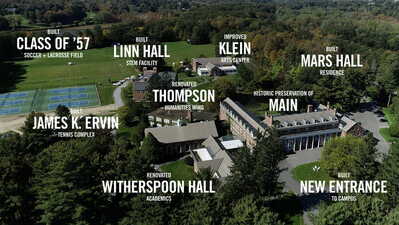
Campus investments included building the state-of-the-art STEM facility Linn Hall, the Mars Hall dormitory, the Class of '57 soccer and lacrosse field, the James K. Ervin Tennis Complex, and a new main entrance off Holmes Road. The campaign also funded preservation of the nearly 100-year-old MHS Main Building and improvements to the Terry Thompson '64 Humanities Wing, the Elizabeth Gatchell Klein Art Center, and the Margaret Witherspoon Hall dormitory. The investments followed master plan recommendations to increase on-campus residential spaces for students, faculty, and staff; to provide flexible spaces to accommodate innovative teaching and learning; and to enhance outdoor athletic facilities while preserving the campus.
"These achievements form the framework for supporting the day-to-day changing of lives for today's 190 Miss Hall's School students and for those yet to come," said Heaton. "Our students are ‘the why' behind everything we do at Miss Hall's, and we continuously innovate, rise to challenges, and seek new opportunities so that they can become the thinkers, creators, global citizens, and courageous leaders the world so desperately needs."
"The Be Bold Campaign marks an auspicious moment in the history of Miss Hall's School," noted Board President Nancy Gustafson Ault, MHS Class of 1973. "One hundred twenty-five years ago, our founder, Mira Hall, envisioned a school where girls could receive the high-quality education they deserved. Our mission is no less relevant today than it was then, as evidenced by the broad support of this campaign. I want to thank everyone who has made this achievement possible, for elevating women's philanthropy and laying critical groundwork for launching Miss Hall's School into its next 125 years."
Tags: miss halls school,