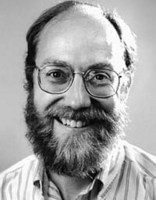
Professor William Wootters is to be honored for his outstanding achievements in physics, not once, but twice in the academic year, by The American Physical Society and by the National Institute on Information and Communications Technology.
In recognition of his pioneering work in quantum theory, the National Institute on Information and Communications Technology bestowed its 2006 International Quantum Communications Award on Wootters at a ceremony in Tsukuba, Japan, Nov. 28-30. The award is given every two years at the International Conference on Quantum Communication, Measurement, and Computing.
Wootters is the Barclay Jermain Professor of Natural Philosophy at Williams College. His research specialty, quantum information theory, is the study of information stored or processed in objects that must be described by quantum mechanics, such as individual atoms. Information stored in quantum systems behaves very differently from ordinary information. It cannot, for example, be copied perfectly. Despite these restrictions, this ghostly sort of information could be of great value in "quantum computation" and "quantum cryptography."
Wootters' work on "teleportation" of quantum information has been widely cited in both the scientific and popular press. While his own work is at the most basic and theoretical level, other scientists around the world are seeking to bring these ideas to practical fruition.
Wootters will be awarded The American Physical Society (APS) Prize to a Faculty Member for Research in an Undergraduate Institution at a ceremony in Denver, Co. in March. The prize is the highest national award of its kind. It is given annually to honor a physicist recognized as contributing substantially to physics research and providing inspirational guidance and encouragement to undergraduate students participating in this research.
The APS cited Wootters "for his pioneering work on quantum teleportation, his widely cited contributions to quantum information theory, and his prolific engagement of undergraduate students in this research at the foundation of quantum mechanics."
Physics Department Chair Kevin Jones commented, "Bill Wootters is remarkable for his skill in weaving his teaching and research interests together. He has a knack for identifying interesting problems, is able to explain them clearly and precisely, and then engage beginning researchers in their solution."
In a recent interview in APS's Quantum Times newsletter, Wootters was asked about doing quantum theory research at a small institution like Williams College.
"I think both theory and experiment can thrive at a liberal arts college," he said, "because the problems are never very far removed from elementary quantum mechanics. One metaphor [is] that one could look for good problems 'near the trunk' of the discipline as opposed to looking at the ends of the longest branches."
Wootters has been at Williams since 1982 and teaches courses that range from those intended for non-science majors to the most advanced upper level tutorials. With mathematician Susan Loepp he teaches a highly successful interdisciplinary course called "Protecting Information." He and his students have published in prestigious scientific journals, including Physical Review Letters.
In 2000, he was elected as a fellow of the APS for his "contributions on the foundations of quantum mechanics and groundbreaking work in quantum information and communications theory." Wootters received his B.S. from Stanford University in 1973 and his Ph.D. from the University of Texas at Austin in 1980.
The American Physical Society has been the leading voice for the advancement and diffusion of physics nationally and internationally for over 100 years. The APS publishes major scientific journals such as the Physical Review.
This is the 20th year of the QCMC, organized by the National Institute on Information and Communications Technology (NICT). The NICT is a Japanese-based organization seeking to advance both national and international scientific understanding. Its goals include the development of technology to strengthen the economy, health, and the environment.
If you would like to contribute information on this article, contact us at info@iberkshires.com.
Your Comments
iBerkshires.com welcomes critical, respectful dialogue. Name-calling, personal attacks, libel, slander or foul language is not allowed. All comments are reviewed before posting and will be deleted or edited as necessary.
No Comments
Free Vaccinations Available Throughout Berkshire County
By Breanna SteeleiBerkshires Staff
PITTSFIELD, Mass. — Fall season is also the flu season, which means vaccine clinics are now available.
The Berkshire Vaccine Collaborative will provide public vaccination clinics in Berkshire communities this fall, including the influenza and COVID-19 vaccines. There are about 49 clinics.
The collaborative began during COVID-19 to help vaccinate people across Berkshire County. Berkshire Health Systems started the Get Vaccinated Berkshires website and still manages it. The group works with the Pittsfield Public Health Department, Community Health Programs, and the Southern Berkshire Public Health Collaborative.
"The majority of people will always get the flu [vaccine] because, as I said, if you've ever gotten the flu, you will always get a flu vaccine because it's so bad. And just so you know, the flu is already in Berkshire County. It's an early season this year," said Leslie Drager, who is the senior public health nurse at Berkshire Regional Planning Commission.
Drager said last year they issued 2,705 vaccines, with more than 1,100 of them being for COVID-19 and more than 1,500 being flu. In total, they were able to vaccinate 1,669 people in Central and North County, in addition to Pittsfield.
Drager also said she will be carrying three types of COVID vaccines this year, which is in high demand.
"We have a high demand of COVID vaccine, which is awesome," she said. "So we're doing a lot of COVID vaccines. Also, I provide Pfizer, and this year I have Moderna and the Novavax, which I think is real important to get out there because the Novavax, a lot of people want, people with long COVID. So I'm carrying all three vaccines this year, which I normally only carry the Pfizer."
Public health departments also can help people access other vaccines such as for measles or meningitis when they cannot get them through a pediatrician, she added.
Using the website, people are able to get vaccines even if they are homebound by filling out a form.
All public Berkshire Vaccine Collaborative clinics are free of charge, but registrants are asked to provide insurance information, when available, in order to defray costs. The clinics are open to anyone 6 months of age or older, the age group recommended to receive an annual flu vaccine and the latest COVID-19 vaccine.
"I always encourage everybody to wear a short sleeve shirt because it makes it a heck of a lot easier to get at," Drager said. "And children, we do carry the nasal flu, the live virus of nasal flu for kids that are afraid to get needles."
Registration is highly recommended for the clinics. Walk-ins may be accepted depending on the number of vaccine doses available at each clinic, with preference given to those who are registered.
"It's really important. I'm really encouraging vaccinations for the schools, because not only you know if the kids are vaccinated and the teachers are vaccinated, the schools won't have the flu go wild right through it," Drager said. "And of course, the best way to prevent infections: washing your hands. So don't touch your face, and wash your hands."
The Cooperative Hoosac Valley football program will resume football related activities on Monday, Sept. 28, after being on “pause” for the past nine days. click for more
Hoosac Valley High School has postponed this weekend’s football games following a reported alleged hazing incident involving a large number of football players, the athletic director announced Friday afternoon. click for more
Cassidy Flynn scattered five hits in a complete-game effort in the circle as Lenox upset top-seeded Hoosac Valley, 3-2, in the quarter-finals of the Division 5 State Tournament. click for more
Brayden Durant struck out seven and walked one in a complete-game effort on the mound Saturday to pitch the Drury baseball team to a 6-0 win over Keefe Tech in the quarter-finals of the Division 5 State Tournament at Joe Wolfe Field. click for more
Jason Codey struck out 13, walked two and allowed just an infield single as the Generals earned a 7-1 win over Wahconah to claim their third straight regional title. click for more