Building Committee Members Get A Tour Of The Drury Renovation

Print Story | Email Story
Judging by a tour of renovation work in one of the two main learning areas at Drury High School in North Adams, the school will bear little resemblance to the original, completed in 1975. Traditional enclosed classrooms have replaced semi-enclosed spaces. Originally, the “Upper B” area under renovation, was basically one huge room with a partition here or there. I know, I started my high school education at the “new” Drury the year it opened. The “Upper B” classroom and other space we saw on the tour April 3 bore no resemblance to what had been there before, as a number of school building committee members noted. Renovation work of Drury High School is continuing, with students attending classes in “Lower B” while work is done on the other main academic area. The $19 million major renovation is being done by contractor U.W. Marx Project Architect James Morrissey, of Tessier Associates, West, Springfield, told school building committee members that school vacation starts on Monday, April 16. The first two days of that week, Massachusetts Electric will be coming in to install permanent electrical power. There will be no power or heat in Drury for those two days. “It’s a pretty intense thing to get it done in two days,” Morrissey said. Once permanent power is turned on, quite possibly on Thursday and Friday of that week, school workers will bring furniture into six classrooms in “Upper B.” “Those six classrooms will be outfitted as completely as they can be,” he said. During two days of the next week workers will outfit the remaining eight classrooms in “Upper B.” “Based upon that we’ll now have the furniture in, we’ll have the permanent electricity on, we will have been inspected by the building inspector...and the fire department,” Morrissey said. That’s all been arranged. So that on April 30th classes will be taking place in Upper B. The lockers should be in place, everything should be there.” “Now you’re going to walk through here tonight and you’re going to say, ‘Oh, I can’t believe they’re going to be done by the 30th,’ but in fact they are,” he said. “They come in here, one guy goes through and puts the wall board up, the next guy’s following behind him with the paint, and the ceiling’s going up in that time.” When the school moves into these classrooms, there are not going to be telephones, as the new system will have to be installed all at once. Computers will be installed by the time students return in September, he said. “Otherwise, the classroom will be there, there will be chalkboards, tackboards, the heating and ventilating is going to be working, the windows in,” he said. “It will look pretty darn good.” Morrissey said that if all goes according to schedule, work will start on “Lower B” around April 30. Students then will occupy classes in “Upper B.” Plans call for the classrooms in “Lower B” to be ready by the start of school next fall. However, two science rooms may not be installed until Oct. 1, he said. Renovation work started in the gymnasium on April 2. The intention is for the gymnasium and locker rooms to be ready for the opening of school next fall, he said. During the tour of “Upper B,” Morrissey noted such areas as where the library will go, places where the lockers will be installed, and restrooms. As he said, all the space still looked quite raw, but materials stood by for workers to install, and at least my impression is that the classroom spaces were pretty far along. Before the tour, Morrissey showed building committee members panels of colors and designs which a committee, including two students, had picked out for various surfaces in the renovated building. After the tour, Morrissey said the work was getting back on schedule after a couple of weeks behind. “We are still a couple of weeks behind. We are endeavoring to make them up,” he said, noting that electricians have been working at the school three nights a week for the last month and a half. “There’s going to be people in here both Saturday and Sunday this weekend working on putting down the floors.” “It appears that if we are in fact occupying 80 to 90 percent of the classrooms by September, we’ve done a heck of a job facing some of the setbacks that we’ve had,” he said. The contract requires that the contractor must start work on the cafeteria and kitchen when the school is dismissed in the summer, and they must be operating when school opens in the fall. “That is a contractual obligation which is non-negotiable, and he is aware of that,” Morrissey. “So there shouldn’t be any issue with that at all.” Joseph Campedelli, head of guidance at Drury, showed this reporter and city councilor and building committee member Michael Bloom “Lower B” and other learning areas not yet undergoing renovation. “When the school was built in 1975 there were three learning areas,” Campedelli said. “This was all open. These learning areas have been modified over the years. This was all open.”
If you would like to contribute information on this article, contact us at info@iberkshires.com.

Northern Berkshire United Way: 1970s Has Its Ups and Downs

By Tammy Daniels iBerkshires Staff
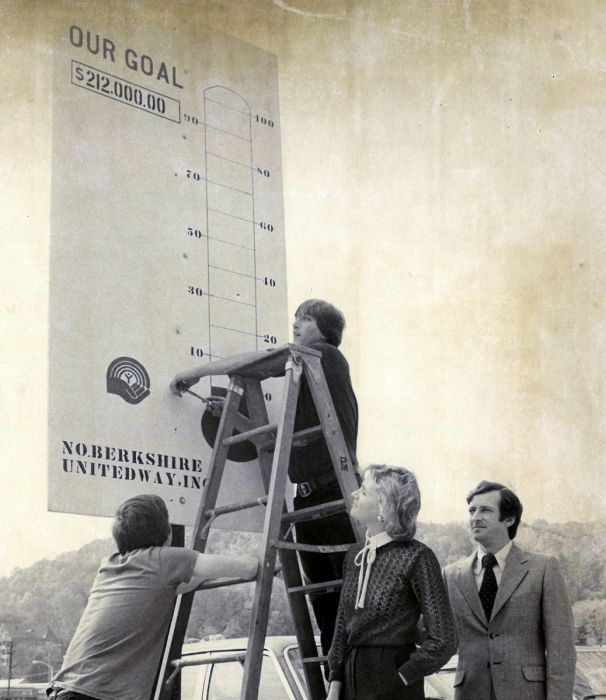
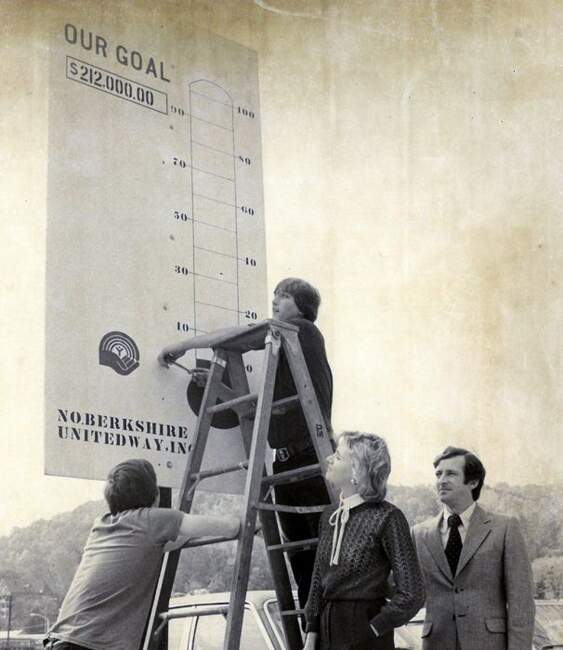
The Northern Berkshire United Way sets its highest goal yet in 1979, and the first time going over $200,000. 
NORTH ADAMS, Mass. — Over three decades, the Northern Berkshire United Community Services had raised some $3 million for its affiliated agencies. 
 
That number was announced that the organizations "fifth" annual meeting in 1974, marking the time since Adams had joined, and counting the funds raised by the North Adams Community Chest and the North Adams and Adams United Funds and Northern Berkshire United Fund. 
 
The report that year was dedicated to past 24 volunteer campaign chairs, of whom 17 were still in the area and three — Russell Lanoue, George Higgins and G. Churchill Francis — had since died.
 
The amount of money raised seemed significant for the time, but the united fund found itself struggling in the early '70s as the economy dipped and its the need for its services grew. 
 
The campaign in 1970 saw an ambitious goal of $184,952 to support 16 agencies, with Northern Berkshire Child Care as the latest addition. The drive kicked off that goal at the Midway with Chair George Bateman, but it reached only 80 percent of its goal by the end. 
 
Batemen said it might not be a financial success but "I believe it was a spiritual success" because of the hard work and enthusiasm of so many drive volunteers.
 
But President Henry Pierpan said there would be allocation cuts for 1971 despite "a substantial sum" voted from reserve funds.
 
View Full Story

More North Adams Stories