A clash of art titans?
By Charles GiulianoPrint Story | Email Story
Sprawling Mass MoCA is now coping with an even bigger neighbor
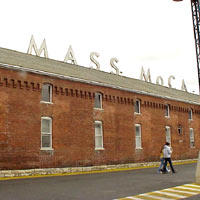
The novelty of being billed as the largest contemporary art museum in North America may have lost some glitter for the Massachusetts Museum of Contemporary Art, now completing its fourth season. In the beginning, many in the art world traveled to North Adams just to revel in the space of a sprawling complex of old mill buildings spaciously sited on 13 acres of downtown real estate. The ambitious art museum recently relinquished some of its bragging rights and must come up with creative strategies to get back into the spotlight. Approximately a two-hour drive from Pittsfield, in Beacon, N.Y., is the newest, largest and arguably most spectacular facility for contemporary art in North America. Dia Beacon is a 300,000-square-foot building complex, with 240,000 square feet of gallery space devoted to an installation of selections from the Dia Art Foundation, which was established in 1974. The museum complex, which is 60 miles and some 80 minutes of driving time from Manhattan, is sited on 31 acres. A short, half hour drive from Dia is the renowned Storm King Art Center, which displays outdoor sculpture from its permanent collection and long term loans, on 500 acres of spectacular landscape with mountain views. A media barrage accompanied the opening of Dia Beacon last May. Overnight, with its collection of works by the stars of Minimal Art from the 1960s and 1970s, it has become a world-class art destination. By mid August, the museum had already exceeded its projection of some 60,000 annual visitors. Its relative proximity to Manhattan by car and by train is a major factor. The Metroliner station stops in Beacon, a short walk away from the museum. Dia Beacon has been an immediate shot in the arm for a depressed city. The enormous factory complex once housed the printing plant for the Nabisco Corp. Its closing represented a serious loss of jobs. Rundown Main Street became a haven for low rent antique stores. There are now some 17 galleries and arts organizations with a monthly Second Saturday program, in cooperation with restaurants and area businesses, that stay open until 9 p.m. with a gala round of openings and parties. Just how does all this good news for Beacon compare with similar efforts for Mass MoCA, and the ongoing recovery of economically depressed North Adams? Has Dia Beacon stolen the thunder from Mass MoCA? Or, do these enormous facilities complement each other by having overlapping missions? Does visiting one great museum complex whet the appetite to see the other? "Dia is Apollo, to Mass MoCA's Dionysus," says Mass MoCA Director Joseph Thompson. "Crystalline, grid-like, with a superb permanent collection, Dia is a monument to many of the most profound ideas in the visual arts of the 1960s and ’70s. Mass MoCA's commitment to changing exhibitions and the art of today contrasts markedly with Dia's profile ... though we share an obvious passion for industrial settings. Taken together, Mass MoCA and Dia Beacon make for a vivid representation of recent art, all within a two-hour scenic drive." His assessment may prove to be true over the long term, but was there a measurable impact on attendance this season, which was reported as booming at Dia and, until mid to late summer "sluggish," at Mass MoCA, as described by Katherine Myers, its spokeswoman? Overall, May/June/ mid July attendance at MoCA was reported as off by 5 to 6 percent from the previous year. But attendance picked up significantly after reviews of current shows were published in late July and August. While MoCA is still a relatively young museum, it has built a solid annual attendance of some 100,000 for exhibitions and another 20,000 for performances and special events. Attendance this summer for performances, including several popular outdoor movies, was solid and there were a number of sold-out events. This is significant, as the audiences for these events are primarily drawn from local residents and tourists who happen to be in town that weekend. It indicates that MoCA is succeeding in creating a core audience for its programming. It’s what keeps people coming back to the museum and becoming members and supporters. Even the most dedicated local art lovers are not likely to visit the galleries more than once or twice for each new installation. This reflects MoCA‚s strategy to draw visitors to the exhibitions on a seasonal basis. Which is why they are often up for a year or more. While some art travelers may opt to visit the new Dia rather than the somewhat older MoCA, there are other factors to consider. In New England we talk about the weather. Fact is it was a lousy spring. July was hot, then came the rain — at one point 13 straight days — and the humidity. There is the poor economy, as well as the ongoing bad news of war and terrorism. All of these factors have a direct impact on a decision to plan an expensive weekend in the Berkshires. Given these factors, the average art tourist may have decided to visit one or the other this year but probably not both. Also, MoCA held over the Robert Wilson exhibition in its major space for a second summer. This decision had a spin of, "by popular demand," by MoCA officials. Closer to the truth was a lack of funding in a poor economy to replace that space with a major installation by the renowned artist, Ann Hamilton. Her installation is rescheduled to open on Dec. 13 for a year or more. There is an annual budget of $1 million for exhibitions, and the Wilson installation is said to have cost around $250,000. Arguably, MoCA tightened its belt but saved money this year. Next summer, there will be entirely fresh programming. In addition to Hamilton, there will be an installation by Matthew Ritchie, and a group show of older and newer political artists that is potentially provocative. MoCA could use a touch of controversy, as this summer’s shows, "Yankee Remix," curated by Laura Heon, and, "Fantastic,” curated by Nato Thompson, were damned by faint praise. In The North Adams Transcript, MoCa spokeswoman Myers described the impact of reviews on attendance: "Particularly The New York Times moved the gate," she said. "They got great reviews." But a careful reading of the Aug.15 review by Grace Gluek in The Times reveals a more tepid response: "It’s a nice idea for a show (the collaboration of Mass MoCA and the Society for the Preservation of New England Antiquities resulting in “Yankee Remix”), and if there are as many misses as hits, well, that’s the way such omnibus efforts often work out. The same might be said of “Fantastic,’" The Times reported. Reading between the lines, The Times implied that MoCA’s exhibitions this year were "hit or miss." This generally describes the exhibition programming of the past four seasons under chief curator Laura Heon. The shows are ambitious with a commitment to showing fresh new work. There is much to praise, but the exhibitions fail to live up to the mandate of a museum that views itself as a world-class destination. Overall, with some notable exceptions, MoCA mounts good but not great contemporary exhibitions. This is an ambition that Dia Beacon has achieved from day one. But it is perhaps an unfair and impossible comparison. The Dia Art Foundation has deep pockets and phenomenal resources. In addition to Dia Beacon, it also maintains Dia Chelsea, a large facility that is rumored to be shutting down relatively soon. There are also a number of sites displaying the ongoing works of single artists maintained by Dia in Manhattan, the West, and South. Dia Beacon’s concept is to display a selection from its vast permanent collection of which a small percentage will change over time. Having visited Dia Beacon this year, there would be no compelling reason to return next year. Here MoCA has a clear advantage, even though shows are remaining on view for a year on average. With fresh programming, MoCA should do well next summer. But Dia Beacon, with its easy access for New Yorkers, has a limitless resource of first-time visitors. While Dia Beacon emerged like Athena, full grown from the forehead of her father Zeus, MoCA has had a long and difficult birth and maturation. The Dia space is now fully developed and permanently installed. The total project cost for this was more than $50 million, including acquisitions and endowments. This compares to the $35 million from the Massachusetts, with the final increment of $9 million now being spent. MoCA has also raised considerable funds for renovation and programming. After demolition and recent acquisitions of new properties, all told, MoCA has 610,000 square feet under roof of which about 300,000 has to date been developed. Currently, the gallery space is 130,000 square feet, but there are long-term plans (10 to 15 years) to add about 100,000 of additional gallery space for exhibitions. By April 2005, MoCA will have developed 136,000 square feet as commercial space. Lacking the endowment and resources of Dia, rental from this space will represent approximately 30 to 35 percent of the current $4.3 million annual budget over the next two to three years. Right now, MoCA seems to be concentrating on the development of its commercial space as a priority over developing gallery space and upgrading resources for exhibitions and programming. It will be a while before the 130,000 square feet of exhibition space at MoCA catches up to the 240,000 square feet of Dia Beacon. But it is a long-term reachable goal. In another crucial point of comparison, Beacon, N.Y., clearly has the advantage in developing an arts community. Galleries and nonprofits are proliferating. Even a perennial heavy hitter David Ross, the former director of the Whitney Museum of American Art, is staking a claim in the action as director of the Beacon Cultural Project. Dia is striving to be a good neighbor, encouraging the promotion of surrounding art galleries, restaurants and businesses. By contrast, the development of a related arts community in North Adams is evolving slowly. There are a few serious galleries and alternative spaces but they are struggling. Several galleries have come and gone in the past few years. The Contemporary Artists Center, which predates Mass MoCA, has been going through a phase of reorganization. Its exhibition program this summer was dismal. But one hears of exciting and ambitious plans. And, by this time next year, there will be a healthy community of some 40 or more contemporary artists in the now developing Eclipse Mill. This will have an impact in building a dynamic arts community. North Adams has a clear advantage over Beacon with more affordable loft living for artists. And, beyond the Eclipse Mill development, there is a lot more potential space to be developed. In years to come Dia Beacon and Mass MoCA may develop a friendly and mutually beneficial rivalry. Dia has a good neighbor in Storm King while MoCA has an expanding Clark Art Institute as well as the dynamic Williams College Art Museum and the Williamstown Theatre Festival. Taken as a whole, this represents a spectacular critical mass of institutions and resources. The healthy competition among these major institutions for visitors and audiences should keep everyone on their toes. Charles Giuliano runs the gallery program and teaches art history at Suffolk University. In addition to writing for numerous arts publications, he is an exhibiting artist. He and his wife, Astrid Hiemer, commute between their homes in Adams and East Boston.
If you would like to contribute information on this article, contact us at info@iberkshires.com.

Friends of Great Barrington Libraries Holiday Book Sale

GREAT BARRINGTON, Mass. — The Friends of Great Barrington Libraries invite the community to shop their annual Holiday Good-as-New Book Sale, happening now through the end of the year at the Mason Library, 231 Main Street. 
 
With hundreds of curated gently used books to choose from—fiction, nonfiction, children's favorites, gift-quality selections, cookbooks, and more—it's the perfect local stop for holiday gifting.
 
This year's sale is an addition to the Southern Berkshire Chamber of Commerce's Holiday Stroll on this Saturday, Dec. 13, 3–8 PM. Visitors can swing by the Mason Library for early parking, browse the sale until 3:00 PM, then meet Pete the Cat on the front lawn before heading downtown for the Stroll's shopping, music, and festive eats.
 
Can't make the Holiday Stroll? The book sale is open during regular Mason Library hours throughout December.
 
Proceeds support free library programming and events for all ages.
View Full Story

More Stories