LENOX DALE — The Center for Ecological Technology will be moving its recycling program from Hubbard Street in Pittsfield to the transfer station in Lenox Dale, and Lenox residents may see a wider range of options for disposing of their own recyclables, according to Meg Morris, manager of community and governmental relations at Eco/Pittsfield.
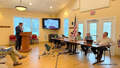
Morris spoke at the Oct. 22 meeting of the Lenox select board about the changes Lenox residents will see in the transfer station. She also suggested options for making Lenox’s waste collection system more efficient, cheaper and more environmentally sound. These could include waste collection days for appliances and substances that are hard to dispose of, an adjustment of rates to make recycling free at the transfer station and, at their most conjectural, a town-run trash collection system.
Eco/Pittsfield took over the management of the transfer station in July. It is a subsidiary of EnergyAnswers Corp. of Albany, N.Y., which develops waste management strategies with environmentally sound technologies. Eco/Pittsfield owns and operates the Pittsfield Resource Recovery Facility, and has been working with Pittsfield for more than five years.
The Center for Ecological Technology has entered into an agreement with Eco/Pittsfield to operate a recycling program at the Lenox transfer station, according to Alan Silverstein, co-director of CET.
They have already begun to move the recycling program from Hubbard Street, Pittsfield, to the Lenox transfer station. They should have the program fully moved and the shredder set up in the new location within the next three weeks, he said.
CET’s recycling program lets businesses recycle waste paper, Morris said. It collects paper and shreds records for businesses from Great Barrington to North Adams.
“It processes 47 tons of paper a month. That’s two compactor boxes,†Morris said.
“You had more traffic with the old system. BFI, the previous operator, processed 49 tons of garbage a day. We are now processing 100 to 150 tons of garbage a month,†she said.
Eco/Pittsfield is scaling back the Lenox transfer station to eliminate traffic from commercial haulers, she said. The transfer station operates Monday to Friday, 3 to 7 p.m. It is still phasing out commercial haulers in favor of recyclables, and while the commercial haulers still use the facility, it will have to be open when they come.
“If we could close Monday, we could be open Tuesday through Saturday,†she said.
Lenox residents coming to drop off trash will now be scaled in and out of the transfer station — they will drive over the scale and the transfer station will bill them for their for garbage by weight. Each trip costs a minimum $5 to cover the overhead costs of processing the trash. A pickup truck carrying a half a ton of old ceramic toilets would be charged $37.50 (at $75 per ton), for example, Morris said. The average householder dropping off trash every two weeks would probably pay $5.
Recycling costs $40 a ton now, and Eco/Pittsfield could change those rates to make recycling free, if the select board preferred, she said.
Representatives from the Lenox Board of Health encouraged the select board to make recycling free, to give residents as much incentive as possible to recycle whenever they could.
“Is there anything you don’t take?†asked Selectman Janet Pumphrey.
Massachusetts has waste bans, Morris said. The transfer station cannot take products containing mercury or freon, for instance.
Lenox could arrange to dispose of hazardous materials and appliances on specific days, she said. In the Pittsfield facility, Eco/Pittsfield has two collection days a year when residents can bring in appliances. The city council establishes prices for different kinds of items. Lenox could appropriate funds at town meeting rather than charging per item at the collection days, but a charge helped people to understand that it costs to get rid of these things, she said. It also encouraged people to get creative about re-using their appliances — donate the washer to a niece just out of college rather than leaving it on the curb.
A pickup at the Lenox transfer station would be for Lee and Lenox residents only, and would not accept more than a pickup truck load, Morris said, adding that in New York State, town officials often volunteered to help at these collections. There are people in the Berkshires who can take appliances without freon, she said, but most are not convenient to Lenox.
Waste management in much of the Berkshires could be better, Morris said. It is not as efficient and cost effective here as it is at facilities in Pioneer valley. Distance contributes to this comparative inefficiency. Berkshire transfer stations have to bring recyclables to Springfield, which is a longer haul and more expensive.
It is also a question of when haulers collect garbage, she said. Lenox has several private haulers in town, and may have five different haulers on the same street at five different times. Collection could be more efficient. Many towns create a garbage district and put out a bid for curbside collection, she said.
Such a district could create problems since, as select board chairman Timothy Doherty pointed out, if one hauler is collecting all of the trash in Lenox, other haulers are not.
To try not to put smaller haulers at a disadvantage, or out of business, the town could create several districts and bid each, Morris said. The town could also require in the bid that the hauler dispose of the garbage at a place of the town’s choosing, so that larger haulers with their own disposal sites did not have that advantage over smaller ones.
She has seen curbside pickup in small, widespread rural communities as well as densely populated areas, she said — Richmond has municipal trash collection, for instance.
Joseph Kellogg from the Lenox Board of Health recommended that Lenox and Lee consider banding together to contract one hauler. Stockbridge, the other branch of tri-town health, has its own transfer station and subsidizes it with tax revenue, and would not need to join in.
A town-run trash collection could provide cheaper service, Kellogg said. Right now, average Lenox resident pays $26 a month to dispose of trash.
“Comparison with other towns suggests that figure could be reduced,†he said.
The town would also have some control over the way its trash and recyclables were collected and disposed of, he said. The board of health has had complaints that recyclables were thrown in with regular garbage, and that trucks crossed and re-crossed town borders when they collected garbage, so the towns could not keep track of which recyclables went where.
“We could run it as an enterprise, like water and sewer,†he said. “We could not require residents to join it.â€
Doherty asked whether the town would have to run the operation — to send out bills. Lenox has been slimming down town government as much as possible in tight budgeting times, he said. It is daunting to take on more government now.
“Where do we go from here?†he asked.
The Board of Health would eventually like to see curbside trash haulers picking up trash and recycling and charging the house owner for trash by weight — keeping the recycling free — Kellogg said. He and other board of health representatives promised to come back to the select board with a more concrete proposal, with Eco/Pittsfield and CET cooperation.
If you would like to contribute information on this article, contact us at info@iberkshires.com.
Your Comments
iBerkshires.com welcomes critical, respectful dialogue. Name-calling, personal attacks, libel, slander or foul language is not allowed. All comments are reviewed before posting and will be deleted or edited as necessary.
No Comments
Pittsfield School Committee OKs $87M Budget for FY27
By Brittany PolitoiBerkshires Staff
PITTSFIELD, Mass. — The School Committee has approved an $87 million budget for fiscal year 2027 that uses the Fair Student Funding formula to assign resources.
On Wednesday, the committee approved its first budget for the term. Morningside Community School will close at the end of the academic year and is excluded.
"This has been quite a process, and throughout this process, we have been faced with the task of closing a $4.3 million budget deficit while making meaningful improvements in student outcomes for next year," interim Superintendent Latifah Phillips said.
"Throughout this process, we've asked ourselves, 'What should we keep doing? What should we stop doing? And what should we start doing?' I do want to acknowledge that we are presenting a budget that has been made with difficult decisions, but it has been made carefully, responsibly, and collaboratively, again with a clear focus first on supporting our students."
The proposed $87,200,061 school budget for FY27 includes $68,886,061 in state Chapter 70 funding, $18 million from the city, and $345,000 in school choice and Richmond tuition revenues. It is an approximately $300,000 increase from the Pittsfield Public Schools' FY26 budget of $86.9 million.
The City Council will take a vote on May 19.
Thirteen schools are budgeted for FY27, Morningside retired, and the middle school restructuring is set to move forward. The district believes important milestones have been met to move forward with transitioning to an upper elementary and junior high school model in September; Grades 5 and 6 attending Herberg Middle School, and Grades 7 and 8 attending Reid Middle School.
"I also want to acknowledge that change is never easy. It is never simple, but I truly do believe that it is through these challenges that we're able to examine our systems, strengthen our practices, strengthen our relationships, and ultimately make decisions that will better our students," Phillips said.
Included in the FY27 spending plan is $2.6 million for administration, $62.8 million for instructional costs, $7.5 million for other school services, and $7.2 million for operations and maintenance.
Assistant Superintendent for Business and Finance Bonnie Howland reported that they met with Pittsfield High School and made two additions to its staff: an assistant principal and a family engagement attendance coordinator.
In March, the PHS community argued that a cut of $653,000 would be too much of a burden for the school to bear. The school was set to see a reduction of seven teachers (plus one teacher of deportment) and an assistant principal of teaching and learning, and a guidance counselor repurposed across the district; the administration said that after "right-sizing" the classrooms, there were initially 14 teacher reductions proposed for PHS.
Qwanell Bradley scored 33 points, and Adan Wicks added 29 as the Hoosac Valley boys basketball team won a Division 5 State Championship on Sunday. click for more
Adan Wicks scored 38 points, and the eighth-seeded Hoosac Valley basketball team Saturday rallied from a nine-point first-half deficit to earn a 76-67 win over top-seeded Drury in the Division 5 State Quarter-Finals. click for more
Caprese Conyers scored 22 points, and Kyana Summers had a double-double with 10 points and 13 rebounds to go with eight assists as Pittsfield got back to the state semi-finals for the second year in a row. click for more