Mountain development: two different worlds
By John HitchcockPrint Story | Email Story
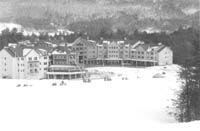
New Jackson Gore Base Complex, including 140 room hotel, at Okemo Mountain Resort in Ludlow, Vt. (Photo by John Hitchcock)
I was exposed to two interesting and diametrically opposed views of mountain development in the past few days. One was a documentary on the long and controversial effort to open a for-profit resort at Greylock Glen at the base of the state’s highest peak in Adams — in the heart of the Berkshires, which are advertised as America’s premier cultural destination. The film, produced by Wayne Klug and narrated by actor Christopher Reeve, covers 50 years of costly and bitter efforts to either develop the 1,063-acre tract or prevent development. My other viewing was on skis and covered the less than five years to convert densely wooded Jackson Gore into a booming four-season resort. The transformation from trees to ski trails, from abandoned pasture to a sprawling complex, including a 140-unit time-sharing hotel, a huge cafeteria, a large pizza hall, a first-class restaurant and a health club with indoor/outdoor pools, was carried out by Diane and Tim Mueller (owners of the adjacent Okemo Mountain Resort) at a cost of some $55 million. One could not find two more opposing approaches to mountain living: the walk-quietly, touch-nothing viewpoint of environmentalists compared to the utilization of the environment to provide thrills and comforts for paying guests. The comparison of Adams, generally described as a declining mill town looking to the lofty summit of Mount Greylock for economic salvation, and Ludlow, a former mill town still converting defunct factories into condos, is equally provocative. After several attempts by private developers to build an aerial tramway from the base to the 3,491-foot summit of Greylock or to build a hotel and chairlifts on the Glen site, town officials sought and received help from the state. But two state-selected developers gave up in the face of the environmentalists’ attacks and a declining economy. Now the state has cut back plans and will settle for picnic tables and trails, with perhaps one small hostelry. At the present time, after a half century, there is nothing left except grown-up fairways of a former golf course and the rusting towers of chairlifts that never ran. Klug’s “The Last Wild Place” is a little off the mark because almost every acre of the Glen site was occupied by cows or hogs until Springfield industrialist Joseph Delisio bought up the land for the first proposed major resort. In fact, when Senator Ted Kennedy and the late Sugarbush Ski School Director Peter Estin skied the Thunderbolt in the late ’60s, they were met at the end by a herd of hogs and a clutch of Democratic politicians. The Muellers arrived in Ludlow, Vt., in 1982, when they bought the nearly bankrupt Okemo ski area, featuring the biggest vertical drop (2,150 feet) of any southern Vermont ski resort and worn-out Poma-lifts that hauled skiers by the seat of their pants to the top of a few narrow trails. By adding modern chairlifts at the rate of one a year and making improvements in all areas, the Muellers turned Okemo into one of the few totally successful ski operations in New England. They also bought a modest nine-hole golf course and turned it into an award-winning 18 hole showplace. In 1998, the Muellers acquired the leasehold operation of Mount Sunapee from the state of New Hampshire and transformed it into the top ski center in southern New Hampshire. And early in March, they bought Crested Butte Ski Resort in Colorado. With some 600,000 skier visits last winter at Okemo and 272,000 at Sunapee, the Muellers are definitely pleasing skiers and snow boarders. Colorado ski resort operators can be sure that the Muellers will go all out to revitalize the Crested Butte operation, founded some 40 years ago by the Callaway family of Georgia. Last winter’s skier visits came to 342,416, but that’s small potatoes in Colorado (the busiest ski state), where several resorts routinely top the one million mark in visits. And there is an outstanding golf course at the Butte, which should appeal to the four-season approach of the Muellers, who are planning a nine-hole course at Jackson Gore. The snow is beginning to leave the Vermont golf courses, but all of the Berkshire golf superintendents are working hard for early April openings. Bas Ridge in Hinsdale, in fact, was scheduled to open Tuesday with some wet spots and reduced rates. Waubeeka in Williamstown is hopeful of opening tomorrow (Friday), thanks to the asphalt cart paths put in place last year. Waubeeka’s first tournament will be the Men’s One Day Member-Guest Sunday, April 25, with a 1 p.m. shotgun start. The venerable Taconic Golf Club in Williamstown is slated to open in mid-month, with Williams College matches held throughout April and May. But the big event will take place July 12 through 16 with the prestigious Massachusetts State Men’s Amateur, which has been held at Taconic several times throughout its more than 100 years of operation. The state’s most significant tourney, however, will take place at the Orchards in Hadley (home of Mount Holyoke College) when the U.S. Women’s Open will be held on the Arnold-Palmer-operated course, July 1-4. Skiing and golf can be combined during May at mighty Killington, where the machine-made snow almost always last until June 1, and the Geoffrey- Cornish-designed 18 holes are usually open by early May. If you are planning to ski in the Berkshires, call ahead! Bousquet in Pittsfield shut down its lifts Sunday after what operator George Jervas called “a very tough winter.” There are generally special deals at the northern resorts such as Okemo, where overnight rates are as low as $63.95 per person (double occupancy) and that includes a lift ticket, which sold for around $60 during mid-season. Of course, you can ski the top of the Thunderbolt Trail on Greylock for free, if you want to climb, as I did with Bill Beattie on May Day, back in 1975. But there is only one motel and couple of B & Bs in Adams, so you might want to head for Jiminy Peak in Hancock, which will offer skiing ’til Easter and has hundreds of beds. John Hitchcock of Williamstown writes frequently about the area sports scene.
If you would like to contribute information on this article, contact us at info@iberkshires.com.

Dalton Announces New Supplier for Energy Program

DALTON, Mass. – The Town of Dalton has signed a thirty-four month contract with a new supplier, First Point Power.
 
Beginning with the January 2026 meter reads, the Dalton Community Choice Power Supply Program will have a new rate of $0.13042 per kWh. The Program will also continue to offer an optional 100 percent green product, which is derived from National Wind Renewable Energy Certificates (RECs), at a rate of $0.13142 per kWh.
 
For Dalton residents and businesses who are enrolled in the Town's Program, the current rate of $0.13849 per kWh will expire with the January 2026 meter reads and the new rate of $0.13042 per kWh will take effect. This represents a decrease of $5 per month on the supply side of the bill given average usage of 600 kWh. Additionally, this new rate is 3 percent lower than Eversource's Residential Basic Service rate of $0.13493 per kWh. Residents can expect to see an
average savings of $3 per month for the month of January 2026. Eversource's Basic Service rates
will change on Feb. 1, 2026.
 
Dalton launched its electricity program in January 2015 in an effort to develop an energy program that would be stable and affordable. From inception through June 2025, the Program has saved residents and small businesses over $1.7 million in electricity costs as compared to Eversource Basic Service.
 
It is important to note that no action is required by current participants. This change will be seen on the February 2026 bills. All accounts currently enrolled in the Program will remain with their current product offering and see the new rate and First Point Power printed under the "Supplier Services" section of their monthly bill.
 
The Dalton Community Choice Power Supply Program has no fees or charges. However, anyone switching from a contract with a third-party supplier may be subject to penalties or early termination fees charged by that supplier. Ratepayers should verify terms before switching.
 
View Full Story

More Stories