Williams art museum to be ‘Stollerized’
By Linda CarmanPrint Story | Email Story
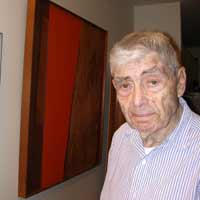
Photographer Ezra Stoller at his home on Saturday. (Photo By Linda Carman)
WILLIAMSTOWN — Ezra Stoller’s eye – and his camera lens – caught the verticals, the horizontals, the spaces and the parabolas of modern architecture, and his images formed the viewers’ perception as much as the architect’s actual work. Stoller, now a resident of Williamstown, is one of the world’s preeminent architectural photographers and is credited with capturing the definitive images of famous buildings — images that remain in the “mind’s eye.” The soaring, swooping roofline of Eero Saarinen’s TWA terminal at John F. Kennedy Airiport, the spiraling vortex of Frank Lloyd Wright’s Guggenheim Museum and the clean ingot of Mies van der Rohe’s and Philip Johnson’s Seagram Building – these are among 50 of his iconic photographs of trailblazing modern buildings which will go on view at the Williams College Museum of Art on June 19 and run through Dec. 19. Stoller, 85, and his wife, Helen, an artist, moved to Sweetwood Continuing Care Community two years ago. He consented to an interview with The Advocate on Saturday. “All architecture, good or bad, has something to say. I’m interested in the good, and not a lot of good is built,” he said. He said he was helped in his career by his knowledge of the basics. “I had gotten a good foundation in architecture, so I know what it’s all about,” he said. “I was sort of in the pilot’s seat. Architectural magazines and good architects called on me.” One of his first important commissions was to photograph the Music Shed designed by Saarinen at Tanglewood. “It was designed as a small, intimate space, but now it’s a circus,” Stoller said, recalling that his fee was $500 and mileage, but that he and his wife also got to meet Boston Symphony Orchestra Music Director Serge Koussevitsky and hear his concert — an experience “worth more than the fee.” He noted also that Marcel Breuer’s best house “is here in Williamstown, but it’s not open to the public.” “I got to be friendly with several of the modern architects,” he recalled. Stoller remembered Frank Lloyd Wright unobtrusively watching him as he moved furniture in preparation for photographing the living room at Taliesin, the architect’s Wisconsin headquarters. He also remembered Wright’s response to a magazine editor’s request for instructions: “Stoller will know.” “One picture often becomes the hallmark,” he said. The appeal of modern architecture was, for him, its honesty. “A building is a statement by an architect. My photographs aim to express that statement,” he said. “Those statements weren’t always very clear, and my job was to clarify them. I get messages from architects saying, ‘I didn’t know it was there.’” He added, “It was a business practice of mine not to give an estimate. I’d say, ‘If you don’t like it, all you have to do is pay my expenses.’ I think that happened twice.” Former New York Times architecture critic Paul Goldberger wrote of Stoller, “His pictures are surely among the most reproduced, and they have in and of themselves played a major role in shaping the public’s perception of what modern architecture is all about.” Deborah Rothschild, Williams College Museum of Art senior curator, wrote in connection with the upcoming exhibit, “His documents of key monuments such as the Guggenheim Museum, the TWA terminal at JFK, and the Seagrams tower remain, 40 and 50 years after they were shot, the quintessential images of these buildings. She added last week, “He is considered among the greatest architectural photographers, and his work was important in spreading the message of modern architecture.” Stoller was a pioneer, and his photographs are still the iconic image that defines an era, she said. “The building in the mind’s eye, what you’ll be imagining, is his image, not the building itself,” she said. Stoller’s photographs, published in architecture magazines such as Architectural Forum and Art & Architecture, were also “a tremendous influence on architects,” she said. “People love architecture, the photographs are amazing, and when we found he was living in the area it was a natural,” said Rothschild, adding, “There seems to be a lot of interest.” She likened Stoller’s architectural photographs to the work of “a great portraitist.” “He did these as commissions. All these architects wanted him because he could show their buildings in the best light,” she said. “These photographs created a new audience for modern architecture, and the architects saw how much the image could mean. He played a major role in shaping people’s perceptions.” In a recent interview with Rothschild, she said, Stoller likened his work to that of a musician. “I see my work in a way that is analogous to a musician given a score to play who must bring it to life and make the piece as good as it can be. While I cannot make a bad building good, I can draw out the strengths in a work that has strength,” he said. Stoller credited his architectural and design training for his perceptions. “My work is the result of being trained in architecture school. Vitruvius’ “Twelve Books of Architecture,” with his three prime requirements for a structure – function, construction and honesty/beauty – forms the basis of my belief. A building interests me on an intellectual level when it fulfills these conditions. And I try to find the viewpoint in my photographs that will express those three conditions best.” Stoller was born in Chicago in 1915 to parents who were both involved in the labor movement. He graduated from New York University’s School of Architecture and Allied Arts with a degree in industrial design in 1938. To make extra money in architectural school, he started making lantern slides for professors, which led to other photographic commissions, and so to his lifelong career. “Things began to fall into place,” he said. In 1961, he became the first photographer to be awarded the American Institute of Architects’ Gold Medal. “His photographs capture the essence of space, structure, light and form with extraordinary power and clarity,” according to the museum. “His exacting attention to detail and unparalleled ability to translate an architect’s vision into two dimensions had made his images prized by architects, editors, and collectors.” So prized that Frank Lloyd Wright wanted Stoller to work for him exclusively. And architects whose buildings had been photographed by Stoller referred to them as having been “Stollerized.” In the introduction to the catalogue for a 1980 exhibition of his work at the Max Protetch Gallery in New York, Arthur Drexler, director of the department of architecture and design at the Museum of Modern Art, wrote, “Ezra Stoller’s photographs are now part of the history of modern architecture in the United States. If he made some buildings look at little better than they were, the improvement provided an image for aspiring architects. For better or worse, his photographs have been more real to architectural students, and more intensely experienced, than most of the buildings they memorialize. Their instrumental value in spreading the good word may now yield to their more durable value as art.” In an article in the August1990 issue of Progressive Architecture, Thomas Fisher wrote, “We think of architecture in this century having been primarily influenced by such technologies as steel, concrete and glass. But the technology of photography may end up having the greatest impact of all, if not on the form of buildings, at least on how we view them, and therefore, how we think about them. One could even argue that Modern and Post-Modern architecture, for all of their differences, succeeded in part because of their memorable imagery, powerfully conveyed on the printed page. What we think of as architectural has become what we see as photogenic.” Stoller served as president of the American Society of Magazine Photographers in the mid 1960s, and in 1966 he founded the photography agency ESTO Photographics, which now operates independently, representing his work and that of a number of other architectural photographers. Stoller’s wife painted a now-vanished mural in the Adams Post Office in the 1930s for the Works Progress Administration (WPA). Rothschild also plans an exhibition of her work. The museum has scheduled events related to the exhibition, including a Summer Reception on Saturday, July 17, from 5 to 6:30 p.m., and a Gallery Talk, on Thursday, Oct. 14, at noon, with E.J. Johnson, professor of art, and Ralph Lieberman, photo historian. The museum will offer free public summer tours on Wednesdays and Sundays, from July 7 through Aug. 22.
If you would like to contribute information on this article, contact us at info@iberkshires.com.

Lanesborough Fifth-Graders Win Snowplow Name Contest

LANESBOROUGH, Mass. — One of the snowplows for Highway District 1 has a new name: "The Blizzard Boss."
 
The name comes from teacher Gina Wagner's fifth-grade class at Lanesborough Elementary School. 
 
The state Department of Transportation announced the winners of the fourth annual "Name A Snowplow" contest on Monday. 
 
The department received entries from public elementary and middle school classrooms across the commonwealth to name the 12 MassDOT snowplows that will be in service during the 2025/2026 winter season. 
 
The purpose of the contest is to celebrate the snow and ice season and to recognize the hard work and dedication shown by public works employees and contractors during winter operations. 
 
"Thank you to all of the students who participated. Your creativity allows us to highlight to all, the importance of the work performed by our workforce," said  interim MassDOT Secretary Phil Eng.  
 
"Our workforce takes pride as they clear snow and ice, keeping our roads safe during adverse weather events for all that need to travel. ?To our contest winners and participants, know that you have added some fun to the serious take of operating plows. ?I'm proud of the skill and dedication from our crews and thank the public of the shared responsibility to slow down, give plows space and put safety first every time there is a winter weather event."
 
View Full Story

More Stories