Lipizzaners to return to North Adams

By Linda CarmanPrint Story | Email Story
A rider rears one of the famous stallions. (Submitted Photo)
NORTH ADAMS — Dazzling Lipizzaner stallions will combine the delicacy of ballet dancers with the precision of military drill when they return to Noel Field to benefit the North Adams Library after a three-year absence. The performance of Herrmann’s Royal Lipizzan Stallions of Austria Sept. 10-12 is sponsored by the Friends of the North Adams Library and will benefit the library’s building fund, according to library director Marcia Gross. “They were very successful here three years ago, and we’ve had a lot of request to bring them back,” said Gross, who has headed the Equus therapeutic riding program at her Oakhollow Farm in Williamstown for the past 23 years. Three years ago, the Lipizzaners made $10,000 for the library. “We hope this year we’ll do even better,” Gross said. “The response has been very good. This show appeals to people who like animals. The performance is spectacular.” Performances will be Sept. 10 and 11 at 7 p.m. and Sept. 12, a Sunday, at 2 p.m. The rain date will be Sept. 13 at 7 p.m. Tickets, if purchased by Sept. 1, are $12; children under 6 free, children 6 to 12, $8. At the gate, tickets will $15, children $10. Tickets are on sale at the library, the David and Joyce Milne Williamstown Public Library, the Adams Free Library, and the Berkshire Athenaeum in Pittsfield. Other locations are: Williamstown, Oak Hollow Farm and Shear Creations; Lanesboro, Country Tack; Shaftsbury, Vt., Trumbull Mountain Tack Shop, Adams, the Adams Cooperative Bank and North Adams, Greylock Animal Hospital. “We’ve been promoting it in the different libraries in the region,” Gross said. he North Adams library’s $4.5 million expansion is under way and expected to be completed by next year. The library has been operating out of temporary quarters in the former Wall-Streeter building at the corner of Union Street and Willow Dell.. The horses will arrive early in second week of September and will open their stables to the community, Gross said. The breed, founded in the 16th century for the exclusive use of the Hapsburg royal family of Austria, is world-renowned for its ability to perform classical dressage, including the gravity-defying “airs above the ground. The performance will include the airs above the ground, including courbette, capriole and levade, highly refined leaps requiring great strength, intelligence and endurance. In the courbette, the horse does several jumps on its hind legs while holding its forelegs off the ground; in the capriole, it leaps in the air and, at the height of the leap, kicks out with its hind legs. In the levade, the horse rises on its haunches from a standstill and tucks its forelegs under. This is often the pose of classical equestrian sculpture and art. All the movements, were originally outlined by Xenophon and derive from defensive horsemanship during war. The leaps were designed for mounted riders to inspire terror among foot soldiers. The performance will conclude with a complex military quadrille, six to eight stallions working intricate patterns. The horses perform to the music of Mozart, Wagner and Tchaikovsky. The Lipizzaner stallions are under the direction of Col. Ottomar Herrmann, who, with his father, helped U.S. Gen. George S. Patton rescue the breed during World War II, a celebrated escape that was recounted in the Walt Disney film “Miracle of the White Stallions.” The Hermann family has trained and ridden Lipizzaners for the Royal House of Hapsburg for six generations, nearly 300 years. Col. Herrmann and two subsequent generations of Herrmanns maintain a 200-acre ranch in Florida to continue propagating the breed. During the performance, Herrmann, who has kept both the horses and their art alive, will give a lively and informative narrative of their history and evolution. A noted trainer, he emphasizes that extreme patience and particularly love are needed to school the talented and intelligent animals. More information is available at www.herrmannslipizzans.com
If you would like to contribute information on this article, contact us at info@iberkshires.com.

Social Service Organizations Highlight Challenges, Successes at Poverty Talk

By Brittany PolitoiBerkshires Staff

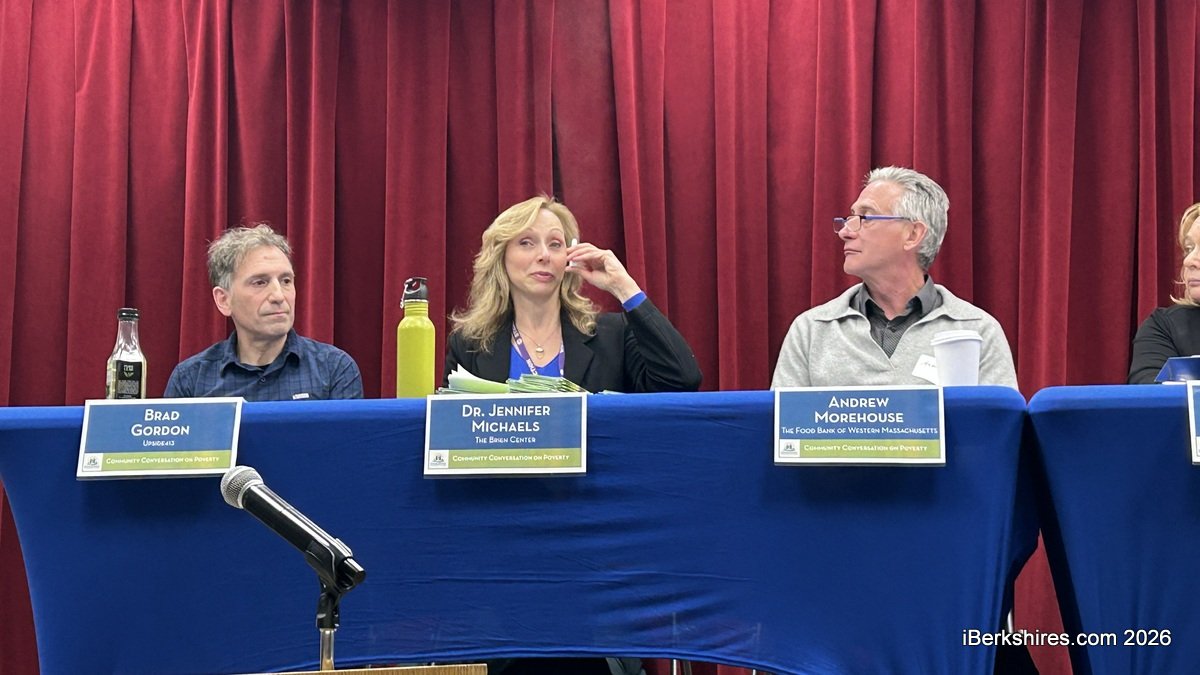
Dr. Jennifer Michaels of the Brien Center demonstrates how to use Narcan. Easy access to the drug has cut overdose deaths in the county by nearly half. 

PITTSFIELD, Mass. — Recent actions at the federal level are making it harder for people to climb out of poverty.

Brad Gordon, executive director of Upside413, said he felt like he was doing a disservice by not recognizing national challenges and how they draw a direct line from choices being made by the Trump administration and the challenges the United States is facing. 

"They more generally impact people's ability to work their way out of poverty, and that's really, that's really the overarching dynamic," he said. 

"Poverty is incredibly corrosive, and it impacts all the topics that we'll talk about today." 

His comments came during a conversation on poverty hosted by Berkshire Community Action Council. Eight local service agency leaders detailed how they are supporting people during the current housing and affordability crisis, and the Berkshire state delegation spoke to their own efforts.

The event held on March 27 at the Berkshire Athenaeum included a working lunch and encouraged public feedback. 

"All of this information that we're going to gather today from both you and the panelists is going to drive our next three-year strategic plan," explained Deborah Leonczyk, BCAC's executive director. 

The conversation ranged from health care and housing production to financial literacy and child care.  Participating agencies included Upside 413, The Brien Center, The Food Bank of Western Massachusetts, MassHire Berkshire Career Center, Berkshire Regional Transit Authority, Greylock Federal Credit Union, Massachusetts College of Liberal Arts, and Child Care of the Berkshires. 

The federal choices Gordon spoke about included allocating $140 billion for the U.S. Immigration and Customs Enforcement, investing $38 billion to convert warehouses into detention centers, cutting $1 trillion from Medicaid over 10 years, a proposed 50 percent increase in the defense budget, and cutting federal funding for supportive housing programs. 

Gordon pointed to past comments about how the region can't build its way out of the housing crisis because of money. He withdrew that statement, explaining, "You know what? That's bullshit, actually."

"I'm going to be honest with you, that is absolute bullshit. I have just observed over the last year or so how we're spending our money and the amount of money that we're spending on the federal side, and I'm no longer saying in good conscience that we can't build our way out of this," he said. 

Upside 413 provided a "Housing Demand in Western Massachusetts" report that was done in collaboration with the University of Massachusetts at Amherst's Donahue Institute of Economic and Public Policy Research. It states that around 23,400 units are needed to meet current housing demand in Western Mass; 1,900 in Berkshire County in 2025. 

View Full Story

More Stories