40 years of gracefully coping with death
By Linda Scott GalokPrint Story | Email Story
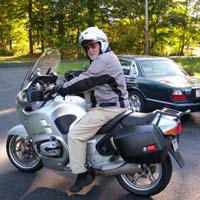
David Dery on his trusty BMW motorcycle. (Photo By Linda Scott Galok)
May the road rise to meet you. May the wind always be at your back. May the sun shine warm upon your face, the rains fall soft upon your fields and, until we meet again, may God hold you in the palm of his hand. — Irish Blessing David Dery says he has always taken the high road in his funeral home business. “There are so many times where you could take a nickel here or a nickel there, and unfortunately, in business, when you start that habit, it becomes hard to break,” he said in a recent interview. “I’ve had friends who have gotten themselves in trouble doing that. Just stay on the road of honesty — it’s easy to stay on that road. I’ve always felt that way and have invited clergy concerned about the cost of funerals to look at my books.” His books may be open to scrutiny, but Dery’s mouth remains closed about matters he considers private. After 40 years in the business, he has many stories, ranging from the truly tragic to the downright funny but declines to share most of them because he feels confidentiality is a fundamental obligation of a funeral director. Dery, who turned 70 on July 13, is president of Dery Funeral Homes in Pittsfield, Cheshire and Dalton. He described himself as a retired consultant to the business. His son Frederick Dery, who joined the business in 1989, is vice president, and runs the day-to-day operations. David Dery’s father, J. Edward Dery, opened the funeral business in 1937. Although he did not map a direct route for his life, David, as the eldest son, said he knew he would eventually follow his father’s footsteps and join the family business. He worked at the funeral home summers and school holidays once he turned 18, until he graduated from college and moved away. Following his heart in his personal life, Dery said, “There was no set plan or really many plans at all. I thought I might be a lawyer, but then I married Hope and joined the Air Force. We were living in Spokane, Wash., flying B52s, having fun and having babies. That was the only plan.” After seven years as an Air Force officer and with a degree in history, Dery returned to Massachusetts to attend The New England School of Anatomy and Embalming in preparation for joining his family’s business. Attending school during the day and working as an apprentice at Waterman Funeral home every night until midnight, Dery spent a year in Boston while his family lived in Pittsfield. “I went from a captain giving orders to going to classes with kids just out of high school. That was a tough year,” he said. Dery and his younger brother, Ed Jr., who had recently graduated from college, both joined the family business in 1964. Ed Jr. was also born on July 13, seven years after David. “I wanted a flashlight but I got a brother,” Dery said. Having had his own tragic losses, Dery said he felt more equipped to empathize with families who were suffering their losses. When his dad, J. Edward Dery, died just four years after he and Ed Jr. had come into the business, Dery said, “We didn’t have time to mourn. We had the funeral on a certain day, and by golly, the next morning we were both right back at the office. The funeral business is a tough business. You can’t just close the doors at 5 o’clock Friday night and come back Monday morning. You are on call 24 hours a day, 365 days a year.” “Funeral directors,” he said, “are primarily needed to bury the dead. Historically, that’s been very important.” The job also includes the ceremony involved with burying the dead, and Dery feels that is just as important. “In most cases, it is a means of therapy for the family, friends and community to join together in a common loss. Unfortunately, there has been a recent trend away from ceremony. I think people come away fairly empty without it.” He added, “People say they don’t want a wake or ‘put me in a pine box and throw me in the woods.’ How many times have I heard that? I challenged a woman one day and said to her, ‘What makes you think your family is going to do that for you anyway?’ I did it deliberately, and she got mad at me because people really want that, but they don’t want to say that’s what they want.” Many people, Dery said, are afraid they aren’t important enough to be mourned or loved enough to be missed. “I have had wakes where one person sat beside the casket for two days straight, one where only the ex-wives came and some where the family comes but they’re happy because ‘It’s no secret, Mr. Dery — he was brutal to us and we’re glad he’s gone.’ Generally, the family, rather than the deceased, decides on the type of ceremony, though prearrangements have gotten more popular recently.” The trend, he said, has also been more toward cremation than burial. It’s much less expensive, but the ceremonies may be just as elaborate. “Over the years, I’ve cremated mahogany caskets just like I’ve buried mahogany caskets,” he said. “The casket is involved in ceremony. Whether you bury it or cremate it, no one is ever going to see it again. As cremations became more popular, we developed a rented casket. From the outside, it looks like a beautiful oak casket, but the inside is a heavy cardboard box. The body, when delivered to the crematorium, must be in a combustible container.” Dery said he has had many unusual requests over the years to dispose of the ashes and does his best to accommodate them all. The cost of funerals in 1964 started at $500 to $600. The cost of a funeral today starts at $5,000 to $6,000. Dery explained. ”The funeral home has a place, and that place has to be paid for, cleaned, heated, maintained, painted once in awhile. Then you have to put manpower in there, and these people may have to be on call because you always have to respond quickly.” Since Berkshire County is a semi-rural area, most funeral homes are small, and the employees do not specialize but become jacks-of-all-trades, he said. “At the Dery funeral home, we own our own livery service, including a hearse,” he said. “The president has washed a number of cars over the years and never minded doing it either.” Sometimes funeral home employees must be the pallbearers as well. A casket made of steel might weigh up to 200 pounds. “Years ago, we used to hire off-duty firemen, but I don’t think they want to do that anymore,” Dery said. “The fire department was a place where you could call and get six strong guys to come for a few dollars and a couple of hours.” The work can be depressing and grueling, and employee turnover can be quite high. There are days, Dery admitted, when he gets depressed, and his son Fred also has bad days. There are ways to cope, however, and Dery recommends finding time off to do things you love. “You have to understand that when a person goes out to buy a TV or a car, he’s usually in pretty good frame of mind — he’s happy. When a person comes in to buy a funeral, they are at the lowest point in their lives. There is not a lot of hilarity going on, and they can be obnoxious and you have to excuse all that because they are not themselves,” he said. “You will have many people who will try you very much — one of the biggest difficulties is working for people who are under a tremendous amount of stress. You need patience. He laughed. “But the older I get, the less patience I have.” Dery has a favorite outlet to relieve stress, and any back road will do when he rides his BMW motorcycle. He has been riding for 19 years, and his only regret is that he didn’t start motorcycling younger because he’s met so many nice people and seen a lot of the world over the years. He has ridden in almost every country from Argentina to New Zealand. His favorite place is northern Spain, where, he said, “The roads are beautiful and the food is marvelous.” He went to Italy and Sicily last year, Scotland and Ireland this year and plans to visit Sweden and Norway next year. When Ed Jr. died at age 48 in an automobile accident in 1989, Dery was on a motorcycle trip and on his way to Estes Park, a national park in Colorado on the highest highway in the United States. Dery said he got to the park at mid-morning and was surprised to find a message to call home. Shaken when he received the news of his brother’s death, he worried about making it home safely. But, thanks to the kindness of friends and strangers, getting home was no problem, he said. A police officer stopped him near Tabernash to give him a message from friends in Denver who had arranged for a ride to the airport and a plane ticket home. “Eddie and I had both intended that I would retire in my early 60s, and I always felt secure in the knowledge that he would be there taking care of things. When I lost him, I didn’t know what to do but just carry on as best I could.” He said he found it difficult meeting with the families for some time and felt lucky to have competent staff to help him in his own time of need. “When someone dies, despair is awful, and the road to recovery may be long. One of the things a funeral does is provide a transition between your husband sitting at the breakfast table that morning and four days later when you’re sitting alone. I can’t imagine people not having a funeral, but plenty of people today don’t. A funeral is the therapy that a family goes through with confrontation. It’s the most important thing, and if you’re lucky enough to have faith, the sadness will pass more easily. It also passes easier if you have friends and relations along the way that you can be with.” Dery’s family includes his wife, Hope, “the love of his life,” his son Bart, whom Dery described as “a free spirit with a generous heart,” his daughter Diane, “a true delight,” Diane’s son, David, 21 and in college, (his only grandchild), and his son, Fred, “the outdoorsman who will continue the family tradition and keep the business on track.” Dery does not speak of death with fear or his own funeral with worry. With his loving family and the thousands of friends he has made the world over, he said he has faith that once he has taken his last ride, he will be mourned with ceremony and, hopefully, remembered with more laughter and love than tears and regrets — just the way he has tried to live his life.
If you would like to contribute information on this article, contact us at info@iberkshires.com.

Friends of Great Barrington Libraries Holiday Book Sale

GREAT BARRINGTON, Mass. — The Friends of Great Barrington Libraries invite the community to shop their annual Holiday Good-as-New Book Sale, happening now through the end of the year at the Mason Library, 231 Main Street. 
 
With hundreds of curated gently used books to choose from—fiction, nonfiction, children's favorites, gift-quality selections, cookbooks, and more—it's the perfect local stop for holiday gifting.
 
This year's sale is an addition to the Southern Berkshire Chamber of Commerce's Holiday Stroll on this Saturday, Dec. 13, 3–8 PM. Visitors can swing by the Mason Library for early parking, browse the sale until 3:00 PM, then meet Pete the Cat on the front lawn before heading downtown for the Stroll's shopping, music, and festive eats.
 
Can't make the Holiday Stroll? The book sale is open during regular Mason Library hours throughout December.
 
Proceeds support free library programming and events for all ages.
View Full Story

More Stories