Berkshire Institute for Lifetime Learning offers more than 50 courses
Print Story | Email Story
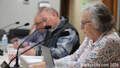
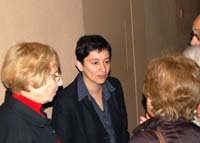
Romance Language Professor Leyla Rouhi holding discussion after the Middle Age class.
Williams College professors in a variety of disciplines regularly volunteer their time to teach courses to seniors in the Berkshire Institute for Lifetime Learning. The organization, better known as BILL, has nearly 1,000 members and each year offers more than 50 courses during three academic semesters at a variety of sites in Berkshire County. The program is organized and run by volunteers and sponsored by Williams College, Berkshire Community College, and Simon's Rock College of Bard. Course categories at Williams during the fall semester include Shakespeare and the Law, The Middle Ages, The History of U.S. Westward Expansion, Perspectives on 20th Century Music, and Pushing the Frontiers of Science. Some of the courses are offered on the Williams campus and others in the auditorium of the nearby Clark Art Institute. "The courses that I'm taking are thoroughly enjoyable," said Sandi Rubin of Hinsdale. "We're all taking Shakespeare and the Law in the morning, and 20th Century Music in the afternoon, and they've been outstanding," Rubin and two friends were sitting on a bench in the sun outside the auditorium of the Brooks-Rogers Recital Hall, awaiting the start of "Bartok's Fusion of Old and New." Williams College Assistant Professor of Music Edward Gollin taught the one-session course as part of the Perspectives on 20th Century Music category. "The professors are wonderful and well-prepared and comprehensive," said Suzanne Rosen, also of Hinsdale. Said her husband, Arthur Rosen, "The BILL program is terrific. It's really suited to our lifestyles," he said. "It enhances our impression of Williams College also." Ira Wasserberg, of West Stockbridge and Manhattan, has been attending BILL classes for about four years. "I enjoy the academics. I enjoy the opening of many, many, many areas that I thought I knew about but find that I didn't have the whole story," he said. "It has broadened my interest in areas that I would not have normally pursued. I think I could have been a student my entire life. I just love going to lectures and contemplating and trying to be an activist." Participants in the BILL program do not do homework or take tests. The experience is more like auditing a college course with a group of friends. Generally the courses run four to six sessions, for an hour-and-a-half weekly. In his course on Bartok, Gollin spoke from the stage to an audience of about 40 and frequently played brief selections on a piano to illustrate what he was talking about. "It was challenging, but rewarding, to try to address an audience of non-specialists about a topic that, by its nature, requires some technical knowledge about music," he said afterward. "The lecture I presented is the topic of a book I'm writing on the transformation of tonality in Bartok's music. The lecture gave me the chance to try out some material for the introductory chapter. Even though the book is intended for music specialists, it is important to be able to explain one's ideas to an educated non-specialist." Leyla Rouhi, professor of Romance Languages, taught two sessions of a six-session course on Medieval Art and Architecture in the auditorium at the Clark Art Institute. "The poetry of the Middle Ages is incredibly vibrant, incredibly three-dimensional," she said at the beginning of the second session. "What we are going to do today is take a look at some samples of excellent medieval poetry, not just for the poetry's sake but for the sake of understanding the mentality that shaped artistic creation at that time." Projected on a screen over the stage were translated versions of poems by such masters at Petrarch and Dante. Rouhi read a couple of the poems in their original languages. She frequently asked the BILL students questions, and they asked her questions in return. After the session, several students spoke to her as she left the auditorium. Rouhi said this was the first BILL class she had taught. She liked the freedom to shape her material for the course, the enthusiasm of the students, and the kindness and efficiency of the program's administrators. "The students struck me as highly motivated and interested," she said. "What is very good about this student body is their life experience and their travels: these enrich the experience a lot." Barbara Mandler, of Becket, said the Williams professors who teach BILL courses are outstanding: "And by that I mean they stand -- well prepared and interesting. They make learning a pleasure." BILL offers non-credit courses, trips, and programs led by experts in the arts, literature, social and natural sciences. For a catalog or further information, call 413-499-4660, ext. 456 or go to the BILL website at www.Berkshirebill.org .
If you would like to contribute information on this article, contact us at info@iberkshires.com.

Mount Greylock Students in Argentina For Cultural Exchange Program

By Jack GuerinoiBerkshires Staff

This is the second trip for Mount Greylock students to La Cumbre. The school has a relationship with St. Paul's School there and hosted 36 Argentine students last year. 
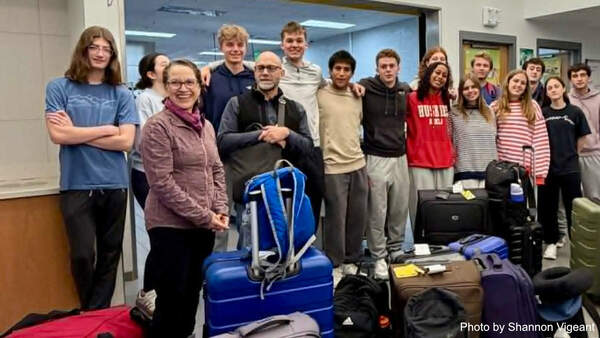
WILLIAMSTOWN, Mass. — Fourteen Mount Greylock seniors boarded a flight for Argentina this past Friday, to immerse themselves in a transformative experience.
 
"So many kids who have taken this trip come back and they're transformed," said Spanish teacher Joe Johnson. "... I guess, the spoiler is, that what these students learn is that they are the same … even though they may be from opposite poles, literally, of the Earth, and grew up speaking different languages … So that's what we're really hoping for. Let's get them to just fall in love with each other, and learn about the world and the culture through those friendships."
 
Students took off on Friday, April 17. They will spend nine days in La Cumbre, a community the school has built a relationship with over the years.
 
Mount Greylock hosted 36 students from St. Paul's School in La Cumbre last year, and the exchange program has become a cornerstone of Mount Greylock's Spanish curriculum. Johnson said the AP Spanish course has become hyper-focused on Argentina in preparation for the trip.
 
"It is all about what can you understand? What can you communicate? And we cover a lot of daily life things as the years go by. What do you need to be able to say? or what do you need to be able to understand?" he said. "We have geared the AP curriculum to where it's very Argentina centered… so we'll just focus on that, and that way, they get used to the accents, they know what kinds of food to expect, what kind of social interactions to expect."
 
Students have been building these relationships throughout the year. Johnson noted that each Mount Greylock student is connected with a St. Paul's student, and they regularly exchange messages in both English and Spanish.
 
As for the town itself, Johnson said it is the perfect community for a cultural exchange and reminds him of Williamstown.
 
View Full Story

More Williamstown Stories