MCVFA Region 5 Honors Village Ambulance
By Paul VallonePrint Story | Email Story
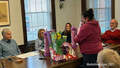
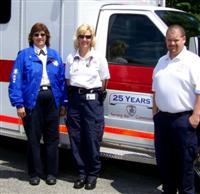
from left. Village Ambulance Service EMTs Marilynn Kirby, Karen Rose, and Chuck Poulton [Photo by Paul Vallone]
Williamstown – On May 23 Massachusetts Call Volunteer Firefighters Association’s Region 5 Vice-president Paul Vallone presented members of the Village Ambulance Service with a letter and certificate of appreciation for their 25 years of EMS Service to the community. The VAS is hosting a May 26 Open House at the Water Street headquarters to celebrate the 25th anniversary. The public is welcome to tour the facility from 10 a.m. to 2 p.m., and ambulance service scrapbooks will be available for public viewing. VAS Service Started VAS service began rolling ambulances on May 24, 1982 from a Main Street-based Colonial Shopping Center site. The ambulance service operations base was located inside a former Sunoco fuel station that was renovated to accommodate an ambulance service. The Water Street headquarters was opened in April 1993 and erected with a $130,000 gift from Williams College. The service provides 24-hour, seven-day-a-week emergency medical response services to residents of the town as well as Hancock and New Ashford. The VAS provides contracted ambulance services to the town of Pownal, Vt.. The VAS responds to emergency calls from the Vermont town from 6 a.m. to 6 p.m. Mon.-Fri.. And the VAS is included in a mutual aid agreement between Northern Berkshire and Southern Vermont communities. "Mutual aid is a big part of what we do," said VAS General Manager Bert Miller. "I am so appreciative of what the North Adams and Adams [ambulance] services do to help us. It's the key thing, that everybody works together, It's like coverage to Pownal; they are our neighbors and we're being neighborly." Standardized training and ambulances help EMTs know what to do and where to find things when the ambulances roll. The "everything the same" policy is deliberate, Miller said, and he noted that EMTs do not want to waste time searching for items that are put in different places in different ambulances. For an EMT, consistency does not equal monotony but does provide a potentially life-saving efficiency, he said. The Helping Hands Active EMTs with over 20 years of service at the VAS are Bert Miller, Jeff Quimby, and Greg Chapman. Those with over 10 years of service are Willam Mahoney, Mark Chretien, Cara Miller, Heather Boudreau, Pamela Costine, Kevin Garvey, Marilynn Kirby, and Ken Sagendorph, said Miller. Those with over five years service include Shawn Godfrey, Karen Rose, Chuck Poulton, and Robert "R.J." Pensivy. Little Bit of History When Bert Miller's grandfather Everett W. Miller founded the town's first ambulance service in 1927, Hopkins Ambulance Service was the first of its' kind in the state and among the first organized ambulance services in the nation. The Hopkins service first ambulance was a De Soto vehicle that was purchased from Massachusetts Gov. Alvan T. Fuller, who was a handicapped person. The De Soto had been altered to accommodate Fuller and the alterations made the vehicle well-suited for the transport of injured or ill individuals. The service operated in a consistent manner with little change until 1954, when the Hopkins Ambulance Service purchased a new, 1954 Pontiac ambulance. The De Soto permitted patient loading via specially-designed side doors; the new model afforded rear-loading of patients. Bert Miller's father Everett H. Miller joined the service during the 1950s. Again, operations remained fairly consistent until 1972, when the North Adams Regional Hospital opened a 24-hour emergency department. That action generated a need for 24-hour ambulance services and was the catalyst for an ambulance service staff increase and increased hours of operations. Bert Miller, who in 1972 met the state's 16-year-old minimum EMT age requirement [the age is now 18 years old], enrolled in cardiopulmonary response classes and EMT training classes and became a member of the Hopkins Ambulance Service. By early 1982, Bert Miller was leading the Hopkins Ambulance Service operations - and announced that due to financial pressures, the private entity would close in March of that year. Changes in state regulations during the preceding decade proved costly to implement, and as was the situation with the privately-operated Mohawk Ambulance Service, which had already ceased operations, the Hopkins service was unable to sustain itself. The Start Of Something New According to information provided by Miller, town Selectmen and town residents were very concerned about losing a town-based ambulance service. After numerous meetings, board appointments and paperwork, the Village Ambulance Service was launched as a non-profit agency with Mary Lou Galusha as the VAS president, Miller as manager, and Miller's wife Cara Miller as the service's clerk. A capital fund drive was initiated and that effort raised $60,000 dedicated to the VAS. The new non-profit service purchased the two ambulances from the former Hopkins service. The VAS was initially staffed with 26 emergency medical technicians. Currently, the VAS hosts 37 full and part-time employees. In addition to the paramedics, there are intermediate and basic level EMTs providing emergency medical services and patient transfer assistance for the service area. Ambulances are replaced every five years; in December, the VAS bought a new ambulance A Life Team Mahoney reviewed other changes. "Call volume has changed; it's gone up. The number of personnel has increased and we need more people. And when we first started, there were no [ambulance-employed] paramedics. There was a Life Team that would come out from BMC [Berkshire Medical Center in Pittsfield] and intercept ambulances that were on the way to the hospital." The Life Team consisted of BMC emergency department nurses who were RNs and also certified as paramedics. The program was administered by Daniel Harrington, a RN who worked at BMC. Harrington remains active as a per diem VAS EMT. "There is a lot more involvement with community education now," said Mahoney. "We do CPR and auto defibrillator training for schools and other places that have to know these things. The laws have changed." Miller noted that the ambulance service serves the residents of two long-term care centers and an assisted living complex as well as the three communities-at-large. As skateboards and rollerblading became popular, youth-related "high velocity" calls increased. As the baby boomer generation grows, calls involving elderly individuals increase. The VAS also serves the Jiminy Peak ski resort in Hancock. "We get a lot of ski calls," said William Mahoney. With such a diverse population, the VAS must stay current with EMT advancements, Miller said. "We work hard to keep up with what's going on," he said. During Just One Year The service is licensed in Massachusetts and Vermont as an Advanced Life Support-Paramedic level ambulance service. During the past year, in-house education has included National Incident Management Systems education, mass casualty incident classes, emergency vehicle driving courses, emergency preparedness, incident command and bloodborn pathogen and infectious control education. a 30-member EMT refresher course was held at the former Hopkins Ambulance Service site on Spring Street. The VAS was among a trio of agencies that participated with a mock airplane crash at the Harriman-West Airport in North Adams. VAS instructors taught a "Choke Saver" program at area restaurants ; 75 restaurant servers were trained with how to assist choking patrons. The service is in the midst of earning state certification to offer basic and intermediate level EMT instruction. Several VAS EMTs have attended a Traumatic Brain Injury instructor program, have completed instructor training for emergency vehicle driving, and three EMTs are presently enrolled in an EMT instructor training program. On The Front Lines The VAS has been at the forefront of emergency medical response evolutions since its' opening. During the early 1980s, the VAS introduced an EMT training program to Williams College students. The curriculum is still taught as a Winter Study offering, and the result has been a consistent Williams College student presence among the VAS employees. The VAS was among the first ambulance services in the state to be licensed as able to deliver advanced life support to patients. In 1985, the VAS was given the first license ever granted by the state that permitted EMT operation of manual defibrillators. In 1988, the town's Lions Club raised money to purchase the tool known as "the jaws of life" for the VAS. The ambulance service maintained the "jaws" until recent years, when the tool became part of the town's volunteer fire department rescue equipment arsenal. Material from an article written by Susan Bush was included in this story.
If you would like to contribute information on this article, contact us at info@iberkshires.com.

Mount Greylock School Committee Discusses Collaboration Project with North County Districts

By Stephen DravisiBerkshires Staff
WILLIAMSTOWN, Mass. — News that the group looking at ways to increase cooperation among secondary schools in North County reached a milestone sparked yet another discussion about that group's objectives among members of the Mount Greylock Regional School Committee.
 
At Thursday's meeting, Carolyn Greene reported that the Northern Berkshire Secondary Sustainability task force, where she represents the Lanesborough-Williamstown district, had completed a request for proposals in its search for a consulting firm to help with the process that the task force will turn over to a steering committee comprised of four representatives from four districts: North Berkshire School Union, North Adams Public Schools, Hoosac Valley Regional School District and Mount Greylock Regional School District.
 
Greene said the consultant will be asked to, "work on things like data collection and community outreach in all of the districts that are participating, coming up with maybe some options on how to share resources."
 
"That wraps up the work of this particular working group," she added. "It was clear that everyone [on the group] had the same goals in mind, which is how do we do education even better for our students, given the limitations that we all face.
 
"It was a good process."
 
One of Greene's colleagues on the Mount Greylock School Committee used her report as a chance to challenge that process.
 
"I strongly support collaboration, I think it's a terrific idea," Steven Miller said. "But I will admit I get terrified when I see words like 'regionalization' in documents like this. I would feel much better if that was not one of the items we were discussing at this stage — that we were talking more about shared resources.
 
View Full Story

More Williamstown Stories